Moneycontrol PRO
HomeNewsTechnology startupMCTech3

Quick Summary

One important thing: Media-tech SaaS unicorn Amagi has landed over $100 million funding from private equity firm General Atlantic, a rare large investment round during the ongoing funding winter. 

  • Amagi has also crossed a key milestone even as the broader SaaS sector is in pain (more on that below): It has crossed $100 million in annual recurring revenue (ARR) after clocking record growth in the July-September quarter.

 In today’s newsletter:  

  • Sequoia scores a duck in FTX, Binance walks away
  • Zomato numbers have a devil in the detail 
  • SaaS firms feel the heat

Was this newsletter forwarded to you? You can sign up for Tech3 here.

Top 3 stories

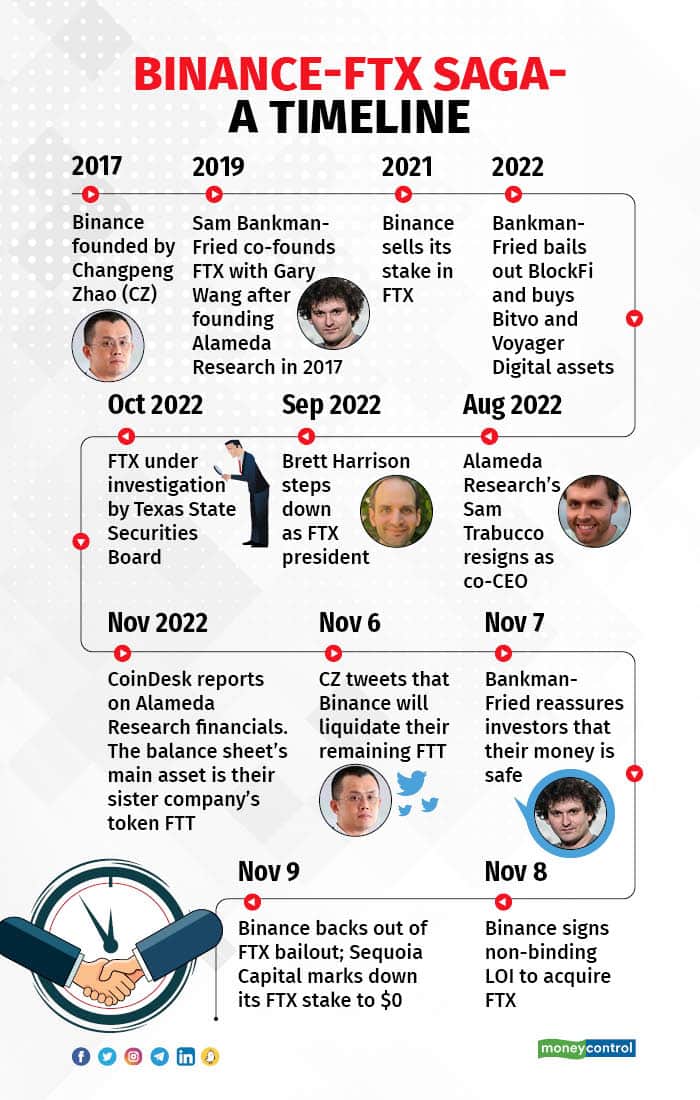
Sequoia scores a duck in FTX, Binance walks away

Sequoia scores a duck in FTX, Binance walks away

Sequoia Capital, one of the world's largest venture capital firms, appears to have lost more than $210 million in a single deal.

Driving the news

Sequoia Capital wrote down the full value of its FTX holdings, indicating that the venture capital firm saw little hope of recovering its investment in the troubled cryptocurrency exchange.

  • Sequoia invested approximately $214 million in FTX's international and US businesses last year, both of which were written down

  • Sequoia reassured investors by saying that the fund through which it invested in FTX represents less than 3% of committed capital

  • The VC also said that the fund has $7.5 billion in realised and unrealised gains.

FTX nearly collapsed earlier this week after withdrawals totalling $6 billion were made in three days due to fears about the cryptocurrency exchange's financial health.

FTX warns of bankruptcy

In a call with investors yesterday, Sam Bankman-Fried said that FTX.com needed a capital infusion or would have to file for bankruptcy.

This happened after FTX's larger rival, Binance, the world's largest cryptocurrency exchange, initially proposed to buy the struggling exchange but then withdrew due to concerns over FTX's financial health.

Moreover, while the US entity of the Bahamas-based FTX was not directly affected by the crisis, Sequoia's write-down of it indicates a lack of confidence in that asset as well.

Zomato numbers have a devil in the detail

Zomato numbers have a devil in the detail

When Zomato announced its first-quarter results a few months ago, it played up the number zero. It claimed that the food delivery segment had broken even in terms of 'Adjusted Ebitda.'

That, however, was not the case.

Wait, what?

The company revised that metric in today's shareholder letter: the food delivery business lost Rs 113 crore in Adjusted Ebitda terms in the June quarter.

  • It seems this snafu was a result of misallocation of tech, salary and rental costs. About 86 percent of those costs have been allocated to the food delivery business now
  • Interestingly, Zomato has again reported break even in the food delivery business for the September quarter, with an Adjusted Ebitda of Rs 2 crore.

Economies of scale

Zomato’s net loss for the quarter narrowed to Rs 250.8 crore, compared to Rs 434.9 crore in the same period the previous year. Meanwhile, revenue from operations zoomed 62.20 percent to Rs 1,661.3 crore.

  • Its marketing cost has come down 23 percent year on year to Rs 300 crore and delivery expenses have dropped 28 percent to Rs 283 crore
  • Given that the gap between revenue growth and the two operational expenses has widened, it is possible that the operating leverage and scale impacts that investors have been waiting for are now materialising

Blink and miss it

In his blog, Deepinder Goyal writes: "I know that most investors currently ascribe zero value to the Blinkit business, and that’s understandable. But I am confident this will change in due course of time."

  • Blinkit's gross order value increased by 26 percent quarter on quarter to Rs 1,482 crore, while revenue increased by 44 percent.

Also read: Loss or break-even? Zomato blinks months after claiming break-even of food delivery biz

SaaS firms feel the heat

SaaS firms feel the heat

Have you heard superstar Rajinikanth's Ra Ra Ramaiya song from the Tamil film Basha, in which he talks about the eight phases of human life? If we make the song for the lifecycle of SaaS firms, we are currently in the 'recession' period, which is followed by the 'hyper-growth' phase that SaaS companies were in last year.

Rough ride for SaaS?

The software-as-a-service (SaaS) ecosystem in India and around the world is beginning to feel the heat of slowing demand growth ahead of a possible global recession and is implementing cost-cutting measures such as layoffs.

Panic situation?

Chargebee was the first company in the Indian SaaS ecosystem to announce layoffs, and other SaaS players are pursuing cost-cutting measures in order to survive this phase.

However, there is no need to panic just yet. While many investors continue to support the industry, calling it "just another cycle of correction," there are concerns that SaaS company valuations may fall further, with more layoffs and cost-cutting measures on the way.

Go deeper

MC Special: The good, bad and ugly of Nykaa’s bonus issue

MC Special: The good, bad and ugly of Nykaa’s bonus issue

Nykaa’s move to time the record date for bonus shares with the release of lock-in shares appears to be part of a two-pronged strategy to deter a fire sale, which would result in a significant drop in the stock price.

While the move seems to be an ingenious way to arrest a stock price decline, it comes at a significant cost to existing Nykaa shareholders and a certain section of pre-IPO shareholders.

Read our special story

Tweet of the day

Crypto corner

What's hot in crypto

  • All deposits and withdrawals for Tether's USDT and Circle's USDC have been suspended on the Solana network, Crypto.com informed its customers via email. The suspension only affects anyone trying to move either of the two stablecoins on Solana; USDT and USDC are present on almost all blockchains.

  • Celsius Network, a bankrupt crypto lender, announced that it has filed a motion to extend the exclusivity period for its reorganisation plan. This would allow the lender to take more time to formulate a reorganisation plan.

ONE LAST THING

The first launch hurdle

The first launch hurdle

It will undoubtedly be a defining moment for not only Skyroot Aerospace, but also for India, as the Hyderabad-based startup plans to launch the country's first privately-manufactured rocket between November 12-16. However, experience teaches us that it is wiser to keep our expectations in check.

Why? Because first launches are notoriously prone to failure. Several launch vehicles belonging to various organisations, ranging from Elon Musk's SpaceX to ISRO and NASA, have failed on their first attempt.

Read our article on a few of these examples to see how difficult the rocket business is and how crucial it is to persevere in the face of failure.

Note: By subscribing to Tech3 you have already made the right choice. Top it up with a premium offering, the Moneycontrol Pro Panorama, a newsletter that gives you a sharp take on macros, markets, business and finance. Sign up for Pro from this link to get this newsletter in your inbox and also a host of content enjoyed by 500,000+ subscribers.

Advisory Alert: It has come to our attention that certain individuals are representing themselves as affiliates of Moneycontrol and soliciting funds on the false promise of assured returns on their investments. We wish to reiterate that Moneycontrol does not solicit funds from investors and neither does it promise any assured returns. In case you are approached by anyone making such claims, please write to us at grievanceofficer@nw18.com or call on 02268882347