-
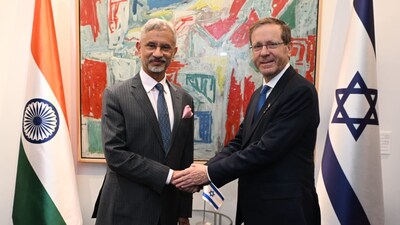
India, Israel share ‘policy of zero tolerance’ against terrorism: Jaishankar
Jaishankar, who arrived in Israel on Tuesday on a two-day visit, made the remarks while addressing the press alongside Israeli counterpart Gideon Moshe Sa'ar
-

Why S Jaishankar’s comments on Asim Munir have riled Pakistan
External Affairs Minister S. Jaishankar blamed Pakistan’s army for India’s terrorism challenges, prompting Islamabad to condemn his remarks. He also highlighted India-Russia ties and India’s accountable approach to security operations.
-
Jaishankar’s Kremlin meeting sets stage for Vladimir Putin’s year-end visit to India
Kremlin visuals showed Vladimir Putin greeting Jaishankar, who was accompanied by Indian Ambassador Vinay Kumar and Joint Secretary Mayank Singh.
-
Jaishankar meets Rubio, discusses trade and global challenges on G7 sidelines as US-India ties deepen
External Affairs Minister S. Jaishankar met US Secretary of State Marco Rubio on the sidelines of the G7 meeting in Canada, discussing trade, supply chains, Indo-Pacific, and ongoing global conflicts.
-
ASEAN Summit: Jaishankar, Marco Rubio discuss bilateral ties amid trade talks
External Affairs Minister S. Jaishankar met US Secretary of State Marco Rubio on the sidelines of the ASEAN summit in Malaysia, discussing bilateral ties, regional issues, and ongoing India-US trade negotiations.
-
'All is not well, UN's decision-making doesn't reflect global priorities,' says EAM Jaishankar
"All is not well with the United Nations. Its decision-making does not reflect its membership or global priorities," Jaishankar said.
-
'Trade calculations being overturned': S Jaishankar flags tariff volatility
External Affairs Minister S. Jaishankar warned that global trade is being disrupted by “tariff volatility” and shifting manufacturing hubs, highlighting geopolitical risks, technology control, and strategic competition amid evolving global economic and security dynamics.
-
'Multipolarity going to be messy, AI taking centrestage in geopolitics': Top quotes from Jaishankar's speech at KEC
"QUAD is alive and well. In turbulent times, it’s important to assess challenges responsibly. I would caution against both extremes -- denying a problem exists and assuming something catastrophic," said Jaishankar.
-
Jaishankar says India has tariff 'issues' with US: 'Both nations actively working on them'
Jaishankar revealed that New Delhi is currently negotiating 50 percent tariffs imposed on India, adding that country's 'red lines have to be respected'
-
‘That country…’: How Jaishankar’s sly dismissal of Pakistan at UNGA overshadowed Shehbaz’s rant
Without naming Pakistan, he coolly labelled it “the epicentre of terrorism” and reminded the world that “major international terror attacks trace back to that one country.”
-
Jaishankar hosts BRICS Foreign Ministers' meeting, stresses multilateralism, UN reforms
Jaishankar emphasised the need for the bloc to reinforce principles of peacebuilding, dialogue, diplomacy, and adherence to international law in a turbulent global environment.
-
'Terrorism is perennial disruptor of peace': Jaishankar calls for zero tolerance on terror at G20 Meeting
Jaishankar emphasized that "the need for reforming multilateralism has never been greater," advocating for structural changes that would create more representative, responsive, and effective global governance systems.
-
State of world today is cause for genuine concern: S Jaishankar at BRICS Leaders meeting
On global trade, Jaishankar said that the world requires 'constructive and cooperative approaches to promote trade that is sustainable'
-
Jaishankar to represent India at BRICS virtual summit on Monday
Brazil is the current chair of the BRICS. The 10-member grouping also includes India, China, Russia, South Africa, Indonesia, Iran and the United Arab Emirates.
-
India's 'Atmanirbharta' premised on its understanding of current geoeconomics: S Jaishankar
Speaking at The Economic Times World Leaders Forum 2025, Jaishankar taking into consideration the global economic calculus, reasoned that over dependence on a single source/ country for supply, production and marketing may belie the true hallmark of an economic powerhouse.
-
China, India seek better ties as US tariffs add uncertainty
“Having seen a difficult period in our relationship” both nations “now seek to move ahead,” Jaishankar said in New Delhi on Monday. “Differences must not become disputes, nor competition conflict.”
-
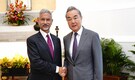
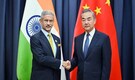
Essential that de-escalation process along LAC move forward: Jaishankar to Wang Yi
In his televised opening remarks at a meeting with Wang, Jaishankar pitched for taking forward the de-escalation process in the border areas along the LAC in eastern Ladakh.
-
‘Terror fight, border peace, multipolar order’: Jaishankar outlines priorities in talks with Wang Yi
Jaishankar noted that this was the first ministerial visit from Beijing since the leaders of the two countries met in Kazan in October 2024, providing a timely opportunity to review bilateral ties.
-
EAM Jaishankar sought cooperation on trans-border rivers during Beijing visit amid China’s planned Brahmaputra hydel plant
The Ministry of External Affairs said as a lower riparian state with considerable established user rights to the waters of trans-border rivers, India has consistently conveyed its concerns to China. including on the need for transparency.
-
How India's response to terrorism changed under PM Modi? EAM S Jaishankar outlines five points
Outlining five points that changed global outlook on how India deals with terrorism, Jaishankar said the fundamental modalities in dealing with terrorism underwent a sea change post 2014.
-
Pahalgam Mastermind Eliminated in Operation Mahadev | Inside India’s New Counter-Terror Policy
India’s External Affairs Minister S. Jaishankar has unveiled a bold new doctrine on terror in Parliament following Operation Sindoor. The military response to the deadly Pahalgam terror attack has triggered a strategic shift. India now pledges sustained retaliation to cross-border terror, no talks with Pakistan except on terror, and zero tolerance for nuclear blackmail. Jaishankar confirmed that the ceasefire was requested by Pakistan, with no US involvement. Diplomatically, India secured backing from the UN Security Council. Meanwhile, Operation Mahadev neutralised Pahalgam attack mastermind Suleman Shah in Dachigam. Watch Shivani Singh's report on how India is syncing strikes, diplomacy, and intelligence to reshape its fight against terror.
-
Sharm-el-Sheikh back in focus as NDA slams UPA’s 26/11 response: Why is 2009 joint statement controversial
During the ongoing Monsoon Session of Parliament, top ministers from the Narendra Modi government launched a scathing critique of the then Congress-led UPA government’s approach to cross-border terrorism.
-
S Jaishankar details diplomatic push that galvanised global support after Pahalgam terror attack
The minister outlined two primary diplomatic objectives: to secure a firm endorsement from the Council on accountability for the attack, and to ensure that its perpetrators and sponsors were brought to justice
-
'No space for third party in India-China bilateral ties': Jaishankar tells Chinese counterpart Wang Yi
The dialogue, held on July 14, marks an important diplomatic exchange aimed at stabilizing ties following the 2020 military standoff between the two countries in Eastern Ladakh.
-
What Jaishankar Told Xi Jinping During SCO Meet in China | N18G
External Affairs Minister S Jaishankar met Chinese President Xi Jinping during his visit to China for the SCO Summit. This was his first visit since the 2020 Galwan clash. Jaishankar discussed bilateral ties and conveyed greetings from President Murmu and PM Modi.