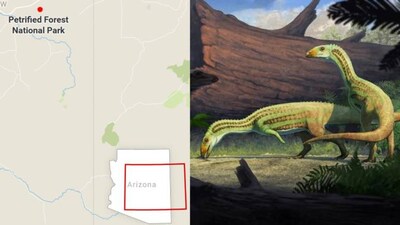
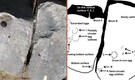
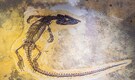
Scientists discovered a crocodile relative that is 200 million years old and had two legs. The diversity of reptiles during the Triassic period is shown by this discovery, which is long before crocodiles came into existence.
Scientists discovered a 150-million-year-old dinosaur egg nest on Portugal’s coast, preserving multiple eggs in their original arrangement. This offers rare insights into Jurassic dinosaur reproduction and nesting behaviour.
Scientists have discovered a water-bottle sized dinosaur fossil in Patagonia, Argentina. The tiny predator lived 95 million years ago and ranks among the smallest dinosaurs ever identified.
Scientists have discovered a rare 68-million-year-old dinosaur egg containing another egg inside it in Madhya Pradesh, India. The extraordinary fossil of Titanosaur reveals new clues about dinosaur reproduction.
Emails released in the Department of Justice’s latest Epstein Files dump have drawn attention to a bizarre dinosaur bone hunting trip allegedly involving Trump’s health secretary Robert F. Kennedy Jr., Jeffrey Epstein and Ghislaine Maxwell.
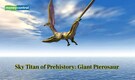
A colossal flying reptile with a wingspan near ten metres once dominated ancient skies, challenging dinosaur supremacy and rewriting flight records.
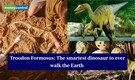
Scientists believe Troodon’s birdlike brain structure and complex survival strategies reveal dinosaurs were capable of some skills long before catastrophic extinction struck.
Previously, a type of phytosaur fossil was found on the Bihar-Madhya Pradesh border in 2023, however, this is said to be the first definitive, well-preserved find in India.
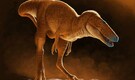
The fossils were first dug up in southeastern Mongolia in the early 1970s but at the time were identified as belonging to a different tyrannosaur, Alectrosaurus. For half a century, the fossils sat in the drawers at the Institute of Paleontology of the Mongolian Academy of Sciences in the capital Ulaanbaatar.
A strange characteristic of dinosaur skulls amazed researchers, showing evidence of muscles nobody was anticipating. Something that started as curiosity in a single specimen has now introduced a new chapter on how we know dinosaur biology.
The discovery was made when a local amateur fossil hunter Peter Bennicke found some unusual fragments the Cliffs of Stevns, a UNESCO-listed site south of Copenhagen.
Experts are working to verify the prints, which are thought to belong to a Camelotia, a large herbivorous dinosaur from the late Triassic period.
The footprints, spaced up to 75 cm apart, are thought to have been made by a creature from the sauropod family—dinosaurs distinguished by their long necks, tails, and enormous bodies.
Heavy rains in Brazil have uncovered a 233-million-year-old dinosaur fossil, which could be the world's oldest.
A revolutionizing discovery made by palaeontologists has found a giant salamander dinosaur fossil in Namibia. The fossil is one of the top predators during the age of dinosaurs.
What began as a casual uncovering of a single dinosaur bone finally turned out to be a nearly complete, 30-foot-long titanosaur at 70 percent completeness.
The accused tried to evade the official agents by labeling the dinosaur fossils as wood, rocks, and stones.
when alive, the dinosaur could have reached more than 80 feet in length and stood over 30 feet tall, researchers said.