-
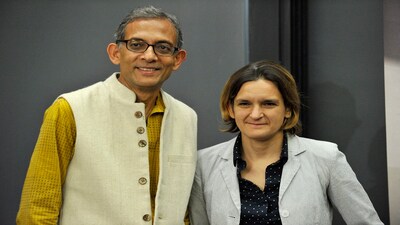
Nobel duo Abhijit Banerjee, Esther Duflo to lead Zurich research centre amid US funding cuts
The nobel economists' move comes at a time when academics in the U.S. have expressed growing concern over cuts to research funding and political hostility toward universities under President Donald Trump’s administration.
-

Economics Nobel laureate Abhijit Banerjee: 'In India, the act of eating and not eating is extraordinarily potent and political'
Economist Abhijit Banerjee on why he reads and writes cookbooks, his new book at the intersection of food and economics, democratizing the social sciences, and presenting new Indian flavour ideas to the world.
-
Pre-poll giveaways not best ways to help poor: Nobel laureate Abhijit Banerjee
Expressing concern over distribution of freebies around elections, Abhijit Banerjee said this needs to be disciplined.
-
COVID-19 3rd wave may pull GDP growth down to 7%: Economist Abhijit Banerjee
Abhijit Banerjee, who heads West Bengal's Global Advisory Board (GAB) and advises the state government on issues related to the pandemic, said that boosting the state's economy is directly related to the revival of the country's economy as it is under stress due to the ongoing pandemic situation.
-
Farmers' agitation less about content of farm laws, more about lack of trust: Economist Abhijit Banerjee
On the issue of loan moratorium, Abhijit Banerjee said that country's policymakers, the Reserve Bank of India (RBI) in particular, had worked towards ensuring that the banks don’t collapse.
-
India among worst performing economies in world; stimulus inadequate: Abhijit Banerjee
Banerjee, currently a professor at Massachusetts Institute of Technology (MIT), said he does not think that India's economic stimulus was adequate.
-
Govt should loosen purse string in short run to provide bigger funds to poor: Abhijit Banerjee
Banerjee added that whosoever needs a ration card should be provided without asking questions such as "are you a citizen, are you this, are you that, are you entitled" in the short run.
-
‘Certainly not an eye-wash’: Nobel-winning economist Abhijit Banerjee on Centre's Rs 20 lakh crore stimulus
The Nobel laureate has voiced hope that the Centre's economic relief package will boost the supply side which will drive economic recovery.
-
Transfer Rs 1,000 to each Indian per month: Abhijit Banerjee and Esther Duflo suggest Centre
Esther Duflo said India was already in a position to start universal basic income quickly as it had the Jan Dhan accounts-Aadhaar-mobile system in place.
-
Not sure whether India will gain if businesses shift from China due to COVID-19: Abhijit Banerjee
Speaking to a Bengali news channel ABP Ananda on Monday evening, Banerjee said that everyone is blaming China for the COVID-19 outbreak as it has origin there.
-
Coronavirus pandemic: Rahul Gandhi to discuss economy with Nobel Laureate Abhijit Banerjee
The first such dialogue was held last week when Gandhi discussed the coronavirus pandemic and its economic implications with former Reserve Bank of India governor Raghuram Rajan.
-
Coronavirus impact | No reason to be tight-fisted, time to boost demand as much as possible: Nobel Laureate Abhijit Banerjee
In an interview with CNBC-TV18, Nobel Laureate Abhijit Banerjee shared his opinion on the government's initiatives to counter the pandemic and outlined what he thinks needs to be done in an unprecedented crisis like this.
-
Review | Nobel laureates Abhijit Banerjee, Esther Duflo's new book presents poverty and migration in new light
Banerjee and Duflo, along with fellow economist Michael Kremer, brought an experimental approach to economics to focus on poverty, and in particular, how the poor make decisions. This approach,while popular in medical research, is a pioneering effort on part of the Nobel prize winners to use randomized control trials in economic studies.
-
Several schemes of Mamata govt interesting: Abhijit Banerjee
The nobel laureate, who hails from the city, met the chief minister at the state secretariat along with his mother Nirmala Banerjee, also an economist.
-
Banking sector is stressed, govt in no position to bail it out: Abhijit Banerjee
Speaking to the media on the sidelines of the 13th Jaipur Literature Festival, Banerjee said the demand slowdown in the automobile sector also shows that people are lacking confidence in the economy.
-
'I don't think so': Abhijit Banerjee on being asked if he would have won Nobel while based in India
Abhijit Banerjee stressed that devolution of power and decentralisation were very important for economic success
-
Nobel laureate Abhijit Banerjee suggests govt not cut corporate tax further, should focus on demand
The economist suggested the government should consider direct cash incentives to boost demand.
-
In The News podcast | RBI may probe Karvy lenders; Banerjee receives Nobel in dhoti; ISRO launches 10 satellites and more
Tune in to In The News podcast to know the top developments from India and around the world.
-
Disagree with Abhijit Banerjee's idea of privatisation of public sector banks: Jairam Ramesh
The former Union minister's remarks came after Banerjee, at a media interaction earlier in the day, termed the banking crisis in the country "frightening" and called for reduction of government stake in public sector banks to deal with the situation.
-
‘India is proud of his accomplishments,’ says PM Modi after meeting Nobel laureate Abhijit Banerjee
During a recent interview with News18, Banerjee had said that voters in India had endorsed PM Modi as a “whole package”
-
Policy | Abhijit Banerjee’s prescription for the economy
The Nobel laureate and the former RBI governor suggest putting more money in the hands of consumers, letting the rupee slide to foster exports growth and privatizing banks and upskilling government as solutions for the economic slowdown.
-
Govt's stringent commitment to low inflation resulted in farm distress: Nobel laureate Abhijit Banerjee
Striking a note of caution, he said Prime Minister Narendra Modi has more faith in corporates than him.
-
NYAY was not well designed, says Nobel Laureate Abhijit Banerjee; read full interview text here
Here’s the full text of Nobel laureate Abhijit Banerjee’s interview with Network18
-
Policy | Has PM-Kisan belied expectations?
The government has not shown any serious intent to undertake major reforms in agriculture sector. Till then, it seems unlikely that the central and state governments will be able to discontinue any of the direct income support schemes.
-
Are the poor risk averse? Just ask Banerjee and Duflo
Their papers combine theory and data in an unmatchable way, turning the traditional worldview on its head