-
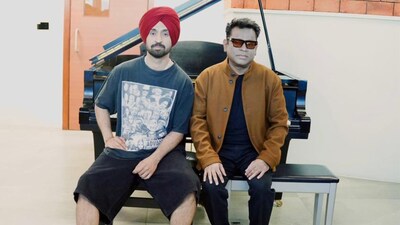
A. R. Rahman and Diljit Dosanjh collaborate for ‘Kya Kamaal Hai’ in Imtiaz Ali's Main Vaapas Aaunga
Diljit Dosanjh, A. R. Rahman, Imtiaz Ali, and Irshad Kamil come together for the song Kya Kamaal Hai in Main Vaapas Aaunga. The track promises a soulful and hopeful addition, building excitement for the film’s emotional narrative.
-

AR Rahman charges Rs 30 cr for Nitesh Tiwari’s Ramayana, demands profit share: Report
AR Rahman has reportedly charged Rs 30 crore for composing the music for Ramayana, making it one of his biggest deals. He is also expected to receive a share of the film’s profits, reflecting the project’s massive scale.
-
AR Rahman agrees to credit Junior Dagar Brothers in ‘Veera Raja Veera’ after SC order
A. R. Rahman has agreed before the Supreme Court to publicly credit the Junior Dagar brothers for their influence on Veera Raja Veera from Ponniyin Selvan II. The court directed that updated credits be added across platforms within five weeks, even as the larger copyright dispute continues.
-
Prakash Raj defends AR Rahman amid controversy, takes swipe at Kangana Ranaut: "Just because he did not work for her.."
Prakash Raj weighed in on the AR Rahman controversy at the Kerala Literature Festival, questioning the backlash faced by the composer for speaking his mind. He also criticised Kangana Ranaut’s remarks, calling the outrage around Rahman unnecessary and aggressive.
-
AR Rahman says he wants to move on from the Chhaava and communal remark controversy after backlash
AR Rahman has said he wants to move past the controversy triggered by his comments about Chhaava and perceived communal bias in Bollywood, adding that further explanation may be futile.
-
BJP’s Nitesh Rane slams AR Rahman’s Kapil Show appearance, says ‘Comedy is welcome, but no compromise on India’s integrity’
BJP leader Nitesh Rane criticised A. R. Rahman’s appearance on The Great Indian Kapil Show, alleging his earlier comments on industry bias hurt Hindu sentiments, while Rahman clarified he never meant to offend and reiterated his love for India.
-
AR Rahman reacts to his communal remark on The Great Indian Kapil Show: "Messages get corrupted on the way"
AR Rahman subtly addressed his recent controversy during an appearance on The Great Indian Kapil Show, comparing it to how messages get distorted in a whisper game. The composer stressed how miscommunication across cultures often leads to misunderstandings.
-
Amaal Mallik supports AR Rahman’s industry-bias stance but rejects communal interpretation
Amaal Mallik backed AR Rahman’s broader concerns about industry bias in Bollywood, saying the system often favours established groups and label preferences, but he disagreed with the idea that this bias is communal in nature.
-
Rani Mukerji defends Bollywood as secular after AR Rahman’s controversial remark, says ‘it is the most secular place’
Rani Mukerji defended the Hindi film industry as a secular and merit-based space, responding to AR Rahman’s controversial remarks about a possible communal bias. She stressed that in her 30-year career, she has never experienced discrimination based on caste or religion.
-
Waheeda Rehman urges peace after Ar Rahman’s communal bias remark, says, ‘this country is ours’
Waheeda Rehman responded to AR Rahman’s recent comments about losing work in Bollywood by urging peace and perspective, saying career ups and downs are natural and encouraging people to stay calm and united.
-
Mithoon defends AR Rahman, says composer ‘has every right’ to express his views amid communal remark row
Composer Mithoon defended A.R. Rahman amid controversy over his comments on communal bias in the Hindi film industry, saying the noted musician “has every right” to express his views and praising his long-standing contribution to music, as the debate over artistic expression and backlash continues.
-
Jaaved Jaaferi reacts to AR Rahman’s 'communal' remark, says "Industry has changed like the world has changed"
Jaaved Jaaferi commented on AR Rahman’s remarks, saying Bollywood is evolving with global changes, digital trends, and audience behavior. He emphasized that modern filmmaking increasingly balances creative storytelling with business metrics and attention spans.
-
AR Rahman accused of plagiarising Roja's Pudhu Vellai Mazhai from Yanni’s 1989 Track
AR Rahman is facing fresh criticism on social media after a video alleged that Roja’s “Pudhu Vellai Mazhai” closely resembles Yanni’s 1989 track Quiet Man. The claim has sparked debate online, with several users questioning the composer’s originality despite the song’s classic status.
-
Anup Jalota reacts to AR Rahman's 'communal bias' remark, says "Dobara Hindu ho jaayein"
Veteran singer Anup Jalota has publicly disagreed with AR Rahman’s claim that political changes affected his work opportunities in Hindi cinema. Reacting to the controversy, Jalota said Rahman’s belief was untrue and questioned the idea that religion played a role in his career.
-
When AR Rahman spoke about his 'painful' childhood, "my parents were thrown onto the street, was seeing trauma every day.."
AR Rahman, now a global music icon, once endured a childhood shaped by loss and hardship. In a throwback conversation, he reflects on the pain and resilience that defined him early on.
-
When AR Rahman called Shah Rukh Khan ‘Brand Ambassador of Islam’, SRK replied, "I am completely against it, being a model for any religion is..."
Shah Rukh Khan is admired for his thoughtful views on identity and belief. When AR Rahman once called him the “Ambassador of Islam,” the actor calmly but firmly rejected the label.
-
AR Rahman’s most talked-about controversies: From communal bias remark to rights dispute with Salman Khan’s film
AR Rahman’s career has seen sharp controversies, from his recent communal bias remarks to past legal and cultural disputes, highlighting how artistic expression often collides with politics, identity, and public sentiment.
-
AR Rahman’s daughters Khatija and Raheema stand by their father amid ‘communal bias’ backlash, say, "disagreement is fine, abuse is not"
Oscar-winning composer A. R. Rahman sparked intense debate after alleging a possible “communal” bias in Bollywood and claiming the Hindi film Chhaava gained traction through divisiveness.
-
Author Taslima Nasreen says AR Rahman is ‘too rich and famous’ to face discrimination amid communal controversy: ‘Difficulties happen to poor people like me’
Exiled author Taslima Nasreen defended AR Rahman amid the backlash over his “communal” comment, saying the composer is too rich and famous to face discrimination in Bollywood. She added that it does not suit him to be pitied, highlighting the difference between his experiences and those of ordinary citizens.
-
Javed Akhtar's old statements resurface online amid the AR Rahman controversy; 'I can write Rama and Krishna aartis'
Javed Akhtar responded to AR Rahman’s “communal” remark, saying he never felt sidelined in Hindi cinema, as his old interviews on belief, culture, and coexistence resurfaced online.
-
Priyanka Chopra hails Gandhi Talks teaser as ‘amazing,’ congratulates cousin Meerra Chopraa
Priyanka Chopra praised the teaser of Gandhi Talks as “amazing” and congratulated her cousin Meerra Chopraa, who is associated with the film. Her reaction has further fuelled excitement around the silent drama ahead of its January release.
-
Manoj Tiwari reacts to AR Rahman’s ‘communal’ remark, says he was ‘very surprised’
Actor and politician Manoj Tiwari expressed shock over AR Rahman’s recent remark, saying he strongly disagreed with the composer’s statement despite being his admirer. Rahman later clarified his comments, stating his love for India and emphasising that his music has always aimed to unite and honour culture.
-
From Javed Akhtar to Manoj Tiwari, celebs reacted strongly to AR Rahman’s 'Communal' bias remark
Oscar and Grammy winner AR Rahman’s remark suggesting a possible communal bias in Bollywood sparked sharp reactions across the industry. While figures like Javed Akhtar, Shobhaa De and Manoj Tiwari rejected the claim, Kangana Ranaut responded strongly, accusing the composer of prejudice, highlighting deep divisions over the issue.
-
From Maa Tujhe Salaam to Vande Mataram: A look at AR Rahman’s patriotic songs amid communal remark controversy
AR Rahman’s patriotic songs, from Maa Tujhe Salaam to Rang De Basanti, have become anthems celebrating India’s spirit, unity, and resilience. His compositions blend soulful melodies and powerful lyrics, inspiring pride and stirring emotions across generations.
-
Mehbooba Mufti to Javed Akhtar: 'Dismissing AR Rahman ignores lived realities of Indian Muslims in Bollywood'
Referring to Akhtar’s reported assertion that there was no communal angle behind Rahman allegedly receiving fewer work opportunities, Mufti said such views gloss over uncomfortable truths.