






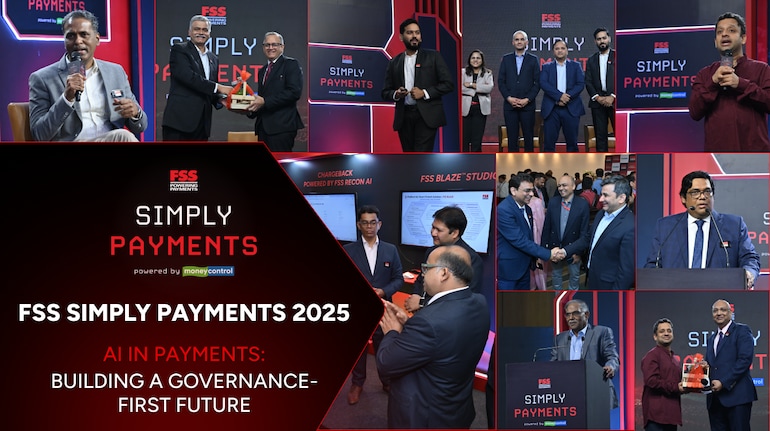
The world of digital payments is evolving faster than most industries, and Simply Payments captured that momentum perfectly. Hosted by FSS in partnership with Moneycontrol, the event convened banking leaders, policymakers, fintech innovators, technologists, and AI visionaries under one roof.
The central question driving the discussions was clear: How can India embrace AI-driven payments while keeping governance, security, and trust at the core? From modernising payment infrastructure to intelligent automation, regulatory expectations, and sovereign AI ecosystems, the event offered a panoramic view of forces shaping the financial landscape.
Vishal Maru, Global Processing Head, FSS, set the tone by emphasising, “Innovation without guardrails is not innovation, it is risk.” Drawing on FSS’s 35-year journey, he underlined how real progress comes from platforms built with governance, security, and trust.
He highlighted the industry’s shift toward AI-ready platforms, sharing that FSS signed 10+ Blaze contracts last year and is expanding Smart Recon across 150+ banks. His message made one thing clear: modernisation is no longer optional; it is the starting point of responsible innovation.
Policy Lens – Inclusion, Stability, and Disciplined Innovation
Building on that foundation, K. Rajaraman, Chairperson, IFSCA, connected innovation to India’s long-term economic approach. “Inclusion has powered India’s biggest shifts,” he noted, emphasising that new technologies must move forward with equal commitment to risk discipline.
His message aligned naturally during the opening keynote: regulators are not opposing progress; they are shaping an environment where innovation and responsibility grow together.
Regulatory Perspective - Responsibility First
Taking the conversation deeper, R. Gandhi, Former Deputy Governor, RBI, distinguished past digitalisation from the intelligence-led transformation ahead.
Digital payments digitised workflows; AI fundamentally changes how decisions are made.
With that leap comes greater responsibility.
“Regulators will always examine what should be permitted, what should not, and what must be banned,” he said, grounding the audience in the ethical expectations that surround AI-led systems.
The transition into technology leadership thus felt natural: if AI introduces new responsibilities, banks and providers must evolve their systems to meet them.
Modernisation, Intelligence and Scale – Engineering for the Future
This shift from policy to practice was carried forward by Anirban Roy, VP – Engineering & Architecture, FSS, who addressed the biggest operational challenge: legacy systems.
“The challenge is moving from ageing architectures to what is best-in-class today,” he said, outlining how FSS’s Blaze creates a data–model–intelligence flywheel powering some of India’s largest banks.
From architecture to delivery, Krishnamurthy KR, Delivery Head, FSS, demonstrated how modernisation translates into impact. Introducing Recon.Ai, he explained how intelligent routing eliminates delays and enables rapid onboarding:
“We’re onboarding banks at the rate of a bank and a half every month,” he shared, projecting 200+ banks by next year.
Risk, Readiness and Rethinking Workflows for an AI-Driven Future
In the fireside chat, Mrugank Paranjape, MCQube, emphasised that AI adoption must begin with rigour: “Your first concern is ensuring your AI models are absolutely robust.”
His focus on data quality, governance, predictability, and scalability echoed earlier regulatory concerns.
Adding the product lens, Kiran Hejmadi, SVP – Product, FSS, reinforced that AI is not a cosmetic addition: “AI is not a layer or a patch; it requires relooking at your complete workflow from bottom to top.”
Together, their insights connected seamlessly to the next theme - AI must be trustworthy, compliant, and explainable from inception.
AI Assurance and Global Compliance - Building Intelligence with Trust
Continuing this arc, Rishi Verma, Head – Global AI COE, FSS, summed up the industry’s biggest shift: “AI is not the challenge - assurance is.”
He outlined how FSS’s Blaze Cosmos framework aligns with global standards including the EU AI Act, RBI guidelines, UNESCO, OECD, and ISO 42001.
In the concluding panel discussion, Visa’s Vipin Surelia reinforced that trust, not technology, is the true differentiator: “The real challenge is earning and retaining consumer trust as technology evolves.”
Rishi Verma added that systems must be compliant, explainable, and auditable from day one, especially in multi-jurisdiction environments.
Federal Bank’s Indraneel Pandit offered a grounding reminder: AI has existed for decades, but generative AI is barely three years old. Transparency and explainability frameworks like LIME and SHAP are essential to maintain clarity as adoption increases.
This led naturally into a broader question: If trust, modernisation, and compliance define India’s approach, what does sovereignty mean for India’s future in AI?
Prof. Ganesh Ramakrishnan, IIT Bombay, answered that question by introducing BharatGen, designed to ensure technological independence in critical sectors like payments.
“Technological sovereignty is essential to avoid recolonisation,” he noted, emphasising localised, culturally contextual AI.
In conversation with Vishal Maru, he highlighted the importance of co-design between academia and industry: “We may fail, but it’s better to fail fast and fail forward - together.”
Balasubramanian, CEO, FSS, concluded by reinforcing trust as the foundation of payments: “For 34 years, banks have trusted us, and in payments, trust is everything.”
He urged banks to modernise legacy systems, citing ten banks already migrating to microservices, and stressed purposeful AI adoption: “Use AI in a way that is relevant to your organisation’s vision; not just as another tool.”
He ended on a global note: “With our AI capabilities, India can lead in payments worldwide.”
Discover the latest Business News, Sensex, and Nifty updates. Obtain Personal Finance insights, tax queries, and expert opinions on Moneycontrol or download the Moneycontrol App to stay updated!



