




Shekhar Iyer
Prime Minister Narendra Modi's chance to emerge a favourite for the 2019 Lok Sabha elections could well be determined by the outcomes of the assembly polls in five states in December.
Across different phases, Madhya Pradesh, Chhattisgarh, Rajasthan, Telangana and Mizoram will go into polls from November 12 to December 7. The counting of votes will be done on December 11. These five states account for 83 of the 543 Lok Sabha seats that go to polls next year.
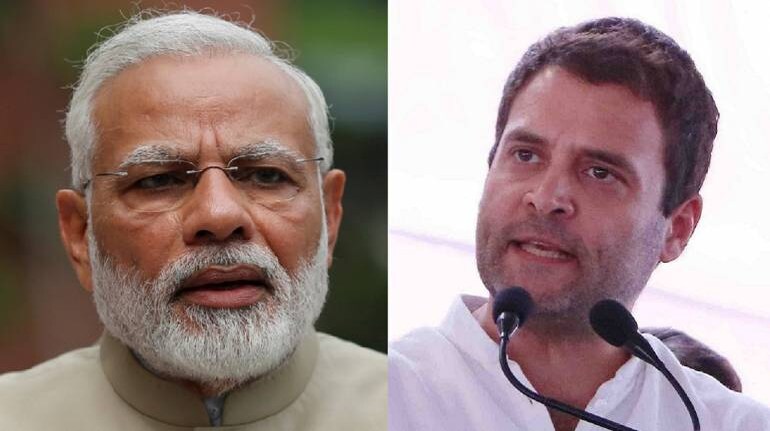
But the challenge between Modi and Congress President Rahul Gandhi is not an even one. This is because Modi will have to win a majority of the five states going to the polls, while Gandhi has to win just one of the states to put the Congress back in serious reckoning.
An emphatic win for the BJP in the assembly polls in these states will be read as Modi retaining his magic and gaining fresh momentum. This could severely impact the prospects of his political opponents in the run-up to the 2019 general elections.
A negative result for the Congress will play a huge spoiler for Gandhi and indicate his stewardship of the grand old party is yet to translate to electoral success.
It will also mean that the talk of a mahagatbandhan (grand alliance) of all opposition parties against Modi is actually a lot of hot air rather than firm strategizing on the ground to corner the Bharatiya Janata Party (BJP).
The last polls that the Congress won on its own strength were in Punjab and Puducherry last year. In Karnataka, the Congress joined hands with arch rival Janata Dal (Secular) to keep the BJP out of power, despite the latter having emerged the single largest party.
On the other hand, being the chief vote-catcher for the BJP, Modi has to ensure that the BJP wins handsomely in Madhya Pradesh, Chhattisgarh and Rajasthan.
That will also nullify anti-incumbency issues of his own government in Delhi and speculations about the BJP to gain enough numbers for a second term at the Centre.
In any case, the BJP's stakes are very high in the above-mentioned three states. In MP and Chhattisgarh, the party has done 15 years. Its chief ministers, Shivraj Singh Chouhan and Raman Singh, respectively, are seeking their fourth terms.
In Rajasthan, where the BJP has completed a term, Vasundhara Raje is striving for a second term. She is battling a host of issues, including rivalry within her own party and anti-incumbency in many pockets across the state. Raje, who got the BJP to win an all-time high of 163 of the 200 seats last time, is on the back foot. This is why Rajasthan is seen as one of the states where the Congress has a fair chance of displacing the BJP.
Gandhi has instated a younger and energetic Sachin Pilot to challenge Raje. Of course, the caste configurations in Rajasthan do not make it easy for Pilot either, but never before has the Opposition looked so formidable.
Among other states, Chhattisgarh does not hold out much hope for the Congress.
Former chief minister and rebel Congress leader Ajit Jogi's outfit and the Mayawati-led Bahujan Samaj Party (BSP) have joined hands, which will immensely reduce Congress' electoral prospects.
Jogi has been very unforgiving of the Congress as he believes Gandhi is against him. Besides, BJP's Raman Singh is seen as an unbeatable state leader who has a fairly good record in governance and is known to have kept the Opposition in disarray.
In Madhya Pradesh, where the Congress got into the act less than six months ago when Gandhi deputed Kamal Nath along with Jyotiraditya Scindia and Digvijaya Singh, the BJP got the early bird advantage as Chouhan hit the campaign trail much earlier. A soft-spoken Chouhan is seen better connected to his voters than Kamal Nath. Under Chouhan's leadership, the BJP cannot be easily vanquished.
Telangana is a big challenge for both Modi and Gandhi. Even though he appears to be favourably disposed to the BJP, chief minister K Chandrasekhar Rao won't let the national party gain a foothold in the state. Rao is confident of denying the Congress and its allies an opportunity to unseat his Telangana Rashtra Samithi (TRS) government.
In fact, Rao called elections eight months in advance, seeing an advantage in separate assembly and parliamentary polls. For the moment, Modi may well have to be satisfied with a pro-NDA TRS winning Telangana rather than looking for the BJP to have a bigger role in the state. Of course, in the event of the TRS failing to win the required numbers, the BJP could step in to help Rao.
The battle for Mizoram is crucial for the Congress as the BJP-driven NDA is eyeing what is seen as the last bastion of the grand old party in the North-East. Today, the BJP rules six of the eight states in the North-East, which account for 25 Lok Sabha seats, either on its own or in alliance with other regional parties that are traditional rivals of the Congress.
In 2013, the Congress got a second term under its veteran leader Lal Thanhawla who now faces dissensions. The main opposition party, the Mizo National Front, which is a member of the BJP-helmed North-East Democratic Alliance (NEDA), looks hopeful.
(Shekhar Iyer is former senior associate editor of Hindustan Times and political editor of Deccan Herald. The views expressed are personal)
Assembly Elections 2018: Read the latest news, views and analysis here

Discover the latest Business News, Sensex, and Nifty updates. Obtain Personal Finance insights, tax queries, and expert opinions on Moneycontrol or download the Moneycontrol App to stay updated!
Find the best of Al News in one place, specially curated for you every weekend.
Stay on top of the latest tech trends and biggest startup news.




