


co-presented by
ASSOCIATE SPONSORS
co-presented by


ASSOCIATE SPONSORS


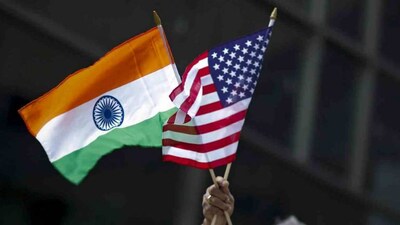
In March 2000, US President Bill Clinton addressed the Indian Parliament, an occasion that encapsulated a nascent bipartisan change in approach to ties with India. The challenge for India in the years ahead to make the engagement with the US more robust will be to navigate two interrelated strands – trade and technology

From Ukraine to information warfare, discussions at the Raisina Dialogue revealed insights about the shifts in contemporary geopolitics that India would do well to adapt to

Both houses of Germany’s Parliament have approved carveouts in the country’s restrictive “debt brake” in the wake of mounting economic and geopolitical challenges. A militarily assertive Germany, rearmed with public spending, can alter the balance of power within Europe and NATO. For Washington, it offers a much-needed “burden-sharing” partner. For Russia and China, it is a clear signal that Europe is mobilising for long-term strategic competition

History is replete with states imploding on the heels of overspending. From ancient Rome to Sri Lanka, we have seen fiscal recklessness led to instability and shook the very foundation of a state. India’s political parties clearly haven’t learnt any lessons. Recent elections have seen parties win on the back extravagant welfare promises which are followed by a fiscal struggle. It’s time for pragmatism

China’s actual defence spending remains a mystery, with Western estimates placing it within an unusually wide range. Indians fall into a cognitive information trap by relying on these sources. India needs to enhance it capabilities to understand China, which should lead to knowledge production that caters to India’s strategic interests

Its nascent revival may be short-lived if insecurity in the borderlands comes to urban centers

After an audacious train hijack on March 11, the Baloch Liberation Army has continued to target Pakistan’s security personnel through smaller attacks. The country is in the grip of a relentless cycle of violence, with no long-term solution as the polity is subservient to an army which continues to repeat mistakes. Pakistan’s neighbours need to be mindful of a spillover effect

In a recent White House briefing, Press Secretary Karoline Leavitt addressed the state of the U.S. economy following a significant plunge in the stock market. Leavitt explained that the country is currently undergoing an "economic transition," emphasizing President Trump’s ongoing commitment to restoring American manufacturing and global dominance. With tariffs on steel and aluminum set to take effect tomorrow, Leavitt reiterated the administration's stance and its focus on revitalizing U.S. industry. Watch as the White House responds to tough questions about the economic outlook and the president's role in this volatile moment.

Greenland’s centre-right opposition won the general election, with nearly 90% of ballots counted. The Demokraatit party, advocating for gradual independence, led with about 30% of the vote, followed by Naleraq, which seeks immediate independence and closer US ties, at 25%. The pro-independence Inuit Ataqatigiit (IA) party, led by Prime Minister Mute B Egede, came in third with over 21%. Greenland, an autonomous territory of Denmark for 300 years, governs its domestic affairs, but foreign and defense policies are decided in Copenhagen. Around 44,000 Greenlanders voted for 31 MPs and the local government. US President Donald Trump has shown interest in acquiring Greenland, citing its strategic location and mineral resources, and has repeated his intention since taking office again in January. However, Greenland and Denmark have firmly rejected the idea, with Egede stressing that Greenland is not for sale and deserves respect.
Japan’s ties with the US face uncertainty under Trump, with trade disputes, security tensions, and shifting global alliances. Concerns over US reliability are pushing Japan to strengthen regional partnerships, maintain economic ties with Washington, and cautiously re-engage with China
The US president says no one has been harder on Russia, but these days no one has been weaker

Dhananjay Munde’s resignation from Maharashtra’s council of ministers once again turns the spotlight on the shadowy links between criminal elements and the political class. The former’s role in election funding represents a serious challenge to the country’s internal security

Sanghnomics: As US-China trade tensions rise, China seeks India’s support. However, India remains cautious due to past economic and security concerns. Experts argue India should prioritise ties with the US while leveraging trade opportunities arising from the tariff war

Bangladesh’s newly formed National Citizens' Party (NCP), led by 26-year-old Nahid Islam, claims the country’s law and order situation makes elections impossible. Islam, a key figure in the 2024 student uprising that ousted Sheikh Hasina, criticised the interim government’s failure to fully restore public safety. The youth-led NCP aims to reform the economy, change the constitution, and contest elections. A UN report accused Hasina’s government of human rights violations, with 1,000 deaths reported during the protests. Islam insists Hasina’s Awami League should be barred from politics, blaming it for destroying democracy. The party awaits Awami League’s response.
Expulsion of her nephew Akash Anand from the party represents one more example of getting rid of people who have tried to revive it through a different approach. With a second rung leadership purged over the years, all that BSP party functionaries are left with is a distant leader whose problems with enforcement agencies have shrunk the potential of a political party that was once a dominant force in Uttar Pradesh

In April, Congress party’s brains trust will meet in Gujarat to find ways to pull themselves out the deep hole they are in. It comes at a time when Rahul Gandhi has managed to staff key positions in the party with trusted aides. The cold, hard truth, however, is absent an effective organisation on the ground, strategies remain empty ideas

In Constituent Assembly debates, there was a consensus that the right to vote should be treated as a fundamental right and, therefore, integrity of electoral process is of paramount importance. As Supreme Court hears a challenge to the Parliament’s law on the composition of the selection committee for EC, also at stake is the question of separation of powers between the judiciary, legislature and executive

Starmer has to do better than Macron and Merz when dealing with the US president

Anupam Kher, the renowned Bollywood actor, recently dismissed rumors of leaving acting for a career in politics. Despite his support for the Bharatiya Janata Party (BJP) and involvement in political discussions, the 69-year-old actor clarified that he has no intentions of switching from films to politics at this time.

A protege of late Wolfgang Schaeuble, finance minister and icon of fiscal conservatism, Merz rose to CDU parliamentary leader in the 2000s before becoming one of several powerful men dispatched by former Chancellor Angela Merkel. He quit parliament after she became chancellor and has never held government office. He worked for 15 years as a lobbyist and board member in companies including the Germany branches of asset manager Blackrock and HSBC bank, as well as the publicly-owned Cologne-Bonn airport. Merz is a hobby pilot who owns two aeroplanes. When Merkel stood down after almost 19 years as party chair, he was defeated by other candidates in 2018 and in 2021, before finally winning the post in 2022. Admirers praise Merz as a tactician. The collapse of Chancellor Olaf Scholz's government in November came after his legal challenge to last year's budget precipitated the funding crisis that wrecked an already unwieldy three-way coalition. In his campaign so far, Merz's economic prescriptions have focused on tax cuts, deregulation and incentives to work, in keeping with the man who once said that tax regulations should be simple enough to fit on the back of a beer mat. He has also hinted that he might loosen a constitutional spending cap - whose stringency it was that made his legal challenge so devastating - to win over voters angered at the state of Germany's infrastructure while promising that any change would finance investment, not spending. An INSA poll released on Friday (February 21) suggests Merz’s CDU are leading with 30% of support while the opposition far-right Alternative for Germany (AfD) would come in second at 21% and Scholz’s Social Democrats (SPD) would make third place at 15%.

Friction between state’s CM Devendra Fadnavis and deputy CM Eknath Shinde may seem like a repeat of the fractious BJP-Shiv Sena relationship between 2014 and 2019. This time, however, there may be other factors at play as the ostensible Sena-BJP battle for the Hindutva space may also be where the BJP’s internal leadership dynamics are playing out

Remember when billionaire Elon Musk brought his son X Æ A-Xii, whom he calls X, to the Oval Office? From making weird noises to picking his nose, the 4-year-old, who was standing close to the President's Resolute Desk, grabbed headlines. Now, President Donald Trump has replaced the iconic 145-year-old desk with a C&O desk. He has called it a “temporary change.” Donald Trump, who has in the past labelled himself as a germaphobe, shared a picture of the Oval Office with the new desk on his social media platform Truth Social. It was not clear if the change was brought in due to the nose-picking incident. The note attached to the post read, “A President, after the election, gets a choice of 1 in 7 desks. This desk, the “C&O,” which is also very well known and was used by President George H.W. Bush and others, has been temporarily installed in the White House while the Resolute Desk is being lightly refinished—a very important job. This is a beautiful, but temporary replacement!”

GTRI founder Ajay Srivastava explains that the threat of reciprocal tariffs is not cause of concern because 75 per cent of US exports to India have an average tariff of 5%. Watch Exclusive conversation with Shweta Punj.
The president’s approach makes US actions more logical, but no less shameful

Much like his predecessor, the current president is eager to talk about the benefits of his policies but reluctant to confront their costs


