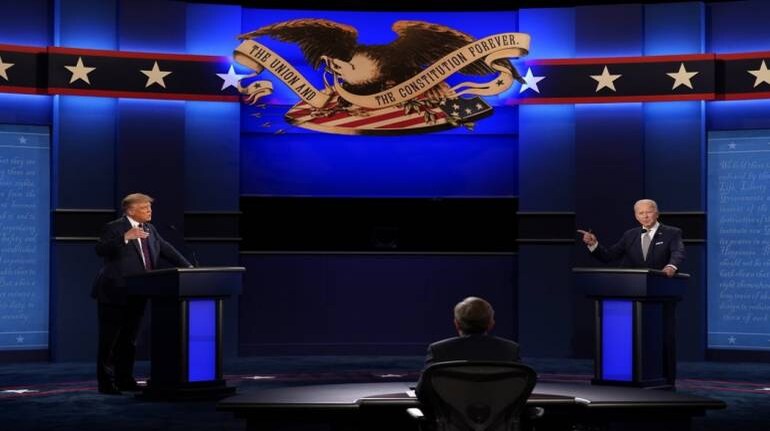
The first televised debates started almost exactly 60 years ago, on September 26, 1960 in Chicago as then Massachusetts Senator John F Kennedy faced off against the sitting Vice-President Richard Nixon. An ailing Nixon was pale and sweating during the telecast and that made a difference, as History Channel noted, “Polls revealed that more than half of all voters had been influenced by the Great Debates, while 6 percent claimed that the debates alone had decided their choice. Whether or not the debates cost Nixon the presidency, they were a major turning point in the 1960 race — and in the history of television.”
In fact, those who listened in to the debates on the radio believed Nixon did as well or equalled Kennedy’s performance. Those who were watching, however, skewed towards the Democrat. This may well have created political image management, a phenomenon that continues to dominate politics not just in the United States, but globally.
Twenty years later, then California Governor Ronald Reagan surged in the polls following the debates. As an actor with a past career in Hollywood, he gave practised performances for the cameras, with zingers like, “There you go again!” Sitting President Jimmy Carter offered little charisma to counter him.
In either case, television may have proven decisive in the verdict. That trend may have held into this millennium, but over the last three cycles, it is on the wane as an influencer. If the debates were critical in deciding who occupies the Oval Office, Mitt Romney would have defeated Barack Obama in 2001, and Hillary Clinton, not Donald Trump, may have been holding press conferences in the Rose Garden.
There are multiple factors why the debates have lost their importance. The most significant is certainly that we now live in the age of social media. Even a decade earlier, a week may have been a long time in politics. Today, the barrage of information has caused an attention deficit disorder that ensures that even seven hours may appear to be an eternity. If memories are short, memes have an even briefer life span.
Not helping is the manner in which the debates are now conducted, especially when Trump is a participant. Courtesy and cogent arguments have given way to personal attacks and talking points spin that leave little room for discussions on policy. Gravitas has given way to a lack of grace, as the latest iteration in Cleveland on September 30 underscored.
Debates were also meant to convince independent, swing and undecided voters over to a candidate. Given the sheer schism that now exists between the parties and their adherents, there may be very few inhabiting that middle ground, even if some may make appearances on post-debate focus groups pretending to be ideologically malleable. If after the last four years of vicious partisanship there are still any truly undecided, they have probably been living off the grid.
Trump himself makes these debates meaningless, not just because his responses are incoherent (for once, he actually faced competition in this regard from his Democratic Party challenger Joe Biden), or that he uses invective instead of reason; his actions will constantly change the narrative in the hours ahead. A tweet storm in the middle of the night could set the conversation off into an entirely new direction.
Biden didn’t help the tenor by calling Trump a “liar” and a “clown”, taking the event into a new extreme. Under these circumstances, perhaps the man in the middle needs a nomenclature since moderator hardly works as intemperance rules the stage.
That this current set of presidential debates is unlikely to prove crucial to determining the outcome, will be a pity. There are substantial issues that America faces where clarity on positions and policy would be helpful. Not only does it continue to suffer grievously from the COVID-19 pandemic, it’s grappling with a potentially divisive confirmation battle to the country’s Supreme Court, even as economic recovery remains brittle and China’s belligerence increases with each day, as Beijing may well be eyeing a possible power vacuum in Washington during a contested election result to make its moves. The country itself is in the throes of another variety of chaos over protests related to racial injustice along with violence and looting.
Each of these topics, unfortunately, is being left to the gatekeepers at Facebook or Twitter to moderate, rather than the host of the presidential debates, as the contenders take this particular process to greater irrelevance with their unserious and ungracious approach.
Anirudh Bhattacharyya, a Toronto-based columnist and commentator on North American issues, has covered US Presidential elections since 2004. Twitter: @anirudhb. Views are personal.
Discover the latest Business News, Sensex, and Nifty updates. Obtain Personal Finance insights, tax queries, and expert opinions on Moneycontrol or download the Moneycontrol App to stay updated!
Find the best of Al News in one place, specially curated for you every weekend.
Stay on top of the latest tech trends and biggest startup news.