







For investors and market participants alike, it’s hard not to be disappointed with this year’s Union Budget. A 50% increase in Options STT (Securities Transaction Tax) and a 150% increase in Futures has delivered a sharp blow to the market sentiment. Especially, when markets were dealing with incessant FII outflows and geopolitical tensions. Clearly, the timing was wrong, in our view. But it is what it is. Like previous tax blows, markets will remain subdued and then move on.
Amongst investors there was, even if unrealistically, a small hope of some relief in capital gains taxes. If that relief came through, the current hike in STT would have been more palatable as a reasonable give and take. But now that’s not the case. It’s not the end of the world though! As the table below indicates, that despite previous hikes in STT, volumes on F&O have continued to rise.
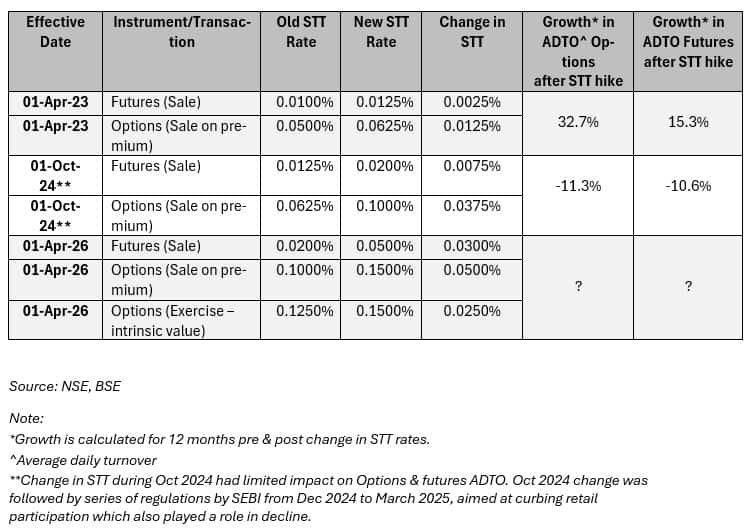
We may see a temporary dip in volumes as the ROI for traders gets impacted and high-frequency traders no longer look as attractive. However, markets have the ability to adapt quickly. In this context, the role of speculation in supporting market depth and efficiency, and the need for government tax measures to be calibrated so as not to distort market structure, become evident over time.
But beyond the overhang of STT, the budget hits many high notes. Now that the government is done doling out direct tax and GST cuts in 2025, there is very little room to do more giveaways. So, it’s back to basics – deepening India’s manufacturing capabilities, moving up the value chain, being more self-reliant in critical areas and building world-class infrastructure.
The Finance Minister delivered on one of the most anticipated numbers – capex of Rs 12.2 lakh crore as against a revised estimate of Rs 11 lakh crore in 2026. A healthy 11% jump. Defence capex got the highest boost as expected of 18%, followed by railways at 10%. This should come as relief, as fears of lower-than-expected tax revenues (due to GST cuts and lower nominal GDP growth) cannibalising capex spending did not happen.
Beyond capex, there has been a deep realisation that India needs to not only become self-reliant but also firmly embed itself in the global manufacturing supply chain. Initiatives such as ISM 2.0 (India Semiconductor Mission) with an Rs 40,000 crore allocation, the deepening of bio-pharma capabilities, leveraging India as a health tourism destination, and laying the foundations of developing our critical mineral ecosystem amongst others are strategically very sharp.
A 22-year tax holiday on data centre buildout is a truly visionary step. We believe, this will not only attract large capital in what happens to be the largest global capex build outs but also integrate India firmly with the future service buildouts of the hyperscalers like Microsoft, Google, Meta and Amazon. If the government displays similar long-term strategic thinking and visibility in other areas, we may attract far more FDI than we do today. But this is indeed a great beginning.
There have been several initiatives to support growth in labour intensive sectors like Textiles, Agriculture, Healthcare, Tourism, Ayurveda and Sports which may leverage our vast manpower, a large domestic market, build competitiveness in exports and increase India’s soft power by leveraging our rich culture and spiritual wealth.
There is also a recognition of the fact that while India builds out its manufacturing capabilities, it would be short-sighted not to focus on services, as they may drive high-value employment, which in turn may drive consumption. The tax and transfer pricing clarity given to GCC’s (Global Capability Centres)/BPO’s/KPO’s and software and other high value services will go a long way in making India a preferred destination for the export of services, in our view.
There are several nuanced changes across several sectors which may seem like micro tinkering; however, they are very critical in driving efficiency and ease of doing business. Most of these initiatives are tucked in several new programmes and policy initiatives, the effectiveness of which shall depend on consistent execution. Once the angst of the STT increase subsides, the strategic intent of the budget should play out. And as it happens, the baton of the markets will then be decided by earnings recovery and global macro and geopolitical events.
Disclaimer: The views and investment tips expressed by experts on Moneycontrol are their own and not those of the website or its management. Moneycontrol advises users to check with certified experts before taking any investment decisions.
Discover the latest Business News, Sensex, and Nifty updates. Obtain Personal Finance insights, tax queries, and expert opinions on Moneycontrol or download the Moneycontrol App to stay updated!
Find the best of Al News in one place, specially curated for you every weekend.
Stay on top of the latest tech trends and biggest startup news.





