Donald Trump’s Second Presidency of the United States is keeping the world politics and economics on an edge. On economics, one major issue is Trump increasing tariffs on US imports across its major trading partners. As Trump tries to navigate tariffs and trade, a question facing economists is: What role will the US Dollar play as a reserve currency going forward?
In a way, this is not a new question. The US has been facing the so-called Triffin dilemma for a long time which has put the US and the global economy in a spot. To understand this ongoing dilemma, we need to go back in time.
How did the market for foreign exchange evolve?
As World War II was raging, a group of economists and government officials assembled in Bretton Woods, New Hampshire, in the US. The Bretton Woods (BW) agreement decided to establish three institutions to achieve three objectives: reconstruction of war torn countries, promote global financial stability and foster international trade. We accordingly got World Bank, International Monetary Fund and General Agreement on Tariffs and Trade (GATT).
One other major decision was on the global exchange rate system. Till WW II, exchange rates were based on Gold Standard wherein exchange rates were pegged against Gold. The Gold Standard had its strengths where the inflation remained under control. It also had weaknesses as the money supply could not increase especially in exigencies such as the two World Wars when gold standard had to be suspended.
In BW, a middle path was adopted wherein the US Dollar was pegged against Gold and all other currencies were pegged against the US Dollar. This implied that only US was required to keep gold reserves whereas all other countries kept US Dollar as reserves. Although, the new exchange rate system made US Dollar the most hegemonic currency in the world, it also created a dilemma for the global monetary system.
What was the flaw in this system?
In 1950s, the US economy ran large trade deficits leading to glut of US Dollars in the world economy. The US also spent resources to prevent fight communism and colonization. The end result was central banks of Europe and Japan had high inflow of Dollar reserves. The central banks redeemed these dollars for gold leading to sharp decline in US Gold reserves.
In 1960, economist Robert Triffin highlighted this dilemma in a testimony before the U.S. Congress. If the US stops running trade deficits, the global monetary system would lose the largest source of their reserves. The loss of reserves will result in shortage of liquidity that could pull the world economy into a contractionary spiral, leading to instability.
If the US trade deficits continue it will fuel global economy but put pressure on US Dollar to depreciate and erode confidence in the US Dollar. The fixed exchange rate system could break down eventually leading to a global crisis. So whether the choice is to stop or allow running trade deficits, there will be an eventual crisis.
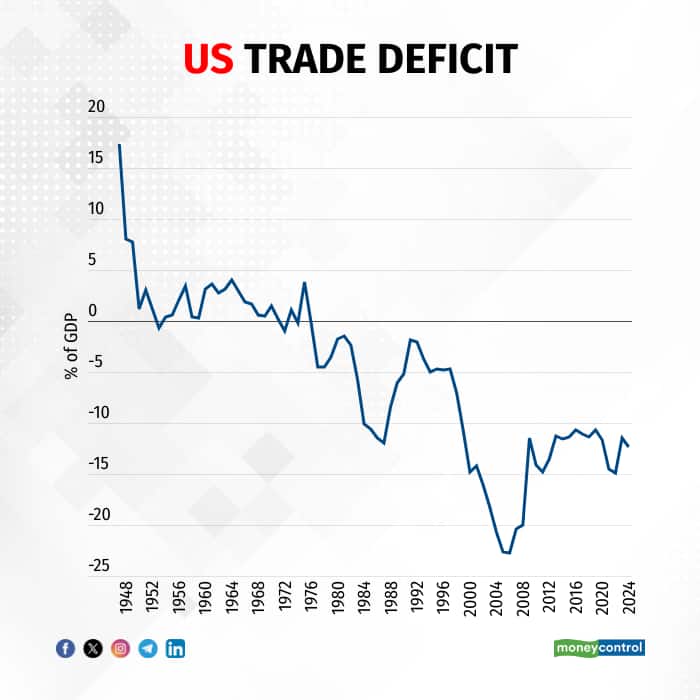
In 1971, the then President Richard Nixon withdrew the US from the BW agreement, leading to its collapse. While the withdrawal removed the US obligation to keep the gold reserves, the problem of trade deficits in the US economy continued unabated (See figure).
If BW ended, why is USD still the international reserve currency?
Before 1971, the global monetary system did not face frequent financial crisis. The BW system acted as a global regulator of capital and finance flows and prevented financial crises. After 1971, with collapse of BW, the frequency of crises increased across the world. The central banks had to resort to stocking reserves in US Dollars. Hence, even though the BW system did not exist, its broad contours remained. US kept running trade deficits and global central banks kept increasing US Dollar reserves.
IMF data shows that forex reserves have increased from USD 1.3 trillion in 1995 to USD 12.7 trillion in 2024. The share of US Dollar in the forex exchange reserves has declined from 70 percent levels in 2000 to 58 percent of reserves in 2024. Yet, the USD as a global currency has only become more hegemonic over time. Economists have termed it as Dominant Currency Paradigm where most transactions in international trade and currency is invoiced in US Dollars.
What’s the difference in the Trump approach to the age old dilemma?
Fast forward to current times. One major agenda of US President Trump in his presidency has been to restore balance of US trade, which may reopen the Triffin dilemma debate once again. Before and after the 2008 crisis, there were discussions on this tension between US trade deficits and USD reserve currency, but nothing was really done to address the dilemma. It was assumed that broadly markets should decide these outcomes. Under Trump Presidency, this issue is being addressed at the policy level which makes it different.
How will this long standing Triffin dilemma pan out under Trump? There are two scenarios. First, the US trade deficit does decline. Second, trade deficit might not decline an anticipated as other countries might respond with higher a tariffs on US exports.
Amidst these two scenarios, the outlook on status of USD is not clear. The share of USD has declined as a reserve currency. But it has not been replaced by another major currency such as Euro or Yen. In fact, the share of non-major currencies such as Australian Dollar, Yuan and Canadian Dollar has risen in forex reserves.
In international transactions in trade and finance, USD remains as dominant as ever. Only time will tell how and whether Triffin dilemma will get addressed in the Trump era.
Discover the latest Business News, Sensex, and Nifty updates. Obtain Personal Finance insights, tax queries, and expert opinions on Moneycontrol or download the Moneycontrol App to stay updated!
Find the best of Al News in one place, specially curated for you every weekend.
Stay on top of the latest tech trends and biggest startup news.