






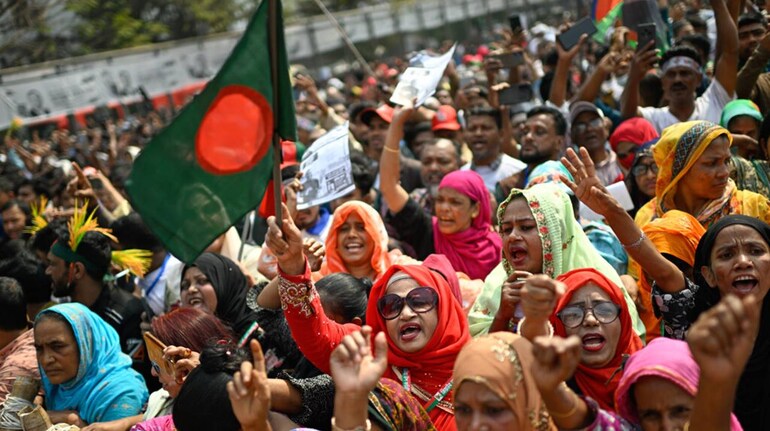
The decisive victory of the Bangladesh National Party (BNP) in the first election in Bangladesh since the deadly 2024 uprising has caused a surprise for the hardline Jamaat-i-Islami Bangladesh (JIB). It had seen itself as the major contender and had been projecting itself as the winner in the run-up to the polls. But now that BNP’s Tarique Rahman is poised to become prime minister, the JIB is casting aspersions on the integrity of the election process. "We are not satisfied with the process surrounding the election results," Jamaat said in a statement.
Women are not willing to accept subservience
While there will be a postmortem of why the JIB lost, given the free run they had under the caretaker government of Chief Advisor Mohamed Yunus, women have played a decisive role. The party's Islamist-driven agenda assigned a subservient role to women, and this found few takers in a land where women historically and traditionally have played a major role in society and politics.
Jamaat’s understanding of women’s role in society
The Jamaat did not field a single woman candidate. Its leader, Jamaat-e-Islami chief Dr Shafiqur Rahman, explicitly spelled out the party's position on women in an interview to Al Jazeera: "On the question of women, Jamaat's position is neither confused nor apologetic - it is principled. We do not think women should come into leadership. In Jamaat, it is impossible. Allah did not permit this... We believe that when women are pushed out of the home in the name of modernity, they are exposed to exploitation, moral decay and insecurity. It is nothing but another form of prostitution..." He even posted this on his social media handles.
The Jamaat has a history of likening working women to prostitutes, says Bangladesh's three-time national award-winning actress and trade unionist Rokeya Prachi.
Bangladeshi women have a big presence in the workforce
Women voters outnumber men in Bangladesh; women have been leading two of the main political parties in Bangladesh - both Awami League and the BNP. Obviously, this did not go well with women voters, though the Jamaat has its own constituency among women, but they are mostly related to Jamaat members.
Women make up 44% of the country’s workforce, according to the International Labour Organization, the highest proportion in South Asia. On many indices - female mortality, maternal mortality - Bangladesh scored higher than India. Rahman’s words sent a shockwave through women in Bangladesh, many of whom had been at the forefront of the students' movement that overthrew Sheikh Hasina’s government.
Midnight march
On the eve of the election, women from different walks of life led a midnight march in Dhaka, calling for equality, alarmed that the Jamaat may win the elections, which would curtail their rights. “The people have given their blood, now we want equality."
For more than a year, women had seen their rights consistently being eroded as the Jamaat consolidated its position with the help of the Yunus government. It lifted the ban on the organisation, freed criminals and violators connected to it from Bangladesh's prisons, and allowed it to be registered as a political party. Foreign funds and support for the organisation also poured in.
Harassment and attacks on women rose in the Yunus phase
Meanwhile, the Jamaat and sundry groups affiliated with it began implementing its agenda - vigilant mobs began roaming the streets enforcing a dress code on women, harassing, even physically assaulting, women it deemed were not dressed according to Islamic principles - something earlier unheard of in Bangladesh. Sexual violence against women, initially against those affiliated to the Awami League, but soon involving others, surged.
A July 2025 report of Human Rights Watch found that the country has been facing “an alarming surge in mob violence, political violence, and harassment of journalists by political parties and other non-state groups, such as religious hardliners hostile to women's rights and lesbian, gay, bisexual, and transgender people.”
Opportunities would have been squeezed in a Jamaat regime
Clerics and sundry groups associated with the Jamaat began opposing women's work, dictating that women can go out to work only if their "mehram" - male guardian - considered it necessary. This was reflected in the Jamaat's election manifesto, which promised women "security" and curtailment of work hours from 8 to 4-5 hours, with the government paying a stipend to make up for the loss.
The Yunus government, eager to co-opt the Jamaat for its own electoral ambitions, gave in. The first casualty was the women's reforms bill, proposed by a committee the government had itself instituted. The reason? Nationwide protests by the Jamaat, which claimed that it contradicted Sharia law.
Within a few months of taking charge, it scrapped all job quotas meant for women. It also did away with women's quotas for elections, which had been in place in the country's polity till recently.
The Jamaat's defeat in Bangladesh has been met with a sigh of relief by many women. Alignment with this hardline agenda is also being touted as a reason for the defeat of the students-led National Citizens' Party. These elections in Bangladesh, flawed in many ways, are also widely believed to reflect the aspirations of Gen Z. And they have given their mandate.
(Aditi Bhaduri is a journalist and political analyst.)
Views are personal, and do not represent the stand of this publication.
Discover the latest Business News, Sensex, and Nifty updates. Obtain Personal Finance insights, tax queries, and expert opinions on Moneycontrol or download the Moneycontrol App to stay updated!
Find the best of Al News in one place, specially curated for you every weekend.
Stay on top of the latest tech trends and biggest startup news.




