






The Karnataka Electricity Regulatory Commission (KERC)’s recent announcement on 3 March 2026 to revise electricity tariffs upward—specifically by ₹0.10/kWh for the industrial sector and ₹0.90/kWh for commercial consumers—has sparked a necessary conversation about the state’s energy future. While the move offers a degree of fiscal relief to struggling distribution companies (DISCOMs), it highlights a cycle of tariff volatility that merits closer examination.
This latest adjustment comes less than a year after an uncharacteristically large tariff reduction in March 2025. At that time, rates were lowered by approximately ₹0.5 to ₹1.9 per unit, despite contrary petitions from DISCOMs. The reversal we see today suggests that the previous reduction may have been overly optimistic, placing an unintended strain on the state’s power infrastructure.
A Fiscal Abyss
The gravity of the situation is underscored by the numbers. As of March 2025, Karnataka’s five DISCOMs reported accumulated losses of ₹35,000 crores. Such losses have led to chronic underinvestment in necessary infrastructure to modernise the grid, which is a crucial component of the “Viksit Bharat” infrastructure goals.
KERC’s official rationale—that DISCOMs simply “had not made provisions” for a reduced tariff in their budgets—is a troubling admission. It suggests a profound disconnect between regulatory policy and the operational realities of our utilities. The 2025 reduction appears either to have been an optimistic oversight or a “punishment” for underperforming DISCOMs that ultimately backfired.
The “Carrot and Stick” Reality
The Ministry of Power, Government of India’s Annual Integrated Rating and Ranking Report, released just last month, reminds us that the Centre is watching. Under its “carrot and stick” approach, poorly performing DISCOMs are increasingly sidelined from federal incentives. By plunging the state’s utilities into a year of artificially suppressed revenue, KERC has not only strained their ledgers but has potentially damaged their national standing and access to future funding.
Failing Grades in a Competitive Landscape
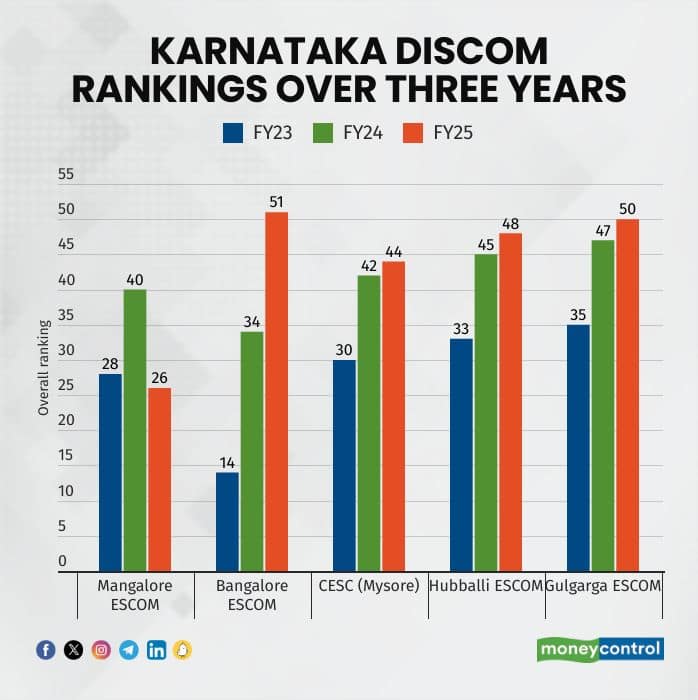
The Union Government’s Annual Integrated Rating and Ranking Report, released last month, confirms these concerns. Karnataka’s DISCOMs (with the exception of MESCOM) have shown a continuous decline in financial parameters over the last three years. BESCOM and GESCOM now languish at 51st and 50th place, respectively, out of 65 utilities nationwide.
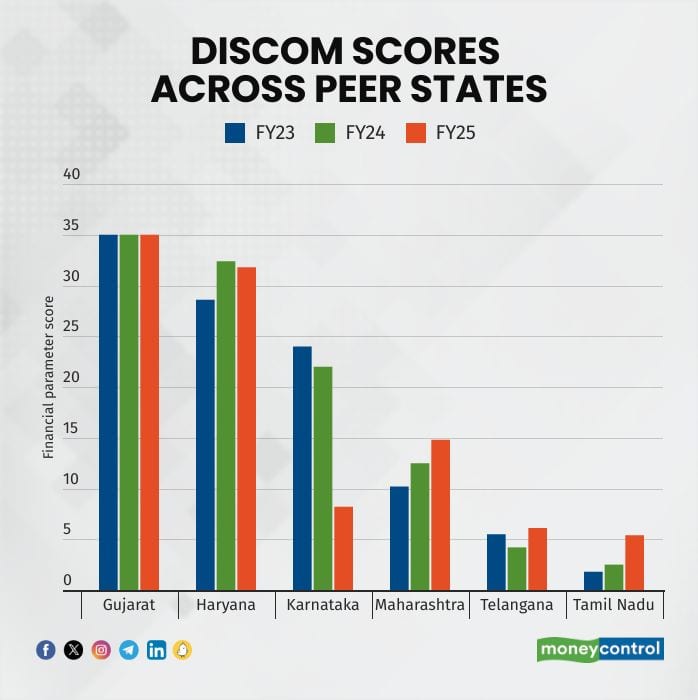
The most important parameter, carrying 35 out of 100 points, measures the difference between the Average Cost of Supply (ACS) and Average Realised Revenue (ARR). The three-year trend for Karnataka DISCOMs and some of their peers in terms of ARR–ACS and the corresponding scores is shown in the graph here. Every other peer state has shown an improvement in scores, whether starting from a higher base or a lower one.
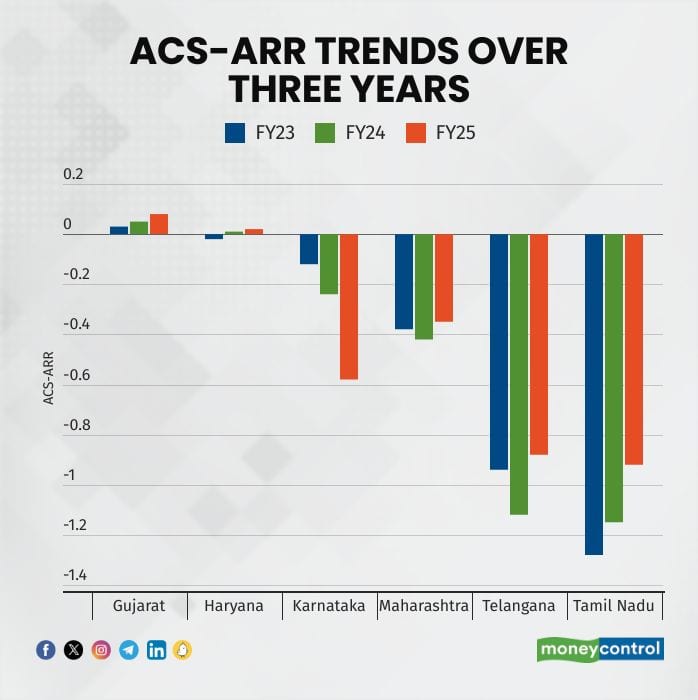
While some point to BESCOM’s worsening collection efficiency (see detailed report) as a reason for the higher cost of procuring electricity, the 2025 tariff cut felt less like a corrective measure and more like a “punishment” that pushed these utilities further into the abyss. Even with the recent hike, the Average Realised Revenue (ARR) is expected to remain lower than 2024–25 levels. We now face the real ignominy of hosting some of the worst-performing DISCOMs in the country.
Structural Rot and the Market Cure
The roots of this crisis are both operational and systemic. On the cost side, our utilities remain shackled to an over-reliance on the ageing Raichur Thermal Power Station, coupled with lacklustre investment in renewable energy. On the systemic side, we remain trapped in a monopoly model where “price-fixing” by non-players—the regulatory commissions—ignores market realities.
The Need for Predictability
Industry thrives on predictability. A regulatory environment that swings from massive cuts to sudden hikes within less than a year creates an atmosphere of uncertainty that stifles long-term planning. KERC must move beyond these reactive cycles. If Karnataka is to maintain its competitive edge, it needs a regulatory framework rooted in market realities, not one that oscillates between unsustainable populism and emergency corrections.
The right long-term approach is to dismantle a monopoly market where prices are set by a regulator. We need an environment where multiple players, preferably private, can offer their services directly to end consumers. Price setting must be market-derived; a regulatory commission’s attempt to determine the “right price” lacks the nuance and incentive structure required to drive efficiency. Sadly, the latest proposed amendments to the Electricity Act, 2003 appear to double down on the failed status quo, granting commissions even more suo motu powers in matters of tariff setting.
(Anoop Gannerkote is a thinker of Public Policy at Takshashila Institution, Bangalore.)
Views are personal and do not represent the stand of this publication.
Discover the latest Business News, Sensex, and Nifty updates. Obtain Personal Finance insights, tax queries, and expert opinions on Moneycontrol or download the Moneycontrol App to stay updated!
Find the best of Al News in one place, specially curated for you every weekend.
Stay on top of the latest tech trends and biggest startup news.




