






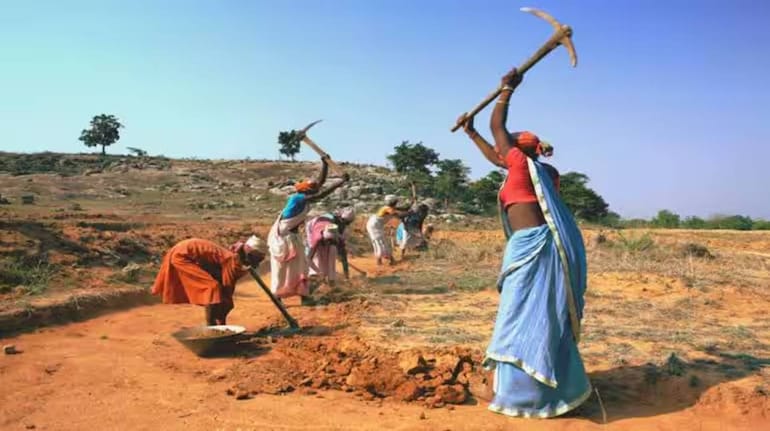
Public debate around recent changes to the rural employment programme has focused disproportionately on symbolism — particularly the renaming of the Mahatma Gandhi National Rural Employment Guarantee Act. That discussion misses the point entirely.
What is underway is not cosmetic. MNREGA is being structurally re-engineered, clause by clause, in a manner that preserves its outward existence while fundamentally altering how it works, who it serves, and what role it plays in India’s political economy.
To understand why this matters, it is essential to first clarify what MNREGA actually achieved.
It was never merely a poverty-alleviation scheme. Its deeper economic function rested on three pillars.
# First, it acted as a counter-cyclical employment buffer during periods of rural distress.
# Second, it established a reservation wage that strengthened labour’s bargaining power even outside the programme.
# Third, it decentralised state capacity by placing planning and accountability at the village level.
With the strength of these pillars it ensured that over the past decade, it created nearly 6.6 crore public works employing nearly 13 crore households. It was a structural buffer against the economic shocks of Demonetization and COVID.
The recent changes weaken each of these pillars.
Under the original Act, MNREGA applied automatically to every rural Gram Panchayat in the country. Any adult could demand unskilled work, and the state was legally obligated to provide it within 15 days. This universality is what made MNREGA a legal entitlement, not a discretionary welfare scheme.
The revised framework empowers the Central Government to unilaterally notify the locations where VB- G RAM G will apply.
This is not a procedural detail. It marks a philosophical shift. Once applicability depends on notification, the programme’s scope can expand or contract based on prevailing fiscal conditions, administrative priorities, and political timing. A right that depends on executive notification ceases to function as a right in any meaningful sense.
MNREGA’s most underestimated contribution was its effect on rural labour markets.
During lean agricultural seasons, it provided employment. During peak sowing and harvesting seasons, it provided bargaining power. The guaranteed MNREGA wage functioned as an outside option. If private employers offered wages below that level, workers could opt for MGNREGA instead. This dynamic pushed up market wages across rural India.
Provisions that allow MNREGA works to be suspended during agricultural peak seasons dismantle this mechanism entirely. When the outside option disappears precisely when labour demand is highest, bargaining power shifts decisively away from workers.
This is not a question of fiscal prudence. It is a structural intervention in labour markets, with predictable downward pressure on rural wages.
The cost-sharing formula has shifted from 90:10 between the Centre and states to 60:40.
In theory, greater state participation might signal cooperative federalism. In practice, this change collides with the post-GST fiscal reality. States today have limited revenue autonomy, with most major tax handles either centralised or politically saturated.
More importantly, even as states are required to fund a larger share, the Centre retains the authority to prescribe terms and conditions, governing how funds are spent. States are thus asked to commit more fiscal resources while surrendering policy discretion.
States are now incentivised to let the scheme wither
The predictable outcome is under-implementation. States will rationally avoid expanding a programme that strains their budgets without offering commensurate autonomy. MNREGA will shrink not through formal repeal, but through attrition.
A defining feature of MNREGA was decentralised planning. Gram Sabhas selected works, prioritising labour-intensive, locally relevant assets. This limited contractor capture and strengthened accountability.
The move toward centrally defined development plans shifts expenditure toward material-intensive projects such as road construction. Labour intensity falls, contractor influence rises, and village-level decision-making weakens.
This changes not only what gets built, but who benefits from public spending.
Public messaging has emphasised an increase in permissible workdays to 125. In practice, given the constraints introduced, most workers will struggle to access even a fraction of that number. The headline figure obscures the more consequential changes to eligibility, timing, funding, and governance.
Meanwhile, political discourse has been diverted toward debates over nomenclature and symbolism. That is unfortunate. The real transformation lies in the legal and administrative architecture.
What is unfolding is not the rollback of a single programme. It is a broader shift in the state’s approach to social protection — away from rights that citizens can claim, and toward schemes whose scope and generosity are administratively rationed.
MNREGA offers a clear case study of how this transition can occur without explicit repeal or parliamentary confrontation.
For investors, policymakers, and those assessing India’s long-term political economy, this evolution deserves careful attention. The impact will also surface in markets. MNREGA has historically stabilised rural cash flows and wage growth, supporting baseline consumption in Bharat-facing categories. Weakening its universality, timing, and wage-bargaining role reduces that buffer.
Lower rural wage growth typically translates into down-trading, deferred consumption, and higher income volatility. Markets should therefore not be surprised if rural demand softens and blue-chip FMCG companies with high rural exposure report prolonged single-digit volume growth, relying increasingly on urban demand to sustain earnings momentum. Programmes may continue to exist in name, budgets may still be allocated, and headline numbers may appear unchanged. Yet the underlying contract between citizen and state can be fundamentally altered.
A right that applies only where notified, only when permitted, and only under centrally prescribed conditions is no longer a right.
It is something else entirely.
(Vatsal Srivastava is a financial markets commentator with experience across venture capital, Big Tech and M&E.)
Views are personal, and do not represent the stance of this publication.
Discover the latest Business News, Sensex, and Nifty updates. Obtain Personal Finance insights, tax queries, and expert opinions on Moneycontrol or download the Moneycontrol App to stay updated!
Find the best of Al News in one place, specially curated for you every weekend.
Stay on top of the latest tech trends and biggest startup news.




