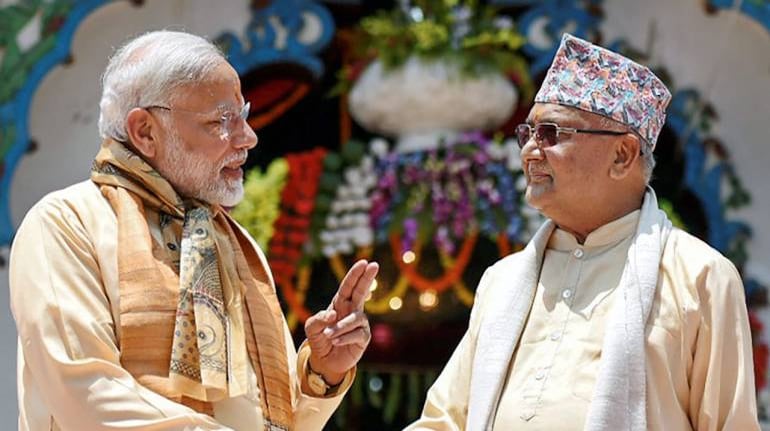
Nepal had been heading towards a perfect storm. The pandemic unleashed a health and economic crisis through a complete shutdown of Nepal's tourism industry and drying up of its foreign workers remittances. Its sugarcane farmers were protesting against non-payment of dues. There was political uncertainty owing to Prime Minister K. P. Sharma Oli’s repeated hospitalisations since his March surgery in United States. His personal bonhomie with Beijing sharpened his sabre-rattling against New Delhi and several leaders of his own party, where his faction is now a small minority. This all came to a head as Prime Minister Oli on Sunday chose to finally carry out his threat to dissolve the Pratinidhi Sabha (lower house of parliament) two years short of its term of five years.
The immediate trigger in Prime Minister Oli's ongoing tussle with the increasingly powerful Prachanda-Madhav Nepal-Jhalanath Khanal faction of his Nepal Communist Party (NCP) was his executive order setting up a three-member decision making committee that had to be withdrawn surreptitiously in face of his distractors planning a no-confidence motion to force him to resign. Oli chose to upstage them by advising President Bidhya Devi Bhandari who immediately dissolved Parliament and announced elections to be held during April 30th and 10th of May next year. This, Oli's opponents fear, will give him time as caretaker prime minister to wedge a split in the NCP and muzzle the elections process. That does not portend well for Nepal's fledgling democracy.
As for its immediate fallout, Kathmandu saw street protests, resignations of seven ministers of the Prachanda faction of NCP and experts raising questions on the constitutional validity of Oli's decision. For them, it is K P Sharma Oli and not the NCP that has not lost majority in parliament. Also, they question the constitutional validity of the President dissolving parliament without exploring alternative government formation with other leaders of the ruling NCP. On Monday, the NCP Standing Committee -- convened by Prachanda and Madhav Nepal -- denounced Oli's dissolution of Parliament as "unconstitutional, undemocratic and based on his personal whim", and initiated disciplinary action against him. It is expected to announce Madhav Nepal as the new chairman of the NCP. Nepal's Supreme Court has also admitted several petitions and will starting hearing them this week.
Oli, however, was quick to dismiss all this saying he has followed the law in letter and spirit. He dismissed the Prachanda faction initiating disciplinary action against him saying that as per Party Statute, Prachanda is only the Second Chair of the Standing Committee and he cannot hold any such meeting without First Chair (Prime Minister Oli) consenting to it. He dismissed this meeting as part of their 'conspiracies" against him.
In his address to the nation Oli said he "was forced to seek this fresh mandate through elections" as his own party leaders had joined the opposition to bring down his government and "not to allow it to function properly." He said he had busted their plan to bring a no-confidence motion against him and decided to go to people to apologise for their misdeeds and to seek their fresh verdict.
Prime Minister K P Oli Sharma's increasing isolation within the ruling party has been the story of this year. This had seen him resort to jingoism using anti-India rhetoric that had climaxed this summer with the Nepalese Parliament approving a new national map showing areas of Lipulekh, Limpiyadhura and Kalapani as Nepal's territory. In the face of India's rising border tensions with China, New Delhi had largely ignored it. While the Oli government explained it as its response to India ignoring requests for talks since November 2019 when it had issued fresh maps following re-organisation of the state of Jammu and Kashmir in August 2019, New Delhi saw this as sub-plot of India's China challenge where this ratcheting up by Kathmandu had coincided with China-India military face-offs.
This skepticism in New Delhi was reinforced by Chinese Ambassador Hou Yanqi being repeatedly seen brokering peace between Prachanda and Oli to keep this pro-Beijing government afloat. China's investments and indulgences with Nepal have also seen a constant increase. But this week's controversy over Prime Minister Oli's executive order proved much beyond her bridge building.
Meanwhile, India's lukewarm response also witnessed a change of gear. While the Ministry of External Affairs continued to call Oli's brinkmanship as "unilateral" and his new territorial claims as "artificial enlargement" lacking any "historical facts of evidence," this had begun to see some unpalatable exchanges from leaders of Uttar Pradesh and Bihar. Now, having reached a stalemate in its border tensions with China, the recent weeks saw India sending a spate of emissaries to engage the Nepalese political elite.
This included a visit by the Army chief, the chief of India's Research and Analysis Wing, and a two day visit by foreign secretary Shringla to personally deliver 2000 vials of anti-virus Remdesivir. That was followed by the visit of Vijay Chouthaiwale of the BJP's foreign affairs cell who was hosted earlier this month by NCP's general secretary and finance minister Bishnu Paudel, and held a meeting with Prime Minister Oil. More noticeable was his meetings with Sher Bahadur Deuba of Nepali Congress and several Madhesi leaders, and his not meeting Prachanda and other leaders of NCP.
This has to be read with D Raja of Communist Party of India -- that has been part of India's engagement with Nepal ever since the communists came to dominate its mainstream politics -- endorsing these visits and initiatives. Likewise, this continued turmoil inside the NCP and its anticipated split has also enthused the main opposition -- Nepali Congress led by Sher Bahadur Deuba that had logged nearly 35 per cent of popular votes during last elections but was overwhelmed by the merger of two main communist parties. Does India's recent robust engagement reflect its advance assessment and its conviction to keep a close tab on these multiple counter currents in the jigsaw puzzle of Nepal's fledgling democracy? The answer remains to be seen.
Discover the latest Business News, Sensex, and Nifty updates. Obtain Personal Finance insights, tax queries, and expert opinions on Moneycontrol or download the Moneycontrol App to stay updated!
Find the best of Al News in one place, specially curated for you every weekend.
Stay on top of the latest tech trends and biggest startup news.