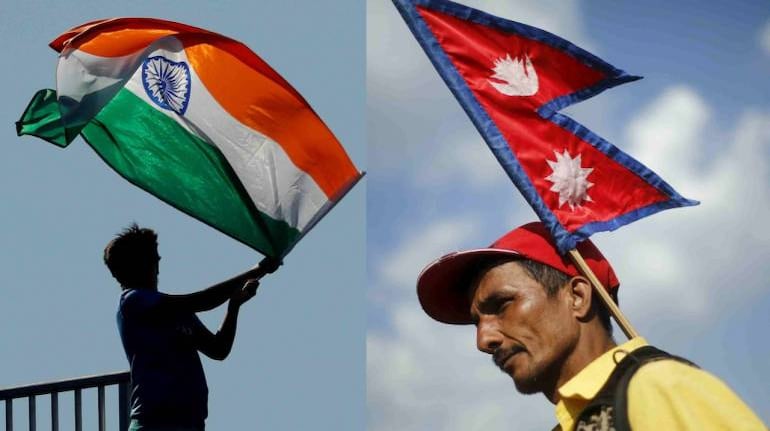
It’s a battle of the maps now.
The Nepalese government has released its new political map which shows Kalapani, Lipiyadhura and Lipulekh as its own territories. As these territories fall under the Pithoragarh district of Uttarakhand, New Delhi was quick to react arguing that “such artificial enlargement of territorial claims will not be accepted”.
However, beyond this back and forth, it is Nepalese Prime Minister KP Oli who has upped the ante by being undiplomatic at a time when diplomacy should have been the central means to resolve an escalating dispute between two neighbours amicably.
In his statement to the nation’s Parliament on these tensions, Oli went overboard in blaming India for the spread of Coronavirus cases in his country, arguing that the virus from India “looks more lethal” than Chinese and Italian. In a statement that was clearly meant to provoke India, Oli said “those who are coming from India through illegal channels are spreading the virus in the country and some local representatives and party leaders are responsible for bringing in people from India without proper testing.” If the aim is to resolve the issue, then clearly this was not the way to go.
The dispute over Kalapani and Lipulekh goes all the way back to the Treaty of Sugauli, which was signed in December 1815 by the East India Company and the Kingdom of Nepal after the end of the Anglo-Nepalese War (1814-1816), where Nepal lost one-third of its territory, The recent tensions have more contemporary cause. Tensions have been growing ever since India released its new political map following creation of two Union Territories of Jammu and Kashmir, and Ladakh from erstwhile state of Jammu and Kashmir, on November 2. Nepal had protested over the inclusion of Kalapani in India’s map with New Delhi refusing to concede any boundary alterations.
Earlier this month, Defense Minister Rajnath Singh inaugurated a Link Road from Dharchula to Lipulekh to help pilgrims going to Kailash-Mansarovar in the Tibet Autonomous Region. Nepal’s foreign ministry summoned the Indian envoy to protest against the construction of the road. Interestingly, this is a road that has been under construction for the last several years with the full knowledge of Nepal.
On May 15, Chief of the Army Staff General MM Naravane added another dimension when he suggested that Nepal's objections to the road were at “the behest of someone else”. He was hinting at the possible role of China in instigating these border tensions between India and Nepal at a time when multiple clashes have been taking place between Indian and Chinese troops along the LAC.
China’s growing role in Nepal is no secret and it has taken on an altogether new dimension under the Nepal Communist Party (NCP). The two-year-old NCP emerged when two dominant communist parties of Nepal, the Marxist-Leninist and the Maoist, merged at the behest of Chinese Communist Party. Earlier this month as factionalism grew in the ruling NCP, it was the Chinese ambassador in Nepal that managed the crisis and helped in defusing it.
Oli’s performance as Nepal’s Prime Minister has been underwhelming to put it mildly. As a consequence, his reflexive anti-India agenda serves him well in shoring up his nationalistic credentials. His performance as an administrator has come under intense scrutiny and criticism during the COVID-19 pandemic, and he’s losing public support. What better way to burnish his credentials than by upping the ante on the border question with India.
This is not to suggest that New Delhi has managed the episode well.
As a bigger power, it is very natural that its smaller neighbours will be very touchy about sovereignty and territorial issues and it is incumbent upon New Delhi to manage them with diplomatic finesse. It is true that Prime Minister Narendra Modi’s outreach to Nepal has been serious over the last few years and it has indeed made it possible for India to have a sense of normalcy in ties even with a leader like Oli who has been very vocal in his criticism of India, and very comfortable in the company of his fellow Chinese communists.
However, with a country such as Nepal and in fact with other smaller neighbours, India should be in a continuous process of dialogue to remove any apprehensions and doubts that might clog the system from time-to-time. In this case, it was not done with the effectiveness that was needed, and the results are there to see.
Now India should make the first move by initiating high-level contacts and Nepalese leadership should recognise that negative rhetoric will only jeopardise the possibility of an amicable resolution to a historical conflict. India-Nepal ties is far too important to be left to the vagaries of misperception and miscommunication.
Harsh V Pant is director, Studies at Observer Research Foundation, New Delhi and professor of international relations, King’s College London. Views are personal.
Discover the latest Business News, Sensex, and Nifty updates. Obtain Personal Finance insights, tax queries, and expert opinions on Moneycontrol or download the Moneycontrol App to stay updated!
Find the best of Al News in one place, specially curated for you every weekend.
Stay on top of the latest tech trends and biggest startup news.