






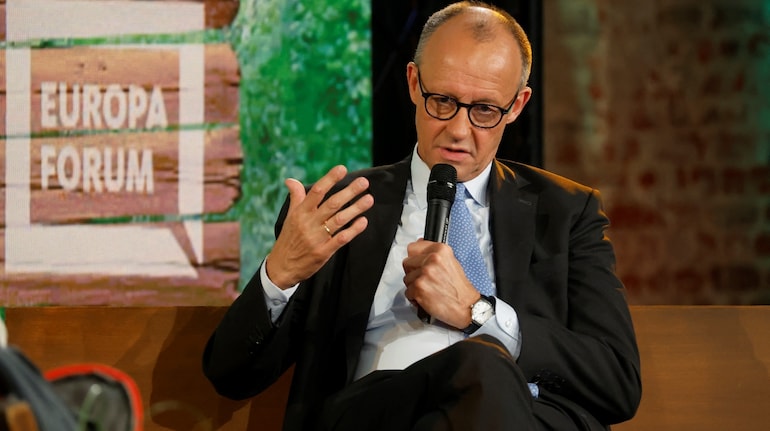
India and Germany’s defence collaboration is seeing a positive uptick following Chancellor Friedrich Merz’s visit to India this week. A fruitful meeting between PM Narendra Modi and Chancellor Merz resulted in 19 signed agreements and Memorandums of Understanding across sectors, including defence, critical technologies, renewable energy, education, and mobility.
Despite the progress over the years, defence cooperation has historically been the weakest pillar of the India–Germany strategic partnership, especially when compared to India’s defence ties with France, the United States, or Russia.
German reticence has kept defence ties subpar
The major cause has been Germany’s post-war strategic culture, defined by restraint and alliance-centric security thinking. This began to change after ex-Chancellor Olaf Scholz’s 2022 speech, which ushered in a bolder acceptance of increased military spending, referred to as the ‘Zeitenwende’.
Having traditionally preferred a low-profile security engagement, the recent visit by Chancellor Merz represents a shift in Germany’s outlook driven by its Indo-Pacific reorientation, and growing European unease over supply-chain and security dependencies.
Futures ties are not limited to arms sales
An important outcome of the meeting is a political push towards defence-industrial collaboration, rather than arms sales alone, indicating that defence is no longer treated as an exceptional or sensitive domain. This political normalisation is itself a structural gain. A Joint Declaration of Intent (DoI) on Defence Industrial Cooperation was signed. A DoI might seem an insignificant development, but it is the launchpad to building frameworks for industry matchmaking and project identification.
Submarine deal is the centrepiece of the changed relationship
The centrepiece of this new defence relationship is Project-75, a deal valued at approximately $8 billion. Negotiations are at an advanced stage for Germany’s ThyssenKrupp Marine Systems to partner with India’s Mazagon Dock Shipbuilders Ltd to build six diesel-electric submarines in India.
These submarines will feature Air Independent Propulsion, a critical technology that allows non-nuclear submarines to stay submerged for weeks rather than days.
Germany is one of the few nations willing to transfer this niche technology to India.
Germany has reduced banned items on export list to India
In September 2025, the Bundestag approved an updated export-clearance framework for India and the removal of about 110 out of 130 defence items from the export control list, minimising licensing hurdles for those categories. Exports opened for items like MP5 submachine guns from Heckler & Koch to India's National Security Guard, which had been restricted for over 15 years.
Building on the High Defence Committee meeting, the joint statement emphasised for co-development and co-production of military hardware along with institutionalised staff talks, service chiefs' visits, joint exercises, training, and naval port calls. Both the leaders also welcomed progress toward MoUs on peacekeeping training, reciprocal logistics support, and DRDO-BAAINBw knowledge exchange on new technologies.
There are clear advantages to deepening this partnership further. Firstly, cooperation on helicopter obstacle avoidance systems and Counter Unmanned Aerial Systems (C-UAS) technology will enable quicker upgrades to HAL platforms and drone defences, improving high-altitude and urban warfare readiness.
Second, components like engines and electronic warfare suites will flow faster, allowing India to diversify from Russian sources and to support 75% indigenous content goals through local co-production.
Challenges to deepening defence ties
Notwithstanding the progress made over the years, there are several constraints that limit the partnership's potential.
The first is export control rigidities. German domestic politics and coalition dynamics continue to restrict defence exports. For example, India’s new Zorawar Light Tank was originally meant to be powered by a German MTU engine. However, delays in German export clearances forced India to switch to American Cummins engines for the prototypes.
The second limitation is the absence of a flagship platform. Unlike the India-France relationship, there is no marquee defence project yet.
For example, India’s Rafale-Marine deal delivered not only carrier-capable jets but also associated training, weapons, and long-term support. Thus, platform-scale procurements become essential for deeper operational integration. Germany’s relationship now resembles that of France around the early 2000s, before defence cooperation matured into a high level of trust.
Finally, Germany’s engineering reputation is unquestioned but what Indian planners remain cautious about is approval predictability. If the country wishes to become a top-tier, it must convince India that contracts signed will be contracts honoured, regardless of domestic political churn. In defence partnerships, reliability often matters more than technological edge.
Nevertheless, Germany remains a critical supplier for the Arjun Main Battle Tank, which utilizes German MTU engines and Renk transmissions. Ensuring a steady supply of spares for these remains a key part of the relationship. The German government does not need to abandon its restrictive framework, but it does need to make it legible and dependable for long-term cooperation.
Defence ties in the context of Europe’s rearmament
The expanding relationship also fits neatly into Europe's broader rearmament under the EU's €800 billion "Readiness 2030" White Paper. The plan, spurred by the Ukraine war, supports Europe's defence autonomy via joint ventures, cross-certification, and supply of artillery, rockets, and missiles meeting NATO standards.
This diversifies EU sourcing and leverages India's manufacturing and modernisation ambitions.
India has already joined the European Eurodrone program as an observer nation. This opens the door for India to access advanced Medium-Altitude Long-Endurance (MALE) UAV technology, reducing dependency on Israeli or American drones. With increase in spending mandates, Europe aims to invest not only in independent capabilities, but seeking external partners for supply chain resilience amid U.S. unpredictability and domestic capacity gaps.
For example, Germany has identified India's scale for cost-effective production, through Diehl Defence's Vulcan joint venture with Reliance Defence to manufacture Vulcano precision guided munitions.
Furthermore, Indian and Belgian firms have entered an agreement to jointly manufacture the turret for the Zorawar tank. Additionally, the Indian Ministry of Defence signed a deal with France, and Spain to manufacture parts for the C-295, tactical transport aircraft, through the partnership between Airbus and Tata Advanced Systems (TASL).
Hence, India is seen as a non-allied but strategically autonomous partner, aligning well with Germany’s preference for flexible partnerships. It is emerging as a test case for Berlin’s ability to operationalise Zeitenwende beyond NATO and Europe. Success with India would signal genuine strategic adaptation.
Discover the latest Business News, Sensex, and Nifty updates. Obtain Personal Finance insights, tax queries, and expert opinions on Moneycontrol or download the Moneycontrol App to stay updated!
Find the best of Al News in one place, specially curated for you every weekend.
Stay on top of the latest tech trends and biggest startup news.




