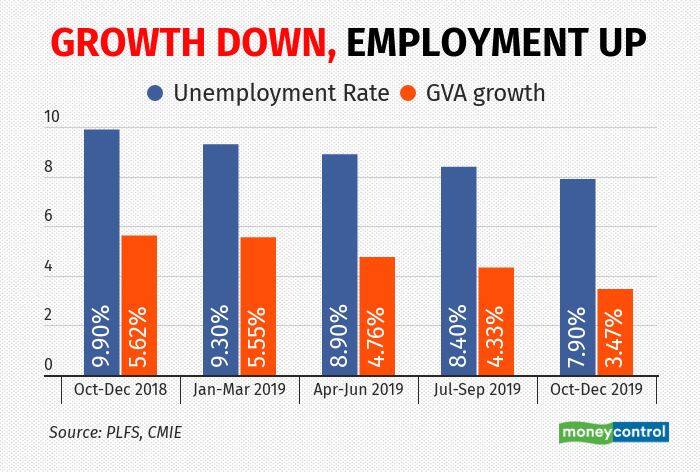
Does employment go up when the economy goes into a tailspin? Well, the data from the government’s Periodic Labour Force Survey (PLFS), published recently, show a steady decline in the
urban unemployment rate from 9.9 percent in October-December 2018 to 7.9 percent in October-December 2019. That’s a pretty steep decline. Was it due to robust economic growth?
Story continues below Advertisement
What the numbers say is that plummeting economic growth over the period has been accompanied by a sharp increase in urban jobs. While critics have often said the Indian economy suffered from jobless growth, the data suggest that the most recent trend, amazingly, is that of more jobs with less growth. The accompanying chart shows that, while GVA growth came down steadily during the period October-December 2018 to October-December 2019, the unemployment rate too fell steadily. The lower the growth, the lower the unemployment, seems to be the upbeat if rather peculiar message from the PLFS data.
Could the decline in the urban unemployment rate be because the urban economy was doing relatively well, while rural India’s growth plummeted? No, that isn’t what happened.
If we take out agriculture and allied activities from GVA, the rest of the economy also saw a steep decline in growth. In fact, even if we strip out ‘public administration, defence and other services’ from GVA, on the rather specious grounds that it’s a proxy for government spending and a large part of that is spending in rural areas, the pattern of slowing growth does not change.
The numbers indicate that LFPR in urban India went up from 36.3 percent in October-December 2018 to 37.2 percent in October-December 2019. That means despite the increase in the percentage of the population looking for work, the unemployment rate has gone down, which is very commendable, all the more so because this has happened during a period of plunging growth.
The LFPR for women, long a sore point, what with India’s rate being around that of ultra-conservative Saudi Arabia’s, also edged up, from 15.4 percent in October-December 2018 to 16.6 percent in October-December 2019. The urban unemployment rate has fallen during the period for both men and women.
Furthermore, youth unemployment rates too have come down. Unemployment among 15-29 year-olds fell from 23.7 percent in October-December 2018 to 19.2 percent in October-December 2019. The job market seems to have improved vastly over the period, even as the economy sputtered.
Of course, unemployment rates before the pandemic are a bit academic at the moment, as the toll on the job market, by all accounts, has been terrible.
Nevertheless, it is a wonderful source of comfort that, according to the government data, even very low rates of growth in India can lead to a lowering of the unemployment rate.
Do write in with your views on the PFLS data to Manas.Chakravarty@nw18.com