






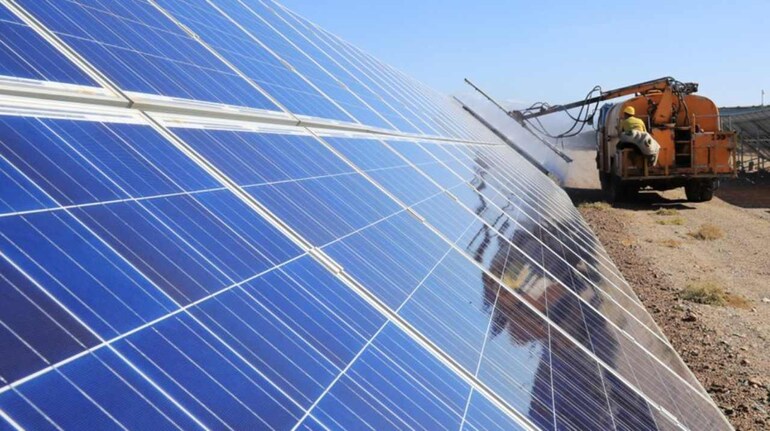
With targets of 500 GW of renewable capacity by 2030 and net zero emissions by 2070, execution as well as associated infrastructure development remain the key.
India’s energy landscape has rapidly evolved over the past year, with increasing focus on storage and transmission infrastructure. Renewable energy capacity touched nearly 258 GW by November 2025, marking a 23% year-on-year surge led by additions in solar power capacity, which grew to 136 GW.
Medium-term demand to be around 5%
Further, while FY2026 is expected to see a muted electricity demand growth of around 1.5-2.0%, largely owing to an early and extended monsoon, the expectations of continued GDP growth and normalisation of weather patterns are likely to result in electricity demand growing by 5.0-5.5% annually in the medium-term.
Things that matter for RE capacity addition
ICRA estimates the share of generation from renewable energy (RE) capacity, including large hydro, to cross 35% by FY2030 from 22.1% in FY2025. The estimated RE capacity (including large hydro) of over 400 GW by 2030 would require an annualised capacity addition of 40 GW during FY2026-FY2030, which is significant.
This hinges on the implementation of the ongoing project pipeline, where the projects are bid out and the PPAs are signed, the development of adequate transmission connectivity infrastructure as well as timely bidding for new RE projects, in addition to the signing of power purchase agreements (PPAs) by the Central nodal agencies.
After a sizeable RE capacity of 47.3 GW awarded in FY2024, which was followed by 40.6 GW in FY2025, the bidding activity has slowed sharply in the current year with only 5.8 GW awarded in FY2026 (first eight months). Further, the unsigned PPA capacity remains sizeable, at about 40-45 GW as on date, based on industry channel check.
Lagging transmission connectivity acts as a drag on growth
Expectations of sustained growth in electricity demand and a rapidly rising share of renewables in India’s generation mix emphasizes the need to prioritise strengthening grid resilience and storage capacities. The decline in new project bids and delays in signing the PPAs for large RE capacity by Central nodal agencies clearly reflects the concerns on available transmission connectivity for the RE sector.
In the current fiscal, there have been instances of grid curtailments, particularly in Rajasthan, for solar assets during peak solar hours in a few time blocks due to grid stability requirements, which raise cash flow concerns for the generating companies. Hence, a focus on the enhancement of both the storage capacity and grid strengthening within the state as well as at inter-state level in a timebound manner remains extremely critical, as the share of renewables increases in the generation mix.
Battery Energy Storage Systems (BESS) continue to be crucial from the point of largescale storage infrastructure for India’s renewable expansion. Continued policy support and anticipated budgetary allocation for the BESS and pumped hydro projects, including viability gap funding, can create an ecosystem for these projects.
Budget can boost backward integration of manufacturing ecosystem
The budget is also expected to reinforce self-reliance by extending manufacturing incentives for grid scale batteries and promoting backward integration for solar module manufacturing ecosystem. With steady reduction in the dependence on imported solar components, incentives for ingot and wafer manufacturing, can result in the surge in completely backward-integrated domestic capacities for solar modules, which can build a domestic supply chain and boost competitiveness in global markets.
Continued reforms in the distribution segment remain critical, with enhanced funding under the Revamped Distribution Sector Scheme (RDSS) and sustained emphasis on smart metering to improve billing efficiency, reduce aggregate technical and commercial losses, strengthen demand forecasting, and improve discom cash flows.
India’s FY2026 budget provided a push towards clean energy adoption, with major increases in allocations for both PM Surya Ghar and PM-Kusum. Funding for PM Surya Ghar, aimed at accelerating rooftop solar uptake, rose sharply to Rs. 20,000 crores, representing an 80% jump over FY2025 revised estimates. Meanwhile, PM-Kusum received Rs. 2,600 crores in FY2026, up from Rs. 1,500 crores in FY2025, strengthening efforts to deploy solar pumps and reduce diesel dependence in agriculture. These enhanced allocations, which are likely to continue, underscore India’s commitment to expanding renewable energy access across households and farms.
Overall, focus is now on executable, financially robust, and grid-ready solutions towards a sustainable and resilient energy future.
(Ankit Jain, Vice President & Co Group Head - Corporate Ratings, ICRA Ltd.)
Views are personal, and do not represent the stance of this publication.
Discover the latest Business News, Sensex, and Nifty updates. Obtain Personal Finance insights, tax queries, and expert opinions on Moneycontrol or download the Moneycontrol App to stay updated!
Find the best of Al News in one place, specially curated for you every weekend.
Stay on top of the latest tech trends and biggest startup news.




