






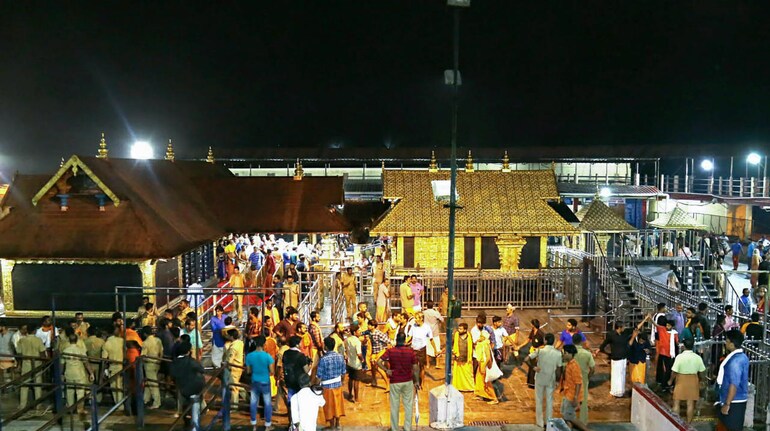
On February 16, a Bench comprising Chief Justice of India Surya Kant, Justice Joymalya Bagchi and Justice Vipul M. Pancholi directed that the review and writ petitions in the Sabarimala matter be listed before a nine-judge Constitution Bench.
The Bench, headed by the Chief Justice, observed that the question of the maintainability of the review petitions had already been examined and settled by a Bench headed by then Chief Justice of India Sharad A. Bobde. Consequently, the present proceedings are not intended to revisit the issue of maintainability, but to consider the larger constitutional questions that have been framed earlier.
In the 2018 judgment, the apex court held that the age-based restriction on the entry of women in Kerala’s Sabarimala temple cannot be justified as an essential part of the religion. The constitutional bench, which had five judges, with one judge dissenting, held that any exception placed on women because of biological differences violates the Constitution. It also struck down the 1965 Kerala law barring women aged 10 to 50 from entering the Sabarimala Temple, declaring it unconstitutional.
Justice Indu Malhotra issued a notable dissent; as the sole woman on the bench, many had assumed she would support the petitioners seeking relief for women. While her dissent had many facets, on the issue of equality in general and gender equality in particular, she held that the right to equality under Article 14 does not override the fundamental right to religion under Article 25 and questioned the petitioners’ standing, as they were not devotees of the Sabarimala temple.
The nine-judge Bench will now deliberate upon a cluster of foundational constitutional questions: the precise scope and ambit of the right to freedom of religion under Article 25; the interrelationship between the individual rights guaranteed under Article 25 and the collective rights of religious denominations under Article 26; whether denominational rights under Article 26 are subject only to public order, morality and health, or also to other Fundamental Rights under Part III; the meaning and extent of the term “morality” in Articles 25 and 26, and whether it encompasses the concept of constitutional morality; the permissible scope of judicial review over religious practices claimed to be protected under Article 25; the interpretation of the phrase “sections of Hindus” in Article 25(2)(b); and finally, whether a person who does not belong to a particular religious denomination or group can challenge its practices through a public interest litigation.
The questions arising in the Sabarimala matter are not episodic disputes confined to a single temple or practice; they are part of a much larger and continuing conversation about the nature of Indian secularism and the judiciary’s role within it. It needs to be located within the broader constitutional framework.
On 11 May 1951, a year after the Constitution came into force, President Dr Rajendra Prasad attended the inauguration of the restored Somnath Temple in Gujarat, despite Prime Minister Jawaharlal Nehru’s clear disapproval. The occasion was not merely religious; it was deeply constitutional. It unfolded at a time when India was still grappling with foundational questions debated in the Constituent Assembly, like what would Indian secularism mean, and how would the State relate to religion in a civilisation where faith permeated public life?
Professor Marc Galanter captures this constitutional dilemma with precision in his essay Hinduism, Secularism, and the Indian Judiciary:
“There is disagreement about what this secular state implies—whether it implies a severe aloofness from religion, a benign impartiality toward religion, a corrective oversight of it, or a fond and equal indulgence of all religions. There appears, however, to be a general agreement that public life is not to be guided by religious doctrines or institutions.”
As the making of the Constitution drew to a close, it had become evident that the majority of the Constituent Assembly did not envision a Western-style doctrine of strict separation. India’s model was rooted in the civilisational ethos of sarva dharma sambhav—equal respect for all faiths. The State was expected to maintain a principled and positive distance from religion, not an antagonistic exclusion of it.
Yet this “positive separation” was never meant to imply indifference. Religious freedom was placed prominently within the chapter on Fundamental Rights. Articles 25 to 28 conferred extensive protections on freedom of conscience, the right to profess, practice and propagate religion, and the autonomy of religious denominations. Once these freedoms were constitutionally guaranteed, any alleged breach necessarily invited judicial scrutiny. The courts were not passive observers; they were constitutional arbiters tasked with ensuring that the promise of religious liberty was not hollow.
More complex still were situations where religious freedom came into tension with other Fundamental Rights—particularly equality under Article 14 and freedoms under Article 19. In such conflicts, the judiciary had to determine which constitutional value would prevail in a given context. These adjudications produced a series of landmark decisions in which the Supreme Court developed innovative doctrines to balance competing claims. Among the most significant was the “essential religious practices” doctrine, through which the Court sought to distinguish between core tenets of a religion and practices that could be subject to regulation.
In India, however, religion does not operate in a social vacuum. In a society where a vast majority of citizens are intimately connected to one faithr another, religion inevitably intersects with politics. State intervention in religious matters, whether regulatory, reformative, or accommodative, cannot be viewed in isolation from political currents. Judicial pronouncements in such cases shape not only constitutional interpretation but also public discourse and political alignments.
The political undertones of the Sabarimala review are as striking as its constitutional implications. As reported by Live Law, Solicitor General Tushar Mehta informed the Bench that the Union Government supports a review of the judgment. However, Senior Advocate Jaideep Gupta submitted that the State of Kerala had, thus far, supported the original petitioners and opposed the review.
The divergence is telling. Beyond the profound constitutional questions it raises, the Sabarimala matter now unfolds against the backdrop of Kerala’s upcoming assembly elections. The Supreme Court’s decision to hear the review petitions places the Pinarayi Vijayan-led Left government in a in a clear-cut dilemma: whether to steadfastly adhere to its earlier pro-entry position or recalibrate its stance in view of electoral considerations In India, where faith and politics are deeply intertwined, the Court’s eventual ruling will resonate not only in constitutional law reports but also in the arena of democratic contestation.
From the Somnath episode to the Ayodhya ruling, and now the Sabarimala case, these have never been just isolated cases of disagreements between institutions and constitutional authorities. Each of these cases has reflected a deeper and continuing debate about the character of Indian secularism and the State’s posture in matters of faith, whether it is marked by principled distance, calibrated engagement, reformist intervention, or civilisational reverence. In that unfolding journey, the judiciary has emerged as a pivotal constitutional arbiter, entrusted with the delicate task of balancing belief with equality, religious autonomy with individual dignity, and constitutional morality with democratic politics.
(Views are personal and do not represent the stand of this publication.)
Discover the latest Business News, Sensex, and Nifty updates. Obtain Personal Finance insights, tax queries, and expert opinions on Moneycontrol or download the Moneycontrol App to stay updated!
Find the best of Al News in one place, specially curated for you every weekend.
Stay on top of the latest tech trends and biggest startup news.




