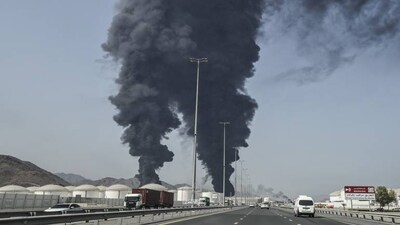
Are markets being too complacent about the Iran war?
Sometimes crises do not blow over as investors might hope

February growth bounce signals strong end to FY26 for life insurers
Life insurers are on a decent growth path this year but it is margins that would set them apart in the market
Power companies brace for demand surge as El Nino indicates extended summer
The optimism is reflecting in shares of electricity producers and of Coal India
Prolonged Iran conflict to keep commodity markets on edge ahead of FOMC, China data
Looking ahead, markets will focus on the upcoming policy decision from the Federal Reserve, where rates are widely expected to remain unchanged but updated economic projections will be closely watched.
The oil bounty India cannot count on anymore
Volatility in energy is at its peak due to geopolitical tensions in Middle East which continue to disrupt supply chains, and the discounts that once drove India’s crude arbitrage has vanished.
Geopolitical tensions rise, but why aren’t gold prices?
A combination of stronger dollar and higher inflationary environment in turn leading to probable rise in interest rates by the US Federal Reserve are hindrances for gold prices moving higher, despite the geo-political risk arising out of the war.
OPINION | War and uncertainty will undermine global economic growth drivers and lower oil price
One major limitation of an inflation target is that it precludes preemptive easing in response to a sudden weakening of the economy, a danger at present. Even as shipments of crude remain low due to Iran’s blockade and steep insurance rates, a sharp drop in global demand, as took place due to Covid, may put an offsetting downward pressure on crude oil prices
The Reading List: March 13, 2026
A selection of articles and social media gems from the world of economy, business and finance, curated by our research and opinion teams
OPINION | Why India Inc is losing women leaders after a decade at work
Women enter India’s workforce in large numbers but many leave at mid-career stages which weakens leadership pipelines and reduces representation in senior corporate positions
OPINION | Why India’s universities must build strong research endowments
Indian universities need stronger endowments to support research attract talent and build financial stability for global competitiveness
Iran, private credit and the echoes of 2008
The investor exodus is unnerving, but the wider financial system is better prepared for shocks
OPINION | Gas shortage after Hormuz squeeze shows energy sourcing autonomy was always conditional
With crude oil, multiple supply sources are available even if Washington’s whims impose constraints. The buffer provided by diverse sourcing of oil is largely absent in gas, leaving sourcing vulnerable to factors beyond India’s control
Startup Street | Women startup founders and the glass ceiling in funding
Women start-up founders outperform their male counterparts in various aspects
OPINION | RSS marks centenary with grassroots Hindu Sammelan outreach
RSSFACTS: To mark its centenary, the RSS is organising thousands of small Hindu Sammelans across India to expand social outreach and engage people outside its traditional network
LPG Shortage: It’s time to change how India cooks its meals
India needs to adopt a holistic policy to promote alternatives to LPG-based cooking as a long term, strategic imperative
Markets to rebound soon? What fundamental, technical signals say
Markets often recover far more quickly than they fall, especially when sentiment is already extremely negative
Chart of the Day: Benign February retail inflation isn’t cause for relief
With LPG price increases, the effect of West Asia war would be felt in March inflation, posing a risk to markets and monetary policy
Press Note 3 tweak — Pressing the pedal on ties with China?
India’s move signals a pragmatic shift toward selective economic engagement with China while retaining safeguards for national security
OPINION | AI-led transformation is inevitable, but its social costs are not
We may be on cusp of a phase when AI-led automation squeezes openings for young members of the workforce. Learning from earlier technological disruptions, it’s the right moment to craft an AI Transition Scheme to mitigate social costs
Chart of the Day | Volumes to drive corporate revenue growth in FY27
Nearly two-thirds of sectors are expected to see healthy volume growth drive sales growth in FY27, which is good news for earnings. But, these projections could go awry if one risk plays out
OPINION | South India’s Tier-2 cities are quietly redefining healthcare
South India’s Tier-2 cities like Coimbatore, Madurai, Mangaluru and Hubballi are emerging healthcare hubs, leveraging private investment and infrastructure to reduce metro dependency
OPINION | Balancing Recovery and Revival: The next phase of IBC
Amendments to IBC are expected soon. The real test of the proposed changes will be whether they simplify the process and reduce delays rather than add procedural layers
Oil fears hit Asian stocks harder than profits
Reaction reflects possibility of sustained supply disruption and prolonged surge in crude prices
What’s next for gold as global instability grows?
Gold is doing what it did for millennia, provide stability
OPINION | Hormuz shutdown shows ethanol blend mandate for petrol added to energy security
The 20% blend provides a cushion of more than two months of petrol consumption and insulates nearly 3.5% of crude oil consumptions from geopolitical volatility