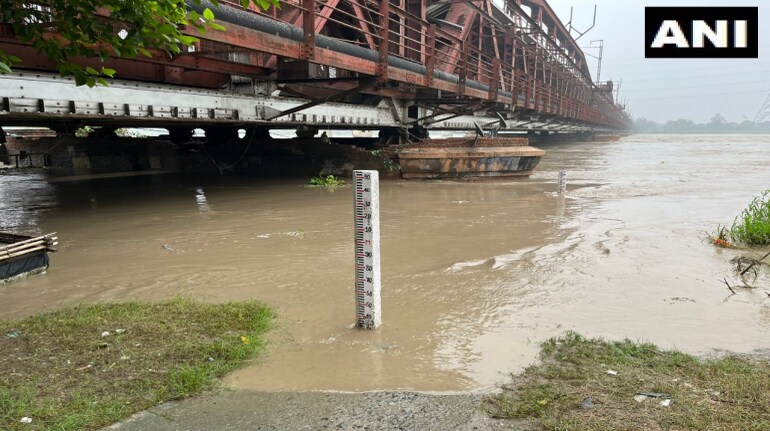
The Yamuna in Delhi swelled to a staggering 208.08 metres on Wednesday, smashing the previous all-time record of 207.49 metres set 45 years ago by a significant margin, and causing immense hardships to people living in close proximity to the river.
The water level at the Old Railway Bridge crossed the 207-metre mark at 4 am, the first time since 2013, and rose to 208.08 metres by 11 pm. It is expected to rise further.
The Central Water Commission (CWC) termed it an "extreme situation".
With the situation deteriorating every passing hour, Delhi Chief Minister Arvind Kejriwal urged the Centre to intervene and the Delhi Police imposed Section 144 of the CrPC in flood-prone areas to prevent unlawful assembly of four or more people and public movement in groups.
All ministers conducted field inspections while leaders of the BJP and the AAP participated in flood-relief work.
Lt Governor VK Saxena has also called a meeting of the Delhi Disaster Management Authority on Thursday.
In a letter to Union Home Minister Amit Shah, Kejriwal requested that the water from the Hathnikund barrage in Haryana be released slowly and pointed out that Delhi is set to host the G20 Summit meeting in a few weeks.
"The news of flooding in the capital of the country will not send a good message to the world. Together we will have to save the people of Delhi from this situation," he said.
There are two major barrages on the Yamuna -- Dakpathar in Dehradun and Hathnikund in Yamunanagar, upstream of Delhi. There are no dams on the river and, therefore, most of the monsoon flow remains unutilised, resulting in floods during the season.
Delhi recorded a rapid increase in the Yamuna's water level over the past three days.
It shot up from 203.14 metres at 11 am on Sunday to 205.4 at 5 pm on Monday, breaching the danger mark of 205.33 metres 18 hours earlier than expected.
The river exceeded the evacuation mark of 206 metres on Monday night, prompting the relocation of people residing in flood-prone areas to safer locations and the closure of the Old Railway Bridge for road and rail traffic. The water level breached the previous all-time record of 207.49 metres by 1 pm on Wednesday and the 208-metre mark by 10 pm.
Delhi Water Minister Saurabh Bharadwaj told reporters that the city government is prepared to deal with the situation.
"We are monitoring the situation and all possible steps are being taken," he said.
Embankments are being constructed in the low-lying areas to prevent the entry of floodwater into other parts of the national capital in case the Yamuna's water level rises further.
Major floods in Delhi occurred in 1924, 1977, 1978, 1988, 1995, 1998, 2010 and 2013. Analysis of flood data from 1963 to 2010 indicate an increasing trend for floods occurring in September, and a decreasing trend in July, according to research.
Experts attributed the situation to the encroachment of floodplains, extreme rainfall in a short duration and the accumulation of silt that elevated the riverbed.
A senior official at the CWC said, "We noticed that the water released from the Hathnikund barrage took less time to reach Delhi compared to previous years. The main reason could be encroachment and siltation. Earlier, the water would have had more space to flow. Now, it passes through a constricted cross-section." The water from the barrage at Yamunanagar in Haryana, around 180 kilometres from the national capital, takes around two to three days to reach Delhi.
Manu Bhatnagar, principal director of the Natural Heritage Division at the Indian National Trust for Art and Cultural Heritage, identified extreme rainfall in a short duration as the primary reason for the Yamuna raging in Delhi.
"The same amount of water falling over a longer period of time would not lead to such a situation as it allows time for the water to pass through. Even a lesser amount of precipitation can result in a higher level downstream if it falls in a shorter period of time," he explained.
Country representative of the International Union for Conservation of Nature, Yashveer Bhatnagar, attributed the record water level in the Yamuna to intense rainfall in the entire upper catchment area.
He said, "Encroachment of the floodplains may have an incremental effect." Bhim Singh Rawat, associate coordinator of the South Asia Network on Dams, Rivers, People (SANDRP), said a major reason for the unprecedented rise in the Yamuna's water level is the riverbed's elevation due to significant silt accumulation.
"More than 20 bridges within the 22-kilometre river stretch from Wazirabad to Okhla obstruct the flow, leading to the deposition of silt in the riverbed and the formation of numerous mid-stream sandbars," he told PTI.
The locations of these sandbars include beneath the Signature Bridge, between the ITO barrage and Yamunabank, between ISBT Kashmiri Gate and the Old Railway Bridge and between the Old Railway Bridge and the Geeta Colony Bridge.
In 1978, the river reached a height of 207.49 metres in September after becoming saturated in the monsoon season and it coincided with a flow rate exceeding 7 lakh cusecs from the Tajewala barrage, said Rawat of SANDRP.
The maximum flow rate this time was 3.59 lakh cusecs on Tuesday.
An official explained that the sharp rise in the water level was due to continuous rainfall in the upper catchment areas and saturated soil from heavy precipitation in Delhi and nearby regions over the weekend.
According to The Energy Resources Institute, the uneven distribution of rainfall, combined with uncontrolled urbanisation and the encroachment upon natural drainage channels and urban lakes is contributing to the alarming rise in flood occurrences within the city.
The unchecked filling of urban water bodies has become a prevalent issue. The proliferation of illegal colonies throughout the city, disregarding proper planning measures, has led to the narrowing of natural drainage systems. This poses a grave threat to the city's well-being and serves as an open invitation to urban flooding, it said.
Over 16,500 people living in low-lying areas have been shifted to safer places at higher altitudes, the city government said.
It said 45 boats have been deployed for awareness, evacuation and rescue work and NGOs have been roped in to provide relief to the evacuated people.
"The Old Railway Bridge has been closed for traffic. All gates of the Okhla barrage have been opened to release excess water and prevent prolonged high water levels," the the Irrigation and Flood Control Department said.
All district magistrates concerned and their sector committees are on alert and are working in coordination with the Irrigation and Flood Control Department, Delhi Police, Delhi Jal Board, Delhi Urban Shelter Improvement Board and other stakeholders to deal with the flood situation, it said.
According to the CWC, the flow rate at the Hathnikund barrage increased to 3,59,760 (3.59 lakh) cusecs at 11 am on Tuesday, the highest in the last three days. It oscillated between 1 lakh cusec and 3 lakh cusec on Wednesday.
Normally, the flow rate at the barrage is 352 cusecs but heavy rainfall in the catchment areas increases the discharge. One cusec is equivalent to 28.32 litres per second.
The India Meteorological Department has predicted heavy rain in Uttarakhand and Uttar Pradesh over the next two days, raising concern about a further rise in the water level in the rivers.
Jammu and Kashmir, Himachal Pradesh, Punjab and Haryana recorded "heavy to extremely heavy" rainfall over three days from Saturday. This resulted in overflowing rivers, creeks and drains that have massively damaged infrastructure and disrupted essential services.
Delhi witnessed its highest rainfall (153 mm) in a single day in July since 1982 in the 24-hour period ending at 8.30 am on Sunday. The city received an additional 107 mm rainfall in the subsequent 24 hours, exacerbating the situation. The heavy rain transformed roads into gushing streams, parks into watery labyrinths and marketplaces into submerged realms.
The Yamuna river system's catchment covers parts of Uttar Pradesh, Uttarakhand, Himachal Pradesh, Haryana, Rajasthan, Madhya Pradesh and Delhi.
The low-lying areas near the river in Delhi, inhabited by around 41,000 people, are considered prone to flooding. Encroachments on the river's floodplain have occurred over the years, despite the land belonging to the Delhi Development Authority, the Revenue Department and private individuals.
The city's northeast, east, central, and southeast districts are most affected by floods in the city. A study on "Urban Flooding and its Management" by the Irrigation and Flood Control Department identifies east Delhi under the floodplain region and highly vulnerable to floods.
The Yamuna breached the danger mark twice in September last year, with the water level reaching 206.38 metres.
In 2019, the river witnessed a peak flow rate of 8.28 lakh cusecs on August 18-19 and the water level rose to 206.6 metres. In 2013, it reached a level of 207.32 metres.
Discover the latest Business News, Sensex, and Nifty updates. Obtain Personal Finance insights, tax queries, and expert opinions on Moneycontrol or download the Moneycontrol App to stay updated!
Find the best of Al News in one place, specially curated for you every weekend.
Stay on top of the latest tech trends and biggest startup news.