






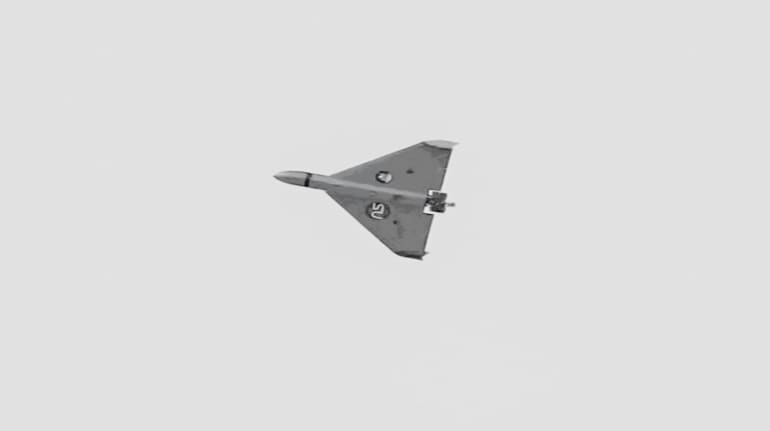

Amid Iran’s low-cost Shahed-136 suicide drones and America’s LUCAS UAVs continuing to deliver outsized battlefield effects at a fraction of the cost of traditional weapons, India’s own Sheshnaag-150 is steadily progressing through development and testing, according to NDTV.
The long-range swarming attack drone was developed from the ground up by Bengaluru-based defence startup Newspace Research Technologies (NRT). Sheshnaag-150 made its maiden flight a year ago.
However, in the aftermath of Operation Sindoor, the NRT was called upon by the Indian military to deploy some of its other drone systems at the warfront. According to the NDTV report, there was the urgency for a mature and indigenous long-range swarming strike capability.
What began as a promising in-house development programme is now being assessed through a far more immediate operational lens.
Key aspects of Sheshnaag-150
The Sheshnaag-150 is a coordinated swarm-attack platform, enabling multiple drones to saturate enemy air defences while executing precision strikes.
With an operational range exceeding 1,000 km and endurance of more than five hours, it can loiter over target zones, offering persistent surveillance and flexible strike options.
The system is designed to autonomously identify, track and engage targets with minimal human oversight. According to NDTV, it can carry warheads in the 25–40 kg class. This is enough to inflict significant damage on infrastructure, vehicles or personnel.
The true core of the Sheshnaag system lies in its proprietary control architecture. The underlying “mother code” governs not only the Sheshnaag-150 but its related platforms. The NDTV report stated that building small, unmanned aircraft is no longer the primary technological hurdle. The real challenge is developing the algorithmic engine that transforms them into intelligent, networked and resilient weapons.
The LUCAS drone is viewed as a technological evolution of the Shahed-136, notably for its reported integration with Starlink — the satellite network operated by Elon Musk — which provides resilient, jam-resistant connectivity.
In contrast, India’s Sheshnaag-150 is expected to eventually incorporate a visual navigation system, enabling operations in environments where satellite-based navigation is disrupted or denied — a growing concern in high-intensity conflicts.
During Operation Sindoor, Pakistan deployed large numbers of low-cost drones in what appeared to be a saturation strategy. Beyond strike roles, these systems were intended to stretch air defence resources, force defensive fire, and potentially expose ground-based positions.
India, by comparison, employed a smaller number of specialised attack drones and loitering munitions aimed at high-value targets. This approach focused less on volume and more on precision and effects.
Discover the latest Business News, Sensex, and Nifty updates. Obtain Personal Finance insights, tax queries, and expert opinions on Moneycontrol or download the Moneycontrol App to stay updated!
Find the best of Al News in one place, specially curated for you every weekend.
Stay on top of the latest tech trends and biggest startup news.





