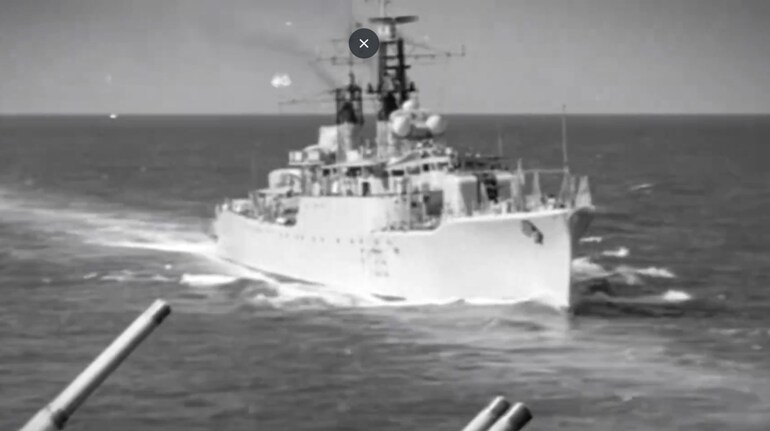
By the late 1960s, the Indian Navy understood its vulnerabilities with unusual clarity. Pakistan’s navy, though smaller in numbers, operated modern surface combatants and submarines, and Karachi remained both its principal port and its strategic heart. India lacked a large blue-water fleet capable of sustained offensive operations, but it had acquired a new and disruptive capability. Soviet-built Osa-I class missile boats, armed with P-15 Termit anti-ship missiles, offered the possibility of striking hard despite limited resources.
At the helm during this period was Vice Admiral SM Nanda, who assumed office as Chief of the Naval Staff in March 1970. A veteran of the Second World War, Nanda believed that technological surprise and bold intent could compensate for numerical disadvantage. His conviction that the Navy should take the offensive, even under logistical constraints, would shape India’s maritime conduct during the 1971 war.
Vice Admiral SM Nanda’s strategic visionNanda’s thinking was both simple and unconventional for its time. He rejected a defensive posture that waited for Pakistan to dictate the pace of operations. Instead, he argued for an early, decisive strike aimed at the enemy’s economic and psychological centre of gravity. Karachi, which handled the bulk of Pakistan’s maritime trade and fuel supplies, stood out as the obvious target.
Distance, however, posed a serious challenge. The missile boats had limited endurance and were not designed for long open-sea transits. Nanda approved an innovative solution that paired the Osas with larger Petya-class frigates, which would escort them, assist with navigation and provide logistical support. The plan required meticulous preparation and commanders willing to operate deep inside hostile waters with little margin for error.
The men who would execute the planOperation Trident was entrusted to a group of comparatively young officers commanding the missile boats and their escorts. The strike group was led by Commodore Babru Bhan Yadav, who commanded the Western Fleet’s missile task force. The missile boats themselves were commanded by officers who combined technical mastery with operational calm. INS Nipat was commanded by KK Nayyar, INS Nirghat by BB Yadav, INS Veer by IM Ramdas, INS Vinash by AK Chatterji and INS Vibhuti by AN Sharma.
They were supported by Petya-class frigates such as INS Kiltan, INS Katchall and INS Kadmatt, whose captains played a crucial but often understated role in bringing the missile boats to their launch positions and ensuring their safe return. Although these officers had trained extensively in missile warfare, none had fired their weapons in combat. Success would depend on discipline, restraint and flawless execution under strict radio silence.
Night of November 4–5, 1971On the night of November 4, 1971, the task group sailed from Okha and headed towards Karachi. Maintaining tight emission control, the ships closed in under cover of darkness. Pakistani naval defences did not anticipate a missile strike from the sea, particularly at such range.
Shortly before midnight, enemy contacts began to appear on radar. What followed was one of the most decisive naval engagements in India’s history. INS Nirghat, commanded by BB Yadav, fired first. Its missiles struck the destroyer PNS Khaibar, which exploded and sank with heavy loss of life. A subsequent missile destroyed PNS Muhafiz, a minesweeper.
INS Nipat, under KK Nayyar, fired into Karachi harbour. One missile hit the ammunition-laden merchant vessel MV Venus Challenger, while another struck fuel storage tanks ashore. Fires raged for days, crippling Karachi’s fuel reserves. INS Veer, commanded by IM Ramdas, engaged additional surface targets, adding to the confusion inside the harbour.
Within minutes, Pakistan had lost key naval assets and vital supplies. The Indian task group withdrew at high speed, returning safely without a single casualty.
Leadership under pressureThe outcome of Operation Trident reflected careful leadership at every level. Vice Admiral Nanda had personally backed the plan despite doubts within parts of the establishment about risking expensive missile boats so early in the conflict. He understood that surprise was a wasting asset.
At sea, Commodore Babru Bhan Yadav maintained firm tactical control while giving individual commanders the freedom to act as situations developed. Missile-boat commanders resisted the temptation to fire prematurely and maintained formation discipline even as enemy contacts appeared unexpectedly. This balance between clear intent and operational autonomy would later become a defining feature of Indian naval doctrine.
Strategic and psychological impactThe immediate damage to Pakistan’s navy was severe, but the wider impact was even more consequential. Karachi ceased to function as an effective naval base. Fuel shortages confined ships to harbour, merchant traffic stalled, and the sense of maritime security evaporated.
India reinforced the message with Operation Python on December 8, delivering another missile strike on Karachi. By then, Pakistan’s navy had been forced into a defensive posture for the remainder of the war. For India, Operation Trident validated missile warfare and confirmed the Navy’s role as a decisive arm of national power.
Recognition and legacyVice Admiral SM Nanda was awarded the Padma Bhushan for his leadership, while several officers received gallantry awards including the Vir Chakra and the Nau Sena Medal. December 4 is commemorated as Indian Navy Day in recognition of the operation.
Beyond ceremonial remembrance, Operation Trident reshaped Indian naval thinking. It demonstrated that audacity, when matched with preparation and technology, could decisively alter the course of a conflict. Many of the officers involved later rose to senior command, carrying forward the lessons of that night.
Why Operation Trident still mattersOperation Trident endures as more than a historical success. It remains a case study in maritime strategy, showing the value of striking critical infrastructure, exploiting technological advantages and trusting young commanders with responsibility.
Above all, it reflects Vice Admiral SM Nanda’s enduring contribution to India’s military thought: the belief that even a resource-constrained navy can achieve decisive results through clarity of purpose, careful planning and courage in execution.
Discover the latest Business News, Sensex, and Nifty updates. Obtain Personal Finance insights, tax queries, and expert opinions on Moneycontrol or download the Moneycontrol App to stay updated!
Find the best of Al News in one place, specially curated for you every weekend.
Stay on top of the latest tech trends and biggest startup news.