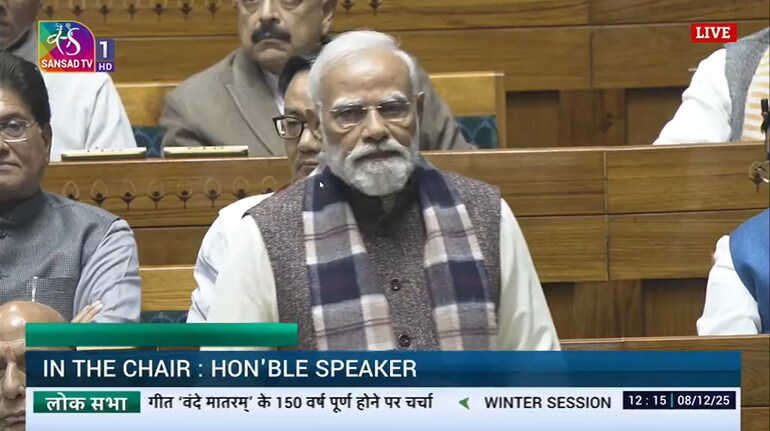
During a discussion on Vande Mataram in Parliament today, Prime Minister Narendra Modi referred to Bankim Chatterjee as “Bankim Dada.” TMC MP Saugata Roy immediately corrected him, saying it should be “Bankim babu.” Modi paused, acknowledged the correction and instantly rephrased it as “Bankim babu.”
Prime Minister then turned to Roy and said, “Thank you, Dada, thank you. Aapko toh Dada keh sakta hoon na?”
वंदे भारत पर चर्चा के दौरान पीएम मोदी ने बंकिम चटर्जी को बंकिम दादा कहा तो TMC सांसद सौगत रॉय ने उन्हें टोक दिया।पीएम मोदी ने तुरंत माफी मांग ली। #ParliamentWinterSession2025pic.twitter.com/mvdBWJaUdM — Vikas Kumar (@vikaskumar86) December 8, 2025
Prime Minister Narendra Modi on Monday used the 150-year commemoration of Vande Mataram in Parliament to highlight the historic power of a song that once stirred an entire nation. Calling it the “rallying cry” that inspired generations of freedom fighters, he traced its roots to Bankim Chandra Chattopadhyay, the 19th-century Bengali thinker who, he said, challenged British rule with the force of his words. Modi noted that Bankim wrote Vande Mataram in 1875, shaped by the memory of the 1857 revolt and rising colonial repression.
For Modi, Vande Mataram was not just a patriotic verse but “a war cry against the British,” a reminder of India’s civilisational bond with its motherland.
As Parliament looked back at the song’s legacy, focus returned to the man behind it — a civil servant-turned-writer whose work sparked a cultural awakening long before the freedom movement took organised shape.
Who is Bankim Chandra Chattopadhyay?
Born on June 27, 1838, in North 24 Parganas, Bankim Chandra grew up in a family steeped in learning. His father was a deputy collector in Midnapur, a role Bankim himself would later assume after an impressive academic journey. In 1858, he became one of the first two graduates of the newly formed Calcutta University, completing degrees in arts and law before joining the colonial administration.
His personal life reflected the social customs of the time. Married at 11, he later remarried Rajlakshmi Devi after his first wife’s death, and they had three daughters together.
As a deputy collector posted in Jessore, Bankim witnessed the realities of British rule, administrative discrimination, economic strain and the steady erosion of India’s self-confidence. These experiences helped shape the nationalism that would eventually flow into his writing.
Bankim’s literary journey began with Rajmohan’s Wife, written in English, but he soon realised that a true national awakening had to be rooted in the language of the people. Turning to Bengali, he wrote Durgeshnandini (1865) and Kapalkundala (1866), both instant successes that established him as a defining voice and set the foundation for the modern Bengali novel.
Discover the latest Business News, Sensex, and Nifty updates. Obtain Personal Finance insights, tax queries, and expert opinions on Moneycontrol or download the Moneycontrol App to stay updated!
Find the best of Al News in one place, specially curated for you every weekend.
Stay on top of the latest tech trends and biggest startup news.