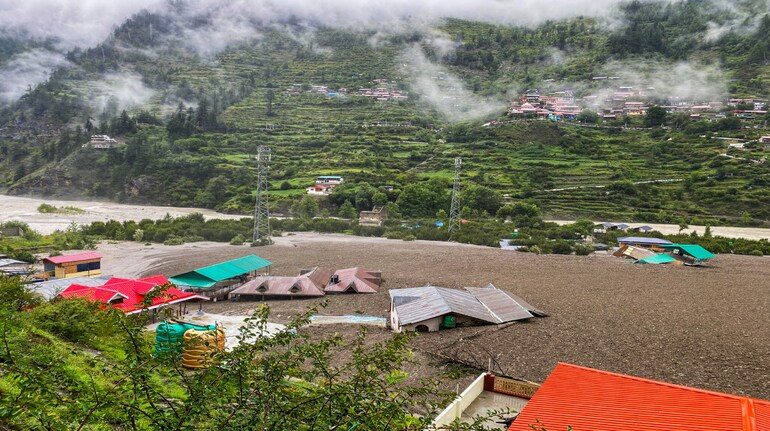

A devastating flash flood that tore through Dharali village in Uttarkashi district on August 5, 2025, was not caused by a cloudburst or a glacial lake outburst flood (GLOF), but by the sudden collapse of an exposed ice patch high in the Himalayas, according to a new study by scientists from the Indian Space Research Organisation (ISRO).
The research, based on satellite imagery and terrain analysis, found that the collapse of the ice mass within a high-altitude nivation zone below the Srikanta Glacier triggered a chain reaction that ultimately unleashed a destructive debris flood downstream.
The study, titled “Ice-patch collapse and early-warning implications from a Himalayan flash flood: emerging cryo-hydrological hazards under deglaciation,” reconstructed the sequence of events using multi-temporal satellite images, high-resolution digital elevation models (DEMs) and videos recorded by residents.
Ice patch collapse identified as primary trigger
According to the researchers, exposed ice patches appeared during the 2025 ablation season in a nivation hollow, a high-altitude depression where perennial snow and buried ice accumulate beneath seasonal snow cover. Such exposed ice had not been observed in nearly 15 years of satellite records.
Satellite images from early July 2025 revealed several exposed ice patches on steep north- to northeast-facing slopes at around 5,220 metres above sea level. Post-event imagery taken on August 12 showed that one of these patches, covering about 0.25 square kilometres, had completely disappeared, leaving fresh erosion scars downslope.
Even assuming a conservative ice thickness of about 0.3 metres, the researchers estimated the collapsed volume at roughly 75,000 cubic metres, weighing nearly 69 million kilograms.
When the ice mass broke free, it plunged more than 1,700 metres toward the Khir Gad channel, generating enormous gravitational energy. As it descended, the collapsing ice mixed with meltwater, sediment and rocks, transforming into a high-velocity debris surge.
Although the amount of meltwater was relatively modest, the steep terrain, narrow valley and large volumes of entrained debris dramatically amplified the flood’s destructive power.
Satellite data and videos helped reconstruct event
Using satellite imagery, digital elevation models and publicly available video footage recorded by residents, the scientists traced the flood’s progression from the ridge near the glacier down to the valley floor.
Footage from Dharali residents showed a sudden, violent burst of water, mud and boulders lasting only a short time, followed by several hours of lower-intensity muddy flow. Researchers said this pattern was consistent with a rapid mass collapse rather than prolonged monsoon flooding.
Rainfall data between August 3 and August 5 showed only light to moderate precipitation, effectively ruling out a cloudburst.
The researchers also confirmed that there were no glacial lakes in the upper catchment, eliminating the possibility of a GLOF.
Earlier studies ruled out cloudburst
Earlier investigations by scientists from the Wadia Institute of Himalayan Geology and the Geological Survey of India had also concluded that the disaster was not caused by a cloudburst or a glacial lake outburst flood. Those studies suggested that slope instability linked to glacial moraine collapse might have triggered the flood.
The new ISRO research, however, attributes the initial trigger specifically to the collapse of an exposed ice patch.
Unlike a glacial moraine, which consists of loose rock and debris deposited by glaciers, an ice patch is a vertically layered mass of snow, firn and ice that does not flow like a glacier and is highly sensitive to warming temperatures.
Impact on Dharali village
Dharali village lies along the Bhagirathi River near the confluence with the glacier-fed Khir Gad stream. Its position on a narrow valley floor makes it particularly vulnerable to sudden upstream surges.
Satellite comparisons before and after the disaster revealed major geomorphic changes in the Khir Gad channel, including widening of the riverbed, extensive bank erosion and heavy sediment deposition where the stream meets the Bhagirathi.
The debris-laden flood spread across low-lying parts of Dharali, damaging buildings and infrastructure as it carried mud, rocks and ice through the settlement.
Warming Himalaya exposing new hazards
Researchers warned that the Dharali disaster highlights a little-recognised risk emerging in the rapidly warming Himalaya.
As glaciers retreat and snow cover declines, buried ice patches that were once protected beneath layers of snow and firn are becoming exposed. Once uncovered, these ice bodies can become mechanically unstable and collapse suddenly.
The study noted that similar ice-patch failures have been documented in the Arctic and Greenland but have rarely been reported in the Himalayas.
Early warning and monitoring needed
The scientists emphasised that exposed ice patches visible in satellite imagery weeks before the Dharali flood could potentially serve as early warning signals in vulnerable mountain catchments.
However, frequent cloud cover during the monsoon season limits the effectiveness of optical satellites. The researchers therefore recommended integrating radar-based satellite monitoring, which can penetrate cloud cover, with ground-based observations.
“The Dharali event broadens the spectrum of recognised glacier-related hazards in the Himalaya and underscores the urgent need to monitor emerging cryospheric instabilities as deglaciation accelerates,” the study concluded.
The research was conducted by ISRO scientists Giribabu Dandabathula, Omkar Shashikant Ghatage, Subham Roy, Apurba Kumar Bera and Sushil Kumar Srivastav.
Discover the latest Business News, Sensex, and Nifty updates. Obtain Personal Finance insights, tax queries, and expert opinions on Moneycontrol or download the Moneycontrol App to stay updated!
Find the best of Al News in one place, specially curated for you every weekend.
Stay on top of the latest tech trends and biggest startup news.