







As 2025 draws to a close and 2026 approaches, Uttar Pradesh politics is ending the year amid intense churn and realignment. The past twelve months saw sharp controversies, open dissent, dramatic personal battles and carefully calibrated political messaging, keeping the state’s political temperature high throughout the year.
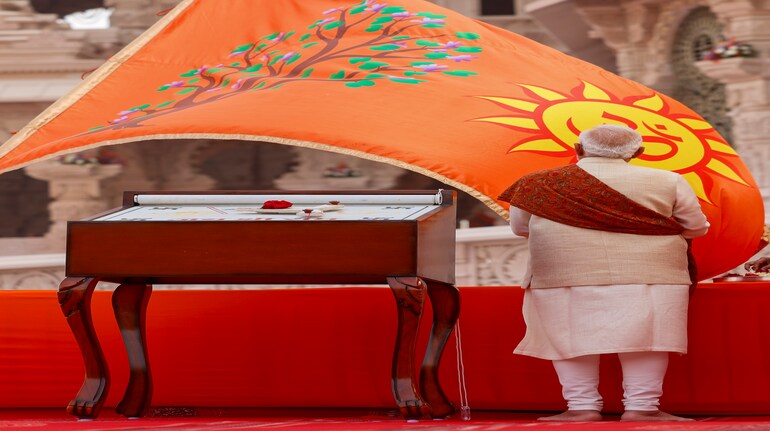
One of the most symbolic moments of 2025 was the completion of the Ram temple in Ayodhya. Prime Minister Narendra Modi unfurled the religious flag atop the temple and appeared visibly emotional as the long awaited project reached its culmination. The BJP and the RSS projected the occasion as the fulfilment of a decades old resolve, reaffirming Ayodhya’s central place in the party’s political and ideological narrative.
The political debate around Ayodhya, however, did not subside. After the BJP’s defeat in the Ayodhya Lok Sabha seat in the 2024 general elections, opposition parties repeatedly questioned the party’s hold over the region. The BJP responded by highlighting its victory in the Milkipur assembly by election, where Chandrabhanu Prasad defeated Ajit Prasad, son of SP MP Awadhesh Prasad. The win allowed the party to argue that the Lok Sabha setback was temporary rather than structural.
Strains within ruling allies surfaced early in the year. Apna Dal (S) chief and Union minister Anupriya Patel and her husband, Uttar Pradesh technical education minister Ashish Patel, found themselves publicly at odds with their own government. Matters escalated when Pallavi Patel, Anupriya’s sister and an SP MLA, staged a protest outside the assembly, accusing Ashish Patel of irregular promotions and submitting a complaint to the Governor.
Ashish Patel hit back strongly, alleging a conspiracy to malign him and accusing the system of misusing state machinery. He claimed a concerted campaign was underway to damage his image and asserted that while others depended on power structures, he trusted public support.
The Samajwadi Party also grappled with internal turbulence. Party chief Akhilesh Yadav adopted a hard line on discipline, expelling three MLAs in June for cross voting in the Rajya Sabha elections earlier in 2024. In August, Chail MLA Pooja Pal was expelled for publicly praising Chief Minister Yogi Adityanath during a discussion on development, underlining the party leadership’s zero tolerance approach.
Several controversies kept the political discourse charged. The alleged codeine cough syrup case echoed from the state assembly to Parliament. Meetings of Thakur MLAs under the banner of Kutumb Parivar and a subsequent Brahmin community feast put the BJP on the defensive, forcing the leadership into damage control and renewed assertions of organisational discipline.
The most striking political comeback of the year belonged to BSP chief Mayawati. On Kanshi Ram’s death anniversary she drew a massive crowd in Lucknow, surprising political observers and energising party workers demoralised by repeated electoral setbacks. Organisational reshuffles followed, along with a renewed outreach to Muslim voters.
Mayawati’s nephew Akash Anand remained in focus through the year. After being expelled, reinstated and gradually elevated, he re-emerged as the party’s key second rung leader, signalling continuity and consolidation within the BSP.
Personal and political flashpoints dominated headlines. The suicide of NISHAD Party leader Dharmatma Nishad in Maharajganj, accompanied by allegations against senior party figures, sent shockwaves through political circles. In Mau, Abbas Ansari’s conviction, disqualification from the assembly and subsequent reinstatement after a High Court stay highlighted the complex intersection of law and politics. SP veteran Azam Khan’s brief release from Sitapur jail after securing bail in multiple cases reignited political debate, only for him to be sent back to prison following fresh legal hurdles. His statements after release prompted Akhilesh Yadav to meet him personally in Rampur, a move that drew widespread attention.
Within the BJP, internal discontent surfaced on several occasions. Deputy Chief Ministers Keshav Prasad Maurya and Brajesh Pathak skipped the Ayodhya Deepotsav, reportedly unhappy over the omission of their names from official advertisements. In Kanpur Dehat, a clash involving a Union minister’s husband and a sitting MP during a government meeting escalated to the point that the meeting had to be cancelled.
Towards the end of the year, the BJP moved to recalibrate its organisational and social strategy. Union minister and seven-time MP Pankaj Chaudhary was appointed state BJP president, a decision widely seen as an effort to regain the Kurmi support base after the Lok Sabha elections. Deputy Chief Minister Keshav Prasad Maurya’s political standing also rose following his role in the Bihar elections, where the NDA secured a sweeping victory.
What 2026 Holds for UP
As Uttar Pradesh steps into 2026, the aftershocks of 2025 are likely to shape political strategies across parties. The BJP is expected to focus on tightening organisational control, refining social engineering and projecting governance and ideological consistency ahead of the 2027 assembly elections. Managing internal dissent while consolidating non Yadav OBC and upper caste support will remain central to its approach.
For the opposition, 2026 presents a test of cohesion and credibility. The Samajwadi Party will aim to balance strict discipline with broader alliance building, while the BSP’s renewed mobilisation under Mayawati suggests an attempt to reclaim political relevance. With alliances fluid and narratives hardening, 2026 is poised to be a year of positioning and experimentation, setting the tone for the larger electoral battles that lie ahead in Uttar Pradesh.
Discover the latest Business News, Sensex, and Nifty updates. Obtain Personal Finance insights, tax queries, and expert opinions on Moneycontrol or download the Moneycontrol App to stay updated!
Find the best of Al News in one place, specially curated for you every weekend.
Stay on top of the latest tech trends and biggest startup news.





