






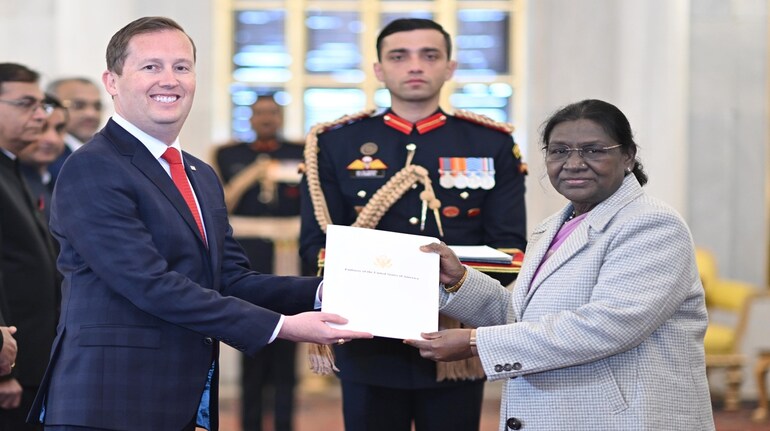

US Ambassador to India Sergio Gor, on Wednesday, formally presented his credentials to President Droupadi Murmu at Rashtrapati Bhavan, officially assuming charge as Washington’s top diplomat in New Delhi.
An official statement from the President’s office said Murmu accepted Gor’s credentials at a ceremony held at the Rashtrapati Bhavan. Envoys from Trinidad and Tobago and Austria, Chandradath Singh and Robert Zischg, also presented their credentials during the event.
Gor, 38, was sworn in as the US Ambassador to India in mid-November last year after his appointment was confirmed by the US Senate in October. He previously served as the White House personnel director before President Donald Trump nominated him as the next US envoy to India in August 2025.
Earlier this week, signalling an intent to strengthen bilateral ties, Gor said “no country is as essential as India to the United States,” adding that both sides are “actively engaged” in efforts to firm up a trade deal.
Addressing an audience at the US Embassy in New Delhi, he described ties between the two leaders as strong, saying, “I can attest that President Trump’s friendship with Prime Minister Modi is real. Real friends can disagree but always resolve their differences in the end.”
It should be noted here that India-US ties have been strained in recent months after Washington imposed higher tariffs on Indian goods, including a 25% surcharge linked to New Delhi’s purchase of Russian crude oil, taking the total levy to 50% under President Donald Trump.
Gor’s remarks this week were widely seen as an attempt to signal a reset and push forward a broader strategic partnership.
Why do ambassadors present credentials to the President
In India, the presentation of credentials is a formal diplomatic practice rooted in constitutional and international convention. The President, as Head of State, is the authority that formally recognises foreign envoys, and an ambassador becomes fully accredited only after presenting a Letter of Credence from their own Head of State.
Under Article 53 of the Constitution, executive power is vested in the President, making the office the formal authority in India’s relations with foreign countries. While day-to-day foreign policy is conducted by the government and the Ministry of External Affairs, diplomatic recognition of envoys rests with the President.
The practice follows the Vienna Convention on Diplomatic Relations (1961), under which the presentation and acceptance of credentials formally acknowledges an ambassador as the official representative of the sending nation. Until this process is completed, an envoy cannot fully perform diplomatic functions.
Discover the latest Business News, Sensex, and Nifty updates. Obtain Personal Finance insights, tax queries, and expert opinions on Moneycontrol or download the Moneycontrol App to stay updated!
Find the best of Al News in one place, specially curated for you every weekend.
Stay on top of the latest tech trends and biggest startup news.





