






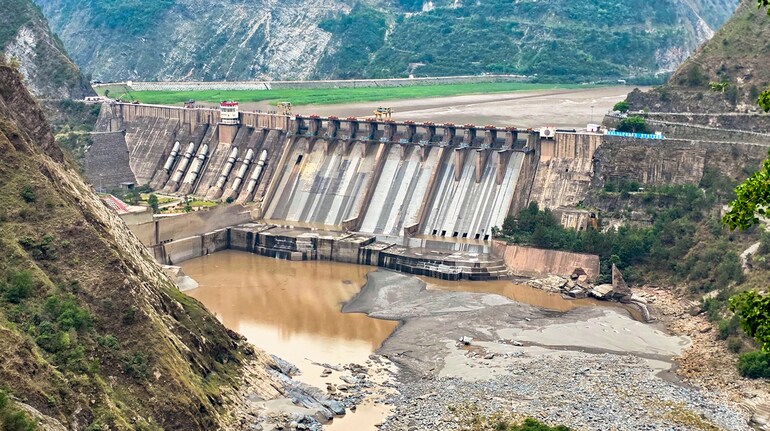

India has begun work on the Rs 5,129 crore Sawalkote Hydroelectric Project on the Chenab river in Jammu and Kashmir, marking the first new project to receive approval from the Narendra Modi government after the Indus Waters Treaty was put in abeyance, according to News18.
The National Hydroelectric Power Corporation (NHPC) on February 5 invited bids from companies to construct the mega project across Udhampur and Ramban districts.
Two-stage, 1,856 MW run-of-the-river plan
The Sawalkote project will be developed in two stages, with a 1,406 MW plant in Stage One and a 450 MW facility in Stage Two, taking the total capacity to 1,856 MW. Located between the Baglihar project upstream and the Salal project downstream, it is planned as a run-of-the-river scheme on the Chenab.
Documents reviewed by News18 indicate that the construction methodology and equipment selection have been designed to ensure the earliest possible commissioning, underscoring the urgency of the project.
An expert committee of the environment ministry had cleared the project in October last year following the suspension of the Indus Waters Treaty, after which NHPC moved to the bidding stage.
The paperwork notes that major construction will begin after initial mobilisation. Underground works are expected to continue throughout the year, while surface construction will proceed at full pace during the non-monsoon period and at about 50 per cent capacity during the monsoon. The estimated completion timeline for the entire project is around nine years.
Part of a larger Chenab strategy
The Sawalkote project is part of a wider push on the Chenab river system. News18 had reported earlier that the Centre has issued firm directions to fast-track four key hydropower projects in the region.
Officials have been tasked with commissioning the Pakal Dul and Kiru projects by December 2026, completing the Kwar project by March 2028, and accelerating work on the strategically sensitive Ratle dam.
Pakal Dul: India’s biggest Chenab storage project
Among these, the Pakal Dul project in Kishtwar is the largest at 1,000 MW and features a 167-metre dam, making it the highest in India. It is also India’s first storage project on a western river flowing into Pakistan, giving New Delhi the capacity not only to generate electricity but also regulate the timing of water flows, a factor Islamabad has historically viewed with concern.
The project was inaugurated by Prime Minister Narendra Modi in May 2018 and is now slated for commissioning by December 2026.
Kiru and Kwar deadlines
Running parallel is the Kiru project, another run-of-the-river dam in Kishtwar with a height of 135 metres. Its strategic importance lies in its placement within a chain of upstream and downstream projects. The Centre has set the same December 2026 deadline for Kiru, signalling that both projects are expected to go online together.
The Kwar project, featuring a 109-metre dam on the Chenab, achieved a major milestone in January 2024 when the river was successfully diverted to facilitate construction, an event closely tracked in Pakistan. The latest directive sets March 2028 as its commissioning deadline.
Ratle and Dulhasti Stage-2
The Ratle project remains one of the most contentious. The 850 MW dam involves a 133-metre structure and has faced repeated objections from Pakistan, particularly over spillway design. Construction momentum increased last year with the diversion of the Chenab through tunnels, and the dam is currently targeted for completion by 2028.
Beyond these headline projects, India is also advancing Dulhasti Stage-2 on the Chenab after receiving environmental clearance last December. Pakistan has objected to this approval, claiming it was not informed, an assertion India has rejected.
Why Pakistan is concerned
The rapid pace of development has amplified concerns in Pakistan because the Chenab forms a critical part of the Indus basin, which supports the bulk of its agriculture and water infrastructure.
Nearly three-fourths of Pakistan’s water originates from western rivers that flow through India, making upstream projects politically and strategically sensitive. India has skipped all Indus Waters Treaty proceedings following the Pahalgam attack, further intensifying the geopolitical backdrop to these developments.
Discover the latest Business News, Sensex, and Nifty updates. Obtain Personal Finance insights, tax queries, and expert opinions on Moneycontrol or download the Moneycontrol App to stay updated!
Find the best of Al News in one place, specially curated for you every weekend.
Stay on top of the latest tech trends and biggest startup news.





