






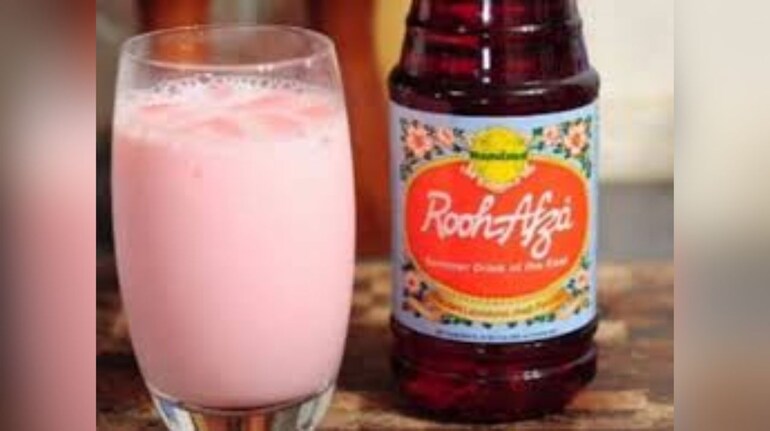

In a significant ruling on tax classification, the Supreme Court on Wednesday granted relief to Hamdard Laboratories, holding that Sharbat Rooh Afza cannot be placed in a higher tax slab merely because it is marketed as a “sharbat.”
The dispute centred on whether Rooh Afza, which contains 10 per cent fruit juice comprising 8 per cent pineapple and 2 per cent orange mixed with invert sugar syrup and herbal distillates, should be treated as a “fruit drink” or be taxed under the residuary category meant for items not specifically listed.
For licensing purposes, the product had been described as a “non-fruit syrup containing 10% fruit juice”, as it did not satisfy the higher fruit content requirement prescribed under food safety regulations for classification as a “fruit syrup.”
A bench of Justices BV Nagarathna and R Mahadevan observed that the beverage draws its essential character from fruit based ingredients and is meant to be diluted before consumption. The court concluded that Rooh Afza qualifies as a “fruit drink” under the applicable tax framework.
Allowing a series of appeals filed by Hamdard (Wakf) Laboratories, the manufacturer of Rooh Afza, the apex court overturned the 2018 rulings of the Allahabad High Court and the tax authorities. The High Court had earlier affirmed the product’s categorisation as an “unclassified” good, making it liable for 12.5 per cent tax under the residuary entry of the Uttar Pradesh Value Added Tax Act.
The Supreme Court instead held that Rooh Afza falls under Entry 103 of Schedule II Part A of the UPVAT Act as a “fruit drink/processed fruit product.” This classification attracts a concessional VAT rate of 4 per cent for the assessment period from January 1, 2008 to March 31, 2012.
Revenue authorities had relied on a clarification under food safety rules stating that a “fruit syrup” must contain at least 25 per cent fruit juice. Since Rooh Afza contains 10 per cent, the department contended it could not be treated as a fruit drink for taxation purposes.
Dismissing this reasoning, the Supreme Court clarified that regulatory definitions under food safety law do not automatically govern fiscal interpretation unless the tax statute expressly incorporates such standards.
Discover the latest Business News, Sensex, and Nifty updates. Obtain Personal Finance insights, tax queries, and expert opinions on Moneycontrol or download the Moneycontrol App to stay updated!
Find the best of Al News in one place, specially curated for you every weekend.
Stay on top of the latest tech trends and biggest startup news.





