






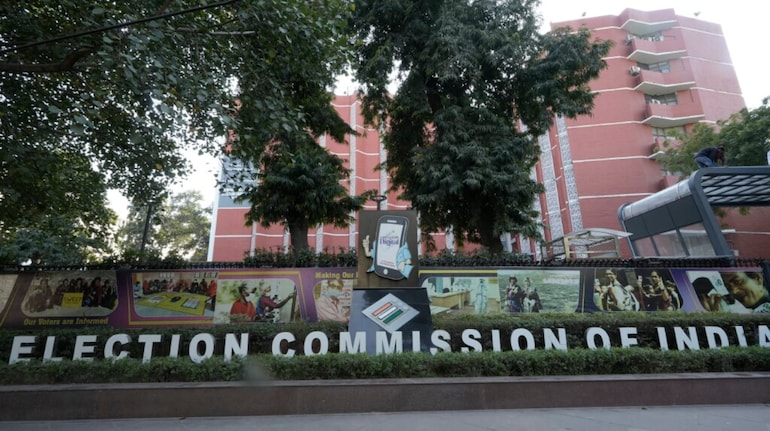

The Supreme Court on Monday issued notice to the Centre and the Election Commission of India on a petition challenging a law that grants what is described as life-long immunity from prosecution to the Chief Election Commissioner (CEC) and the Election Commissioners (ECs).
Hearing the matter, a bench led by Chief Justice Surya Kant indicated that the court would closely scrutinise the issue, saying, “We would like to examine it. We are issuing notice”.
The notices were issued to enable the respondents to place their stand before the court on the validity of provisions contained in the Chief Election Commissioner and Other Election Commissioners (Appointment, Conditions of Service and Term of Office) Act, 2023.
Here's what has been challenged in the apex court against the law:
Core challenge to the 2023 law
The plea assails the constitutional validity of the Parliament-enacted legislation, alleging that it confers sweeping and unprecedented protection on the CEC and the ECs.
According to the petition, the law shields them from both civil and criminal proceedings for any act done while discharging official duties, and that such protection extends for life.
Questioning the extent of this safeguard, the petitioner’s counsel argued before the court, “the Bill cannot give life long unprecedented to CEC and EC which makers of Constitution didn’t even grant to the judges. Parliament cannot grant such an immunity high Constitutional framers did not grant to other dignitaries.”
The submission said that even constitutional authorities such as judges do not enjoy such blanket immunity.
Appointment panel also under lens
Apart from immunity, the petition challenges changes introduced in the selection process for appointing the ECs.
Under the 2023 law, the selection committee consists of the Prime Minister, the Leader of the Opposition in the Lok Sabha, and a Union Cabinet Minister nominated by the Prime Minister. This replaced the earlier position of the Chief Justice of India (CJI) on the panel.
The petitioner, Congress worker Jaya Thakur, has contended that removing the Chief Justice from the committee weakens institutional checks and undermines the independence of the Election Commission.
The plea claims the revised structure disproportionately empowers the executive, contrary to the principle of free and fair elections.
Background of judicial directions
The issue is closely tied to the Supreme Court’s landmark ruling of March 2, 2023 in which it had directed that appointments of the CEC and ECs be made by the President on the recommendation of a committee comprising the Prime Minister, the Leader of the Opposition, and the CJI.
The arrangement, the court had said, would operate until Parliament enacted a law governing the process.
Subsequently, the government passed the 2023 legislation during the Winter Session of Parliament in December. The move drew sharp criticism from opposition parties, who accused the Centre of bypassing the spirit of the Supreme Court’s ruling and reconfiguring the panel to favour the executive.
Earlier delays and next steps
The case has seen procedural hurdles in the past. In December 2025, then Chief Justice Sanjiv Khanna had recused himself from hearing the matter, citing propriety, as the dispute involved questions related to the role of the Chief Justice in the appointment mechanism.
With notices now issued, the Supreme Court’s latest order signals that the constitutional questions surrounding immunity, appointments, and the independence of the Election Commission will be examined on merits once responses are filed.
Discover the latest Business News, Sensex, and Nifty updates. Obtain Personal Finance insights, tax queries, and expert opinions on Moneycontrol or download the Moneycontrol App to stay updated!
Find the best of Al News in one place, specially curated for you every weekend.
Stay on top of the latest tech trends and biggest startup news.





