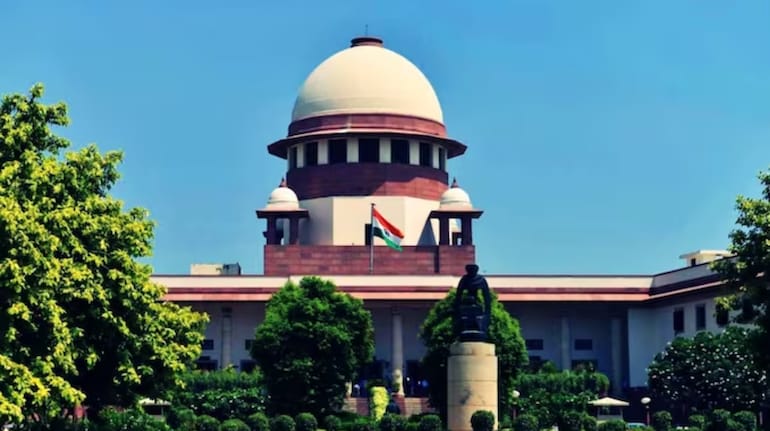

The Supreme Court (SC), on Tuesday, agreed to examine the Centre's appeal against a ruling by the Bombay High Court that struck down provisions enabling the Centre to establish fact-check units to identify alleged fake news about the government on online platforms.
A bench comprising Chief Justice Surya Kant and Justice Joymalya Bagchi said the case involves questions of "paramount importance", stating that the top court should settle the legal position on the issue.
The apex court, however, declined to stay the High Court’s judgment and instead decided to hear the matter expeditiously.
"The question is of paramount importance and it is better the Supreme Court lays down the law. It is about balancing without compromising the constitutional values," the Chief Justice said while directing that the case be placed before a three-judge bench.
The court was hearing the Centre’s appeal against the High Court decision that struck down Rule 3 of the Information Technology (Intermediary Guidelines and Digital Media Ethics Code) Amendment Rules, 2023. The provision allowed the government to create Fact-Check Units (FCUs) to flag or identify content on social media and digital platforms deemed false or misleading in relation to government business.
Solicitor General Tushar Mehta, appearing for the government, told the bench that the rule was not intended to curb criticism of the government. "There is no intent to suppress any humour, satire, or critique," he said.
The bench, however, noted concerns over the spread of misinformation on certain online platforms and emphasised the need for clear regulatory guidelines.
“The way some of these platforms are acting… such news can damage the reputation of institutions as well,” the Chief Justice observed. “Clear demarcated guidelines are needed, but without putting any onus on those who spread it, the issue needs to be examined.”
Senior advocate Arvind Datar, appearing for stand-up comedian Kunal Kamra, argued that adequate mechanisms already exist under current law to deal with problematic content.
“It is about fact-check units and proper rules need to be framed. Blocking rules are there… Section 69 is there,” he said, referring to provisions under the Information Technology Act that allow the government to block content.
Senior advocate Navroz Seervai, representing the original petitioners, pointed out that the High Court had already struck down the rule.
Responding, the Chief Justice noted that if the High Court had merely kept the rule inoperative it would have been different, but striking it down effectively meant that the rule no longer existed.
The Supreme Court issued notice to respondents, including Kamra, and directed them to file replies within four weeks, after which the Centre may submit its rejoinder.
“Let us hear and decide the matter first and at the earliest,” the Chief Justice said while declining the government’s request to stay the High Court’s order.
The dispute stems from amendments made in 2023 to the Information Technology (Intermediary Guidelines and Digital Media Ethics Code) Rules, 2021, which empowered the government to set up FCUs to identify misinformation about its policies or functioning circulating online.
Several petitions, including one filed by Kamra, challenged the amendments before the Bombay High Court, arguing that the provision exceeded the scope of Section 79 of the Information Technology Act and violated constitutional protections under Articles 14 and 19, including the rights to equality and freedom of speech.
In January, a division bench of Justices GS Patel and Neela Gokhale delivered a split verdict on the matter. Justice Patel struck down the rule, warning that it could enable censorship and shift responsibility for verifying content from creators to intermediaries.
Justice Gokhale, however, upheld the amendment, stating that it targeted misinformation spread with malicious intent while safeguarding free speech.
Following the split verdict, the then Chief Justice of the High Court, DK Upadhyay, assigned the case to Justice Atul Chandurkar for a tie-breaking opinion.
Justice Chandurkar later struck down the rule in September 2024, holding that it violated constitutional guarantees under Articles 14 and 19.
The Centre subsequently moved the Supreme Court, challenging the High Court’s decision.
Discover the latest Business News, Sensex, and Nifty updates. Obtain Personal Finance insights, tax queries, and expert opinions on Moneycontrol or download the Moneycontrol App to stay updated!
Find the best of Al News in one place, specially curated for you every weekend.
Stay on top of the latest tech trends and biggest startup news.