







Prime Minister Narendra Modi on Sunday inaugurated two new corridors of the Delhi Metro Rail Corporation and laid the foundation stone for three additional metro lines, as part of a series of development projects worth around Rs 33,500 crore launched in the national capital.
The projects, unveiled at an event in New Delhi, also included redevelopment works worth Rs 15,200 crore under the Centre’s General Pool Residential Accommodation (GPRA) programme aimed at modernising housing for central government employees.
The prime minister inaugurated the 12.3-km Majlis Park–Maujpur-Babarpur stretch of the Pink Line and the 9.9-km Deepali Chowk–Majlis Park extension of the Magenta Line, expanding the city’s rapid transit network and improving connectivity across several densely populated areas.
Addressing the gathering, PM Modi said, “We have gathered here to give new momentum to development in Delhi. A short while ago, projects worth over ₹33,000 crore were inaugurated and foundation stones were laid. From the expansion of the Metro to housing facilities for thousands of government employees, infrastructure in the national capital is being continuously strengthened.”
The event coincided with International Women's Day, observed annually on March 8 to recognise the contributions of women across sectors.
The newly opened Majlis Park–Maujpur-Babarpur section of the Pink Line is expected to significantly improve connectivity between north and northeast Delhi.
The elevated corridor features nine stations -- Majlis Park, Burari, Jagatpur-Wazirabad, Soorghat, Sonia Vihar, Khajuri Khas, Bhajanpura, Yamuna Vihar and Maujpur-Babarpur -- and will form part of what officials describe as the country’s first operational ring metro network.
The prime minister also inaugurated the Deepali Chowk–Majlis Park elevated extension of the Magenta Line, which includes seven stations and connects localities such as Uttar Pitampura–Prashant Vihar, Madhuban Chowk, Haiderpur Badli Mor and Bhalaswa. With the new extension, the Magenta Line’s total length will reach nearly 49 km.
Officials said the addition of the two corridors will significantly strengthen connectivity across the capital and reduce travel time for thousands of daily commuters.
PM Modi also laid the foundation stone for three new corridors under Phase V(A) of the Delhi Metro project: Ramakrishna Ashram Marg–Indraprastha, Aerocity–Indira Gandhi International Airport Terminal-1, and Tughlakabad–Kalindi Kunj.
The 9.9-km Ramakrishna Ashram Marg–Indraprastha corridor, also referred to as the Central Vista corridor, is expected to improve access to key official and cultural landmarks such as Bharat Mandapam, Central Secretariat and India Gate.
Highlighting the pace of development in the capital, the prime minister praised the BJP-led administration in the city.
“A year ago, with hope and renewed resolve, the people here formed a BJP ‘double-engine’ government. The results of that are now visible in the development works taking place here. I congratulate all the citizens of Delhi for this continuous flow of development,” he said.
Taking a swipe at the previous Aam Aadmi Party government, PM Modi added, “Because of AAP Government, this project was delayed.”
Apart from the metro projects, the government also launched redevelopment works under the GPRA programme, which aims to modernise ageing government housing colonies in the capital.
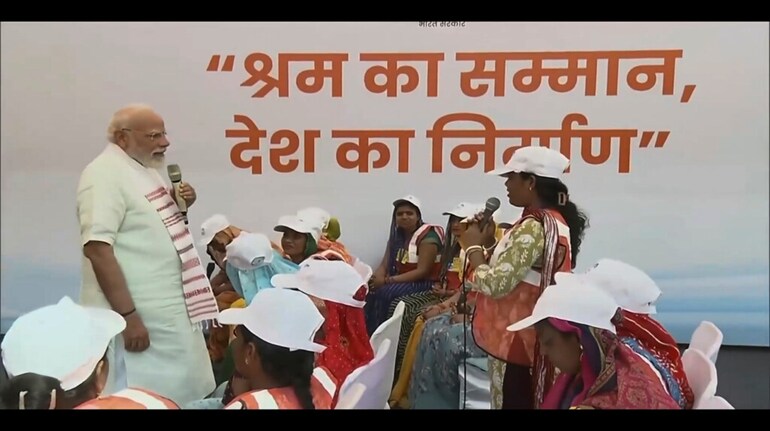
Earlier in the day, PM Modi visited GPRA Type-5 quarters in Sarojini Nagar and handed over keys to women allottees.
The redevelopment plan covers seven ageing government housing colonies — Sarojini Nagar, Netaji Nagar, Nauroji Nagar, Kasturba Nagar, Thyagraj Nagar, Sriniwaspuri and Mohammadpur — spread across nearly 537 acres.
Many of the existing residential quarters in these colonies had become old and structurally unsafe, with nearly 40 per cent declared uninhabitable. The project seeks to address a shortage of more than 20,000 houses for central government employees by replacing the old low-rise structures with modern high-rise residential complexes.
Once completed, the redevelopment will provide more than 21,000 new residential units along with upgraded infrastructure and public facilities. The works being inaugurated and launched under the GPRA programme alone are valued at about ₹15,200 crore and are expected to deliver over 9,350 modern flats for government staff.
Officials said the project is being implemented through a self-financing model that does not require funding from the public exchequer. Around 69.41 acres,— roughly 12.9 per cent of the total project area, will be monetised for commercial and residential use to finance the redevelopment.
The limited land monetisation is expected to generate more than Rs 35,100 crore, covering the estimated redevelopment cost of around Rs 32,800 crore and potentially generating a surplus of over Rs 2,300 crore for the government.
Delhi Chief Minister Rekha Gupta said the metro expansion represents an important step toward creating a faster, smoother and environmentally friendly public transport system in the capital, adding that the projects will help reduce pressure from private vehicles and lower air pollution levels.
Discover the latest Business News, Sensex, and Nifty updates. Obtain Personal Finance insights, tax queries, and expert opinions on Moneycontrol or download the Moneycontrol App to stay updated!
Find the best of Al News in one place, specially curated for you every weekend.
Stay on top of the latest tech trends and biggest startup news.





