






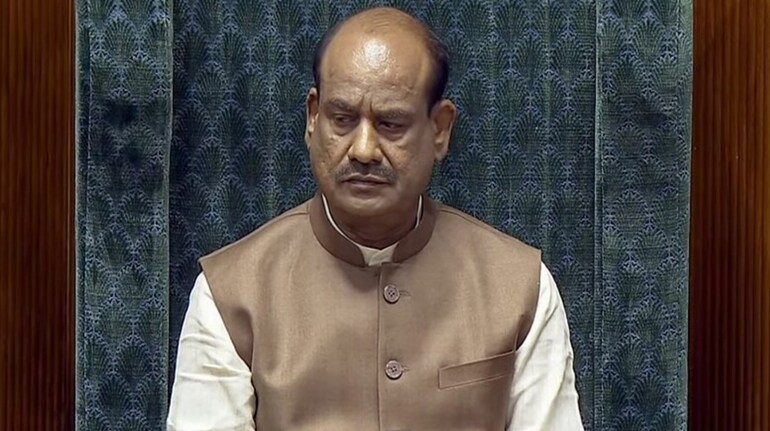

The Lok Sabha Secretariat is expected to take up the Opposition’s motion seeking the removal of Speaker Om Birla on March 9, the first day of the second leg of the Budget Session.
According to the Lok Sabha secretariat officials, Birla has decided not to sit in the Speaker's chair until the no-confidence motion moved against him is settled.
Article 94 (C) of the Constitution allows a House Speaker to be removed through a duly followed process. Before a motion is taken to remove the Speaker, a 14-day written notice is mandatory to the House. The Speaker can defend himself in the House if the resolution is discussed in the Lok Sabha.
Even after the Lok Sabha is dissolved, the Speaker does not vacate office and continues in the post until immediately before the first meeting of the newly constituted House of the People.
Why did the Opposition move the motion?
The Opposition MPs alleged that he had acted in a "blatantly partisan" manner and curbed the Opposition’s voice in the House. Submitted on Tuesday afternoon, the motion carries the signatures of 118 MPs. Congress leader Rahul Gandhi did not sign the notice as it is not proper for the LoP to sign a petition for the removal of the Speaker in a parliamentary democracy.
The Congress also attacked Birla for not allowing Leader of Opposition (LoP) Rahul Gandhi to quote from or speak about former Indian Army Chief General M M Naravane’s unpublished memoir, and for the Speaker’s claim that Prime Minister Narendra Modi could have been attacked inside the House.
According to reports, the only Trinamool Congress (TMC) did not back the notice for the motion. The party felt the Congress should have first written to Birla outlining its grievances and given him three days to respond.
Does the Opposition have numbers?
To remove the Lok Sabha Speaker, the Opposition must secure the passage of a resolution by an effective majority of the House.
This means most of the total number of members of the House at the time, excluding any vacant seats.
For a removal motion to be admitted, it must be backed by at least 50 members.
The 18th Lok Sabha has a strength of 543 members. An effective majority would require at least 272 votes.
However, the BJP-led National Democratic Alliance (NDA) currently has 293 members in the House, while the Opposition has 238. Given these numbers, the Opposition will not be able to gather the tally required to pass the motion.
Why has the Opposition still pushed for the motion?
The Opposition’s move is less about winning the vote and more about sending a political message.
The Opposition has been accusing Birla of functioning in a partisan manner. It has cited several issues such as the suspension of MPs, the handling of adjournment motions, the admission (or rejection) of discussions, and decisions under the anti-defection law.
By formally moving a no-confidence motion, the Opposition seeks to frame the debate around the neutrality of the Speaker’s office. The office is expected to rise above party lines.
Since the motion may lead to a discussion, it allows the Opposition to articulate its grievances on the floor of the House and place its allegations on parliamentary record. This can be politically significant, especially in the run-up to state elections or future parliamentary sessions this year.
Not first time
This is not the first time the Opposition has sought to move a no-confidence motion against a parliamentary presiding officer.
In 2024, a similar motion was brought against then Rajya Sabha Chairman and Vice-President Jagdeep Dhankhar. However, Deputy Chairman Harivansh rejected the notice, terming it an act of impropriety. At least 60 Opposition MPs had signed the December 10 notice seeking Dhankhar’s removal.
There have been at least three instances since Independence when motions were moved to remove a Lok Sabha Speaker.
The first was in 1954 against the first Speaker, G V Mavalankar, after MP Vigneshwar Misra alleged partiality. In 1966, Opposition MPs moved a motion against Speaker Sardar Hukum Singh, with Madhu Limaye leading the effort while Deputy Speaker S V Krishnamoorthy Rao presided.
The third instance came on April 15, 1987, when CPM MP Somnath Chatterjee moved a motion against Speaker Balram Jakhar, with Deputy Speaker Thambi Durai in the Chair. That motion was later rejected by the House.
Discover the latest Business News, Sensex, and Nifty updates. Obtain Personal Finance insights, tax queries, and expert opinions on Moneycontrol or download the Moneycontrol App to stay updated!
Find the best of Al News in one place, specially curated for you every weekend.
Stay on top of the latest tech trends and biggest startup news.





