






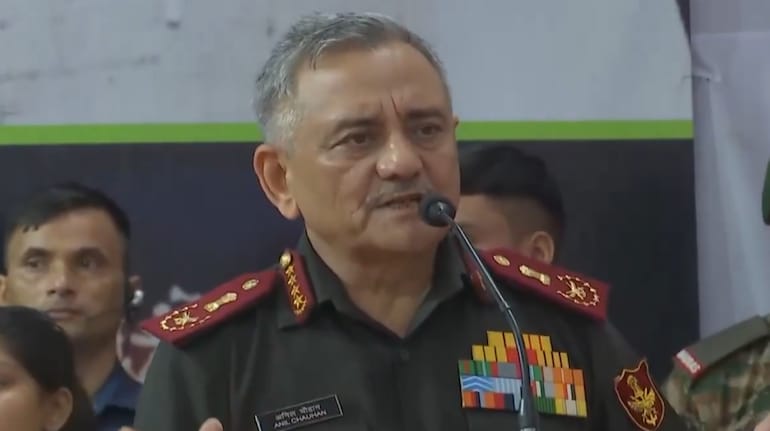

Chief of Defence (CDS) Staff General Anil Chauhan has said India believed the 1954 Panchsheel Agreement effectively addressed the northern boundary question, even though Beijing viewed it differently.
Speaking at an event in Dehradun, Uttarakhand, he noted that India recognised Tibet as part of China that year and entered into the five principles pact signed by Jawaharlal Nehru and Chinese premier Zhou Enlai.
“In 1954, India recognized Tibet as part of China; both countries signed the Panchsheel Agreement. With this, India assumed that it had settled its border, the northern border, the only area which we assumed that was not settled, through a formal kind of a treaty,” he said.
However, he pointed out that Beijing maintained the understanding was limited in scope. “… But the Chinese stand was that this agreement was negotiated only for trade, and it in no way reflected the Chinese stand on the border,” General Chauhan said.
McMahon Line and Nehru’s calculations
Reflecting on the situation inherited after the British departure, the CDS suggested that New Delhi had to determine its frontiers. “… The British left, they had to leave one day, and it was for India to decide where our front is. Nehru probably knew that we had something as McMahon Line in the east; we had some kind of a claim in the Ladakh area, but it was not here [in the east]. So that's why he wanted to go for the Panchsheel Agreement, probably,” he said.
The McMahon Line, stretching 890 km, had served as the boundary between British India and Tibet in the eastern sector.
Tibet, stability and the vanishing buffer
General Chauhan also referred to China’s actions in Tibet and Xinjiang, saying Beijing sought calm in the frontier belt after what he termed its “so-called” liberation of Tibet. “For the Chinese also, because they had kind of liberated, so-called liberated Tibet -- they had moved into Lhasa, they had moved into Xinjiang - this particular area was extreme from both ends, so they wanted stability, probably in this particular region,” he said.
He added that independent India aimed to foster cordial ties with China and did not pursue certain inherited claims or privileges following China’s 1949 revolution.
According to him, once China took control of Tibet and India backed China for a permanent seat at the United Nations, the “Himalayan buffer” between India and Tibet “evaporated,” effectively turning it into a live boundary.
Trade passes and continuing tensions
India believed the legitimacy of the frontier rested on the Panchsheel understanding, which it thought had been delineated through six identified passes for trade and pilgrimage: Shipki La, Mana, Niti, Kingri-Bingri, Lipulekh and Dharma.
Despite these assumptions, the Line of Actual Control in the rugged Himalayas remains fraught. The most severe confrontation in recent years occurred in June 2020, when 20 Indian soldiers were killed in action along the LAC. Intelligence assessments indicated that more than 30 Chinese personnel also died in that clash.

Discover the latest Business News, Sensex, and Nifty updates. Obtain Personal Finance insights, tax queries, and expert opinions on Moneycontrol or download the Moneycontrol App to stay updated!
Find the best of Al News in one place, specially curated for you every weekend.
Stay on top of the latest tech trends and biggest startup news.





