






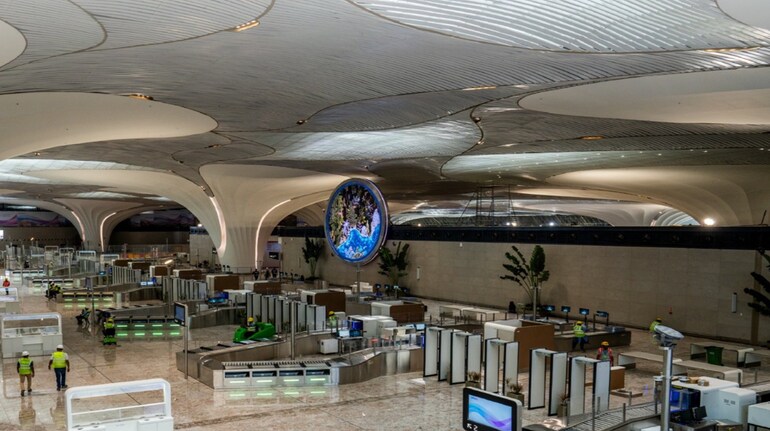
The Adani Group-promoted Navi Mumbai International Airport (NMIA) will commence commercial flight operations on Thursday, according to a statement.
The airport was first conceived in 1997 by Maharashtra’s city planning agency, the City and Industrial Development Corporation (CIDCO). Prime Minister Narendra Modi laid the foundation stone for the project in 2018, and formally inaugurated the airport on October 8 this year.
Airlines, routes and operating hours
The development is expected to ease congestion at the existing Mumbai International Airport and significantly enhance aviation capacity in the Mumbai Metropolitan Region (MMR). On the first day of operations, IndiGo, Air India Express, Akasa Air and Star Air will operate domestic services, connecting NMIA to nine destinations across India, the private airport operator said on Wednesday.
The airport will handle 15 scheduled departures on the first day. During the initial phase, operations will run for 12 hours — between 8 am and 8 pm — with up to 24 scheduled daily departures to 13 destinations and the capability to manage up to 10 aircraft movements (arrivals and departures) per hour.
Long gestation, shifting timelines
At the foundation-laying ceremony, Chief Minister Devendra Fadnavis had announced that the "first flight from Navi Mumbai International Airport will take off in December 2019".
Since 2021, the development, construction and operational readiness of the greenfield airport have been led by Adani Airports Holdings Limited (AAHL), a subsidiary of Adani Enterprises Limited (AEL). The company progressed the project from accelerated construction to phased commercial operations within a compressed time frame.
After nearly eight years — including two years impacted by the pandemic — the airport is now set to begin operations. Inspired by India’s national flower, the lotus, the terminal architecture integrates cultural identity, contemporary design and sustainability features.
Scaling up and passenger experience
From February next year, operations are planned to progressively scale up to round-the-clock services, the airport operator said. The opening adds a critical new gateway for a region that has faced sustained congestion for over a decade and supports Mumbai’s transition to a multi-airport system aimed at improving capacity, operational resilience and long-term scalability.
Passenger services from day one will be supported by Digi Yatra-enabled contactless processing at designated touchpoints, along with trained terminal staff across kerbside, check-in, security and boarding areas, the operator said.
Retail and food and beverage offerings at the airport have been curated with a focus on affordability and local relevance.
With operations set to begin from Thursday, NMIA is expected to strengthen Mumbai’s role as a global gateway and support long-term economic growth through expanded aviation capacity, the airport operator said.
Cost, capacity and phased development
The first phase of the five-phased airport project has been built at a cost of Rs 19,650 crore. Spread over 1,160 hectares, the airport will feature one terminal and one runway in Phase I, with an annual passenger handling capacity of 20 million.
Once all five phases are completed, NMIA will be capable of handling 90 million passengers annually, along with dedicated cargo terminals and multimodal connectivity. The project is being developed through a special purpose vehicle, Navi Mumbai International Airport Ltd (NMIAL), in which the Adani Group holds a 74 per cent stake, while CIDCO owns the remaining 26 per cent.
*With Agency InputsDiscover the latest Business News, Sensex, and Nifty updates. Obtain Personal Finance insights, tax queries, and expert opinions on Moneycontrol or download the Moneycontrol App to stay updated!
Find the best of Al News in one place, specially curated for you every weekend.
Stay on top of the latest tech trends and biggest startup news.




