






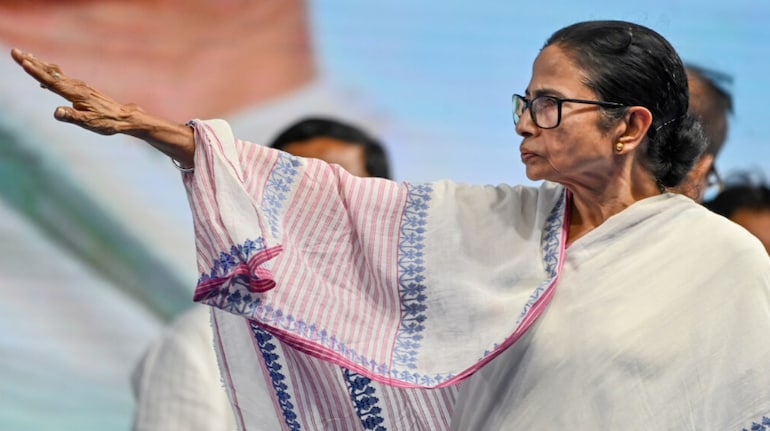

West Bengal Chief Minister Mamata Banerjee's recent spate of temple projects has reopened a familiar question in Bengal politics. Is the Trinamool Congress (TMC) recalibrating its ideological positioning ahead of the 2026 Assembly elections, and does this mark a turn towards "soft Hindutva"?
In less than a year, Banerjee has inaugurated a Jagannath temple in Digha, laid the foundation for a sprawling Durga temple and cultural complex in Kolkata's New Town, and announced a Mahakal temple project in north Bengal's Siliguri. For a leader routinely targeted by the BJP for "minority appeasement", the optics of the Trinamool chief's actions are unmistakable, and calculated.
After laying the foundation stone of the 17-acre 'Durga Angan' complex this week, Banerjee addressed the charge head-on. "Many people blame me for appeasement politics, but I am a true secularist," she said. "I believe in peaceful coexistence of all religions...You can't show me a religion whose celebrations I don't attend."
A political counter
Within the TMC, the temple push is being read as a deliberate attempt to blunt the BJP's principal ideological weapon in Bengal that envisages a pan-Hindu consolidation against the ruling party.
A senior TMC leader said the party sees two clear political advantages. "The BJP has always tried to brand us as a party of Muslim appeasement. These temple initiatives reinforce Didi's image as a leader who respects all faiths and takes the wind out of that narrative," the leader told The Indian Express, adding that it directly undercut the BJP's campaign plank in Bengal.
The second objective is more tactical. While Muslim voters have remained largely consolidated behind the TMC, the BJP has steadily chipped away at Hindu votes, particularly among upper castes and certain Matua and Rajbanshi communities, helping it win 77 seats in the 2021 Assembly elections. The TMC believes that visible engagement with Hindu religious symbols could arrest that drift without alienating its minority base.
Another senior TMC functionary claimed that women and minorities remained firmly with the party. "The BJP's growth came from Hindu consolidation. If even a slice of that support shifts back, it changes the arithmetic significantly."
Beyond politics, the temple projects are also being framed as part of a broader push to promote religious and heritage tourism, a sector the state government sees as an economic opportunity rather than purely a political instrument.
Bengal is currently India's second most-visited state by foreign tourists, and the TMC is keen to build circuits around sites such as Gangasagar, Tarapith, Dakshineswar and Digha. The Jagannath temple in Digha, inaugurated in April, has already recorded a footfall of over one crore visitors, party leaders claim.
An awkward bind
The BJP's response reflects the complexity of the moment. The party cannot afford to oppose temple construction outright, yet Banerjee's moves dilute its core ideological advantage.
Leader of Opposition Suvendu Adhikari attempted to sidestep the issue by invoking RSS chief Mohan Bhagwat's recent comment that governments should not build temples, pointing out that the Ram Temple in Ayodhya was constructed by a trust, not the state. At the same time, Union Home Minister Amit Shah handled it differently: "We welcome the construction of temples, but it is too late."
Privately, BJP leaders concede that Banerjee's strategy complicates their Hindu mobilisation narrative, especially when combined with unresolved issues such as citizenship for Matuas and other groups where the BJP's promises remain unfulfilled.
The Left, meanwhile, has been more direct in its criticism, accusing Banerjee of mimicking the BJP's playbook to mask governance failures. "This is soft Hindutva politics," CPI(M) Central Committee member Sujan Chakraborty told The Indian Express. "The government has nothing to show on industry, jobs or development. Temple politics is being used to divert attention from corruption and administrative failure."
A calibrated shift
Rather than a wholesale ideological shift, Banerjee's temple push appears to be a calibrated political manoeuvre aimed less at replacing the TMC's secular identity and more at insulating it from BJP's campaign in a state where elections are increasingly fought on margins.
For now, the strategy places the BJP in a defensive position where it can neither afford to oppose temple building nor ward off the challenge in monopolising the symbolism of faith.
Discover the latest Business News, Sensex, and Nifty updates. Obtain Personal Finance insights, tax queries, and expert opinions on Moneycontrol or download the Moneycontrol App to stay updated!
Find the best of Al News in one place, specially curated for you every weekend.
Stay on top of the latest tech trends and biggest startup news.





