






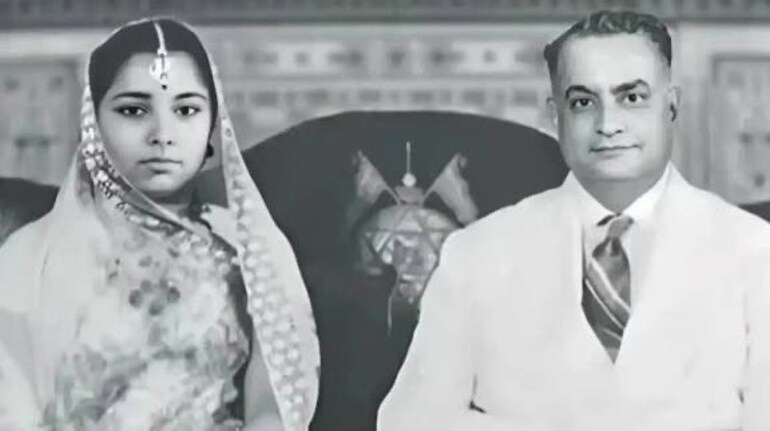

Kamsundari Devi, the last surviving Maharani of the Darbhanga royal family, passed away on Monday, January 12, at the age of 93. She breathed her last at the historic Kalyani niwas in Bihar’s Darbhanga, where she had been unwell for the past several months.
Her death marks the end of a dignified era for the Darbhanga royal family and the wider Mithilanchal region, where she was revered for her legacy of service, sacrifice and patriotism.
600-kg gold donation in the 1962 India-China war
The Darbhanga royal family occupies a special place in India’s history for its extraordinary support during the 1962 India-China war. Responding first to the government’s appeal for assistance, the family donated 15 maunds (about 600 kg) of gold for national defence at Indrabhavan ground in Darbhanga. They also transferred three private aircraft and a 90-acre airstrip to the government -- the site that later became Darbhanga Airport. Historians regard the gesture as one of the most significant royal contributions to independent India.
Educational and industrial contributions
The Darbhanga estate also made significant contributions to education and industrial development. Lalit Narayan Mithila University is housed within the royal complex, while institutions such as Banaras Hindu University, Calcutta University, Aligarh Muslim University and Patna University received substantial financial support from the family, according to an NDTV report. Darbhanga Medical College is also among its notable legacies.
On the industrial front, the estate backed the establishment of sugar mills in Sakri, Lohat, Raiyam and Hasanpur, a spinning mill in Pandaul, Ashok Paper Mill in Hayaghat and the Rameshwar Jute Mill in Samastipur. The origins of aviation services in India are also closely associated with the Darbhanga estate.
Last Maharani passes away
Maharani Kamsundari Devi, the third wife of Maharaja Kameshwar Singh, was born on October 22, 1932. Married at eight, she spent 64 years in widowhood following the Maharaja’s death in 1962. Maharaja Kameshwar Singh, despite three marriages, had no children.
Living by the principle of duty above privilege, Queen Kamsundari Devi was widely revered, and news of her demise led to widespread mourning across Darbhanga and Mithilanchal. Her last rites were performed at the Madhmeshwar Temple premises, the private crematorium of the Darbhanga Raj, where the funeral pyre was lit by her grandnephew, Ratneshwar Singh, in accordance with traditions.
Historians point out that the Darbhanga Raj was far more than a feudal estate, functioning as a major institution that influenced Bihar’s academic, cultural and intellectual life for generations.
“With her passing, a living chapter of Darbhanga’s royal history has quietly closed,” Professor Jitendra Narayan, former professor of political science at Lalit Narayan Mithila University was quoted in a Hindustan Times report.
“Whenever the country needed support, the Maharajas of Darbhanga opened their treasury for the nation. The contributions of the royal family will always be remembered,” Bihar’s industries and road construction minister Dilip Kumar Jaiswal, who attended her funeral on behalf of the state government, told Hindustan Times.
Discover the latest Business News, Sensex, and Nifty updates. Obtain Personal Finance insights, tax queries, and expert opinions on Moneycontrol or download the Moneycontrol App to stay updated!
Find the best of Al News in one place, specially curated for you every weekend.
Stay on top of the latest tech trends and biggest startup news.





