






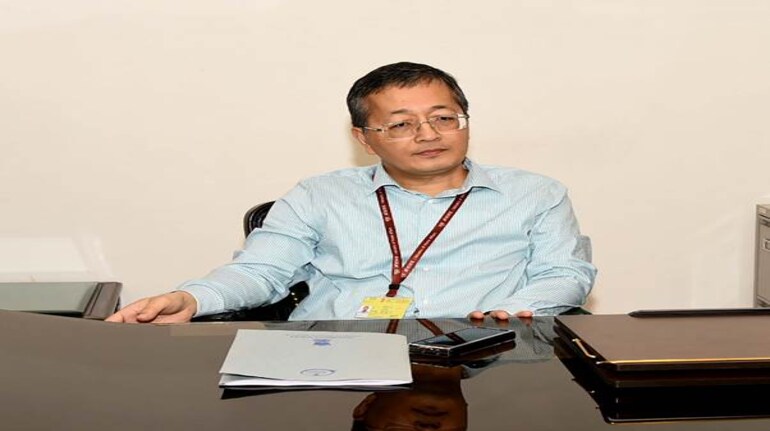

Just in time release of funds by the government is helping in managing central finances, optimising borrowing, and reducing the interest burden, Vumlunmang Vualnam, Secretary, Department of Expenditure told Moneycontrol.
In an exclusive interview, Vualnam said that the SNA SPARSH portal – operational from late 2024 – has onboarded 50 central schemes, which is helping the government track the money, and release it only at the time when it reaches the beneficiary.
"Earlier, money from the Consolidated Fund of India used to go the states' treasury. It used to get parked there, and never got to the intended beneficiary," said Vualnam, adding that almost Rs 1 lakh crore used to parked with states every year, and the Centre has to bear the burden, which now reduce to almost nil.
He further said that the government is reviewing its Centrally Sponsored Schemes, and some of them may be merged or closed down next financial year – in case they are not found to be impactful.
On the VB: G RAM G Act, the Expenditure Secretary clarified that the scheme is "demand-driven" – just like the erstwhile MGNREGA. "The interpretation that it is not demand-driven has been exaggerated."
"The so-called normative allocation is based on data—rural population, poverty levels, and likely requirements across states. By definition, a normative estimate is not something fixed; it reflects what should normally be required based on available data," explained Vualnam. Edited Excerpts:
Q. 16th Finance Commission report has recommended review of the centrally sponsored schemes. It has suggested the Centre to appoint a high powered committee that does a fresh assessment of the schemes and recommends closure of the schemes that are not spending resources productively. Is there any plan to do it?
A committee may not be required also, but we agree fully with what they have mentioned, that if the centrally sponsored schemes are not impactful, or the resources are not used, should definitely be closed down. And in fact, right from the time when the devolution jumped to 42% (from 41%) that thought has been very much there, because our centrally sponsored schemes involve huge outlay.
So, we agree with them fully. The evaluation will happen even without their recommendation, which all the Ministries are doing presently through the NITI Aayog. Third party agencies are doing evaluation of all the centrally sponsored schemes. Those reports will go to the ministries, and they will analyse those findings, not just on the use of the budget, but also the impact, the output, the outcome, and we would expect that some of them will get closed down, and maybe some will be merged.
Q. Can we expect some schemes closing down or merging in FY27?
Yes.
Q. The 16th FC report also suggests to nudge states towards privatization of DISCOMS. It’s asking states to pay the debt owed by DISCOMS, and urging Centre to make that as an eligibility criterion under 50-year capex loan scheme. Any thought on that?
See the DISCOMS and the way they function, is one of the issues that have to be tackled by the state governments. Even now we have that incentive where we allow an additional 0.5% of their GDP borrowing, provided states reimburse the DISCOM. So that system exists even now.
But the reality is that out of all the states, just about eight or nine states have been able to take those steps to make themselves eligible for that borrowing window. So DISCOMS and managing their finances is important, but we will see how the sectoral ministry, the Ministry of power, frame it out…maybe they'll have discussions with all the states, and we are there to support it. It is an aspect which has to be streamlined further.
Q. Are there any thoughts on taking steps to keep a check on irresponsible cash transfers by states? Can the capex loan scheme have one tied-provision which releases funds to only those states who don’t give such freebies?
I don't think so. The key word is ‘irresponsible’. Which one is responsible, which one is irresponsible? Because unconditional cash transfers, all said and done also have their attractiveness. You know, for that poor person, the villager, you know the cash reaches the household, it has that attraction. So irresponsible, definitely. If we could say that this is responsible, yes, everyone will agree and cut it down, shut it down. But that is too detailed a matter, which I don't think from central government level here can be prescribed.
Q. The interest payment burden, at the moment, is about 26% of your total expenditure. Is there a roadmap there to reduce it, considering you have a debt to GDP ratio estimated at 55.6% for FY27?
In our public finance management system, we have introduced an IT portal SNA SPARSH. This portal helps us in controlling our interest burden, because it allows us to release funds just in time.
In the new system, 50 schemes of the Centre have been onboarded. Now for those, the money gets released from Consolidated Fund of India (CFI) only when it is actually required for the disbursement to the beneficiary.
Earlier, money from the CFI used to go the states' treasury. It used to get parked there, and never got to the intended beneficiary. However, the Centre used to bear the borrowing costs. So now it is streamlined.
Also, just in time payment means that we also borrow, or we have to borrow only when it is required. The idle parking every year in the past used to be something like Rs 1 lakh crore -- of all the states combined.
Q. How much savings is expected in this financial year because of SNA SPARSH?
That will require some calculation. The SNA SPARSH portal is helping the borrowing being optimised.
Also, our colleagues in the Department of Economic Affairs, are working on how to meet with the market requirements of a predictable schedule of (borrowing). And our revenue colleagues are working hard to generate more revenue.
These are all the three aspects through which we will reduce interest payment. Going forward, the portal will onboard more than 50 schemes.
Q. There is an allocation of over Rs 95,000 crore for VB: G RAM G, while MGNREGA still retains about Rs 30,000 crore outlay. Why is that?
MGNREGA, which is based on an Act of Parliament, stands repealed. In that way, it has come to an end. It is only that there were some carryover liabilities which the Ministry of Rural Development received from the states.
The Rs 30,000 crore allocation is to honour those liabilities lying with the states. The ministry will verify these amounts. Some relate to the material component and some to the wage component of the scheme.
Once these are verified and disbursed, this coming financial year will be the last year when such allocations are required. Beyond that, there is absolutely no reason for it to continue. FY27 should be the year in which this is completed and closed.
MGNREGA was demand driven, and yet only 50-55 days of workdays was provided on average to a worker. Despite this, almost every year the revised estimate used to top the Budget estimate. In G RAM G, the allocation is fixed, but it provides guaranteed employment for 125 days.
Q. Is the estimate for FY27 not conservative?
First of all, let me clarify that the scheme is demand-driven. The interpretation that it is not demand-driven has been exaggerated.
The so-called normative allocation is based on data—rural population, poverty levels, and likely requirements across states. By definition, a normative estimate is not something fixed; it reflects what should normally be required based on available data.
It is very much demand-driven and, in fact, provides for up to 125 days of employment per household. With states now being active players, we believe the process will be much more streamlined and that those who genuinely require employment will receive it.
Q. Now the spending from G RAM G will be done by both Centre and states under the ratio of 60:40. Will this not increase states’ fiscal burden?
The allocation that you see is only the Centre’s share. With the 60:40 sharing pattern, overall expenditure on the scheme will be higher because states will also contribute.
The Centre is also flexible in providing additional allocation, as was the case earlier. It is an Act of Parliament that guarantees employment and that remains intact.
Concerns about state finances are a matter of prioritisation. If there are unemployed poor within a state’s jurisdiction and the state is unable to find resources even for less than half the cost, the people will decide.
Overall expenditure under G. Ramji is expected to be higher than what we saw under MGNREGA, since the states’ pool will now also come into play.
Q. Can you tell us when the 8th Pay Commission is expected to enforced?
It is very early days. There is no roadmap for implementation yet because we do not know how much time the Pay Commission will take. Some past commissions have taken up to three years to give their recommendations.
While the effective date is likely January 1, 2026, implementation planning will depend entirely on the Commission’s progress.
Q. Is there any estimate on what additional fiscal burden could the 8th pay commission impose?
There is no estimate that we are working with. The Pay Commission works on a clean slate, and we do not have any elements of the formula to assess fiscal impact at this stage.
In about six months, it should become clearer how the Commission is progressing and how it plans to approach the issues.


Discover the latest Business News, Sensex, and Nifty updates. Obtain Personal Finance insights, tax queries, and expert opinions on Moneycontrol or download the Moneycontrol App to stay updated!
Find the best of Al News in one place, specially curated for you every weekend.
Stay on top of the latest tech trends and biggest startup news.





