






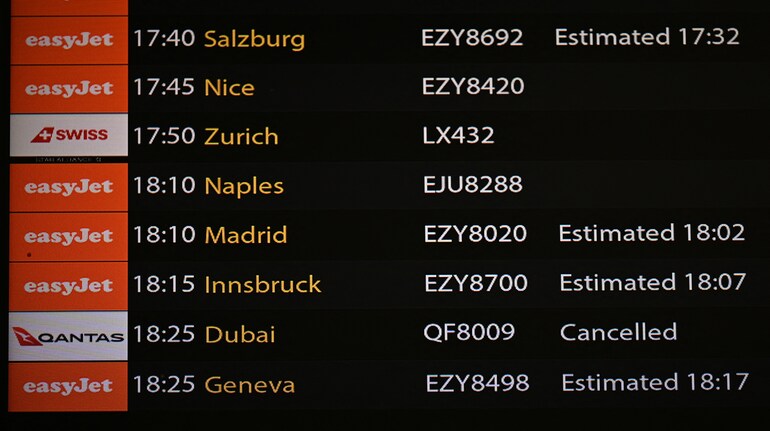

Airfares from India to Europe and North America have surged sharply after the shutdown of Dubai International Airport following missile strikes by Iran in the UAE and other Gulf regions, triggering a scramble for limited non-stop seats.
The suspension of operations at Dubai — a critical global transit hub — has disrupted one of the busiest air corridors for Indian travellers, forcing passengers to compete for direct flights to western destinations and pushing ticket prices to record highs.
An economy class seat on an Air India non-stop flight from Delhi to London Heathrow Airport for March 2, 2026, was priced at ₹156,500 on Saturday — more than double its typical fare. A similar economy ticket on Virgin Atlantic for the same route and date was selling at Rs 231,000.
These prices are approaching business-class fare levels typically charged on the route. By contrast, economy fares for departures a few days later were quoted between Rs 50,000 and ₹80,000, indicating that the spike is being driven by immediate travel demand.
Premium cabins have also seen sharp increases. A first-class seat on an Air India non-stop flight from Mumbai to London Heathrow for March 2 was priced at Rs 611,000, compared with its usual fare of about Rs 400,000.
Transit Hub Paralysed
Indian travellers often rely on one-stop connections via Gulf hubs due to lower fares and wider availability. The closure of both Dubai International Airport and Al Maktoum International Airport has severely disrupted this model.
Dubai International — the main hub of Emirates — is widely regarded as the world’s busiest international transit airport. The shutdown has had ripple effects across global flight networks.
The disruption has also placed pressure on neighbouring hubs. Abu Dhabi International Airport, the base of Etihad Airways, is among the region’s major international connectors, though airspace restrictions have complicated operations across parts of the Gulf.
Cancellations and Uncertainty
Late on February 28, Air India said it had cancelled 11 international flights from Delhi, Mumbai and Amritsar to destinations including London, New York, Newark, Chicago, Vienna and Frankfurt. Many of these services typically traverse Middle Eastern airspace.
While there remains uncertainty over when flying restrictions may be lifted, Gulf-based carriers were still offering tickets for March 2 departures from India to Europe with one-stop connections via their hubs. These included flights operated by Emirates, Qatar Airways, Oman Air and Saudia.
However, industry observers say pricing remains volatile and subject to further spikes depending on airspace developments in the region.
With Gulf hubs accounting for a substantial share of India’s westbound international traffic, the temporary loss of Dubai as a transit gateway has once again underscored the vulnerability of global aviation networks to geopolitical tensions — and left thousands of passengers facing steep travel costs or sudden cancellations.

Discover the latest Business News, Sensex, and Nifty updates. Obtain Personal Finance insights, tax queries, and expert opinions on Moneycontrol or download the Moneycontrol App to stay updated!
Find the best of Al News in one place, specially curated for you every weekend.
Stay on top of the latest tech trends and biggest startup news.





