
Operation Sindoor, India's unprecedented action against Pakistan-based terrorists to avenge the Pahalgam terror attack, was a meticulously planned operation carried out jointly by the Army and Air Force.
Defence sources have revealed exactly how India's calculated retribution played out — from 1.05am to 1.30am — catching Pakistani forces completely off-guard.
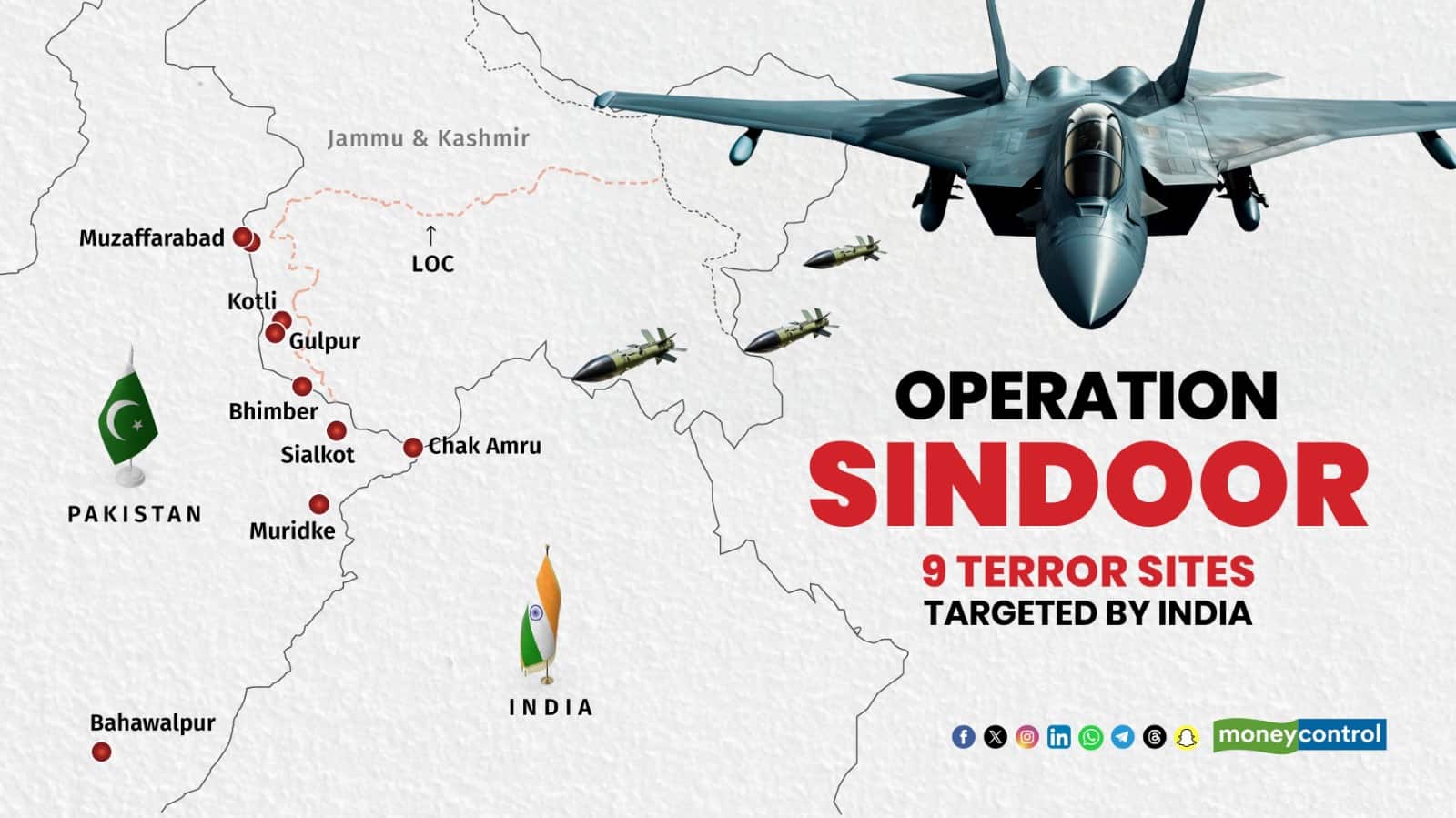
The armed forces carried out as many as 24 precision missile strikes on nine terror targets in Pakistan and Pakistan-Occupied Kashmir (POK), including Muridke and Bahawalpur — strongholds of terror groups Lashkar-e-Taiba and Jaish-e-Mohammed (JeM), respectively.
Strikes without crossing LoC
According to defence sources, the Indian Air Force (IAF) executed the operation without crossing the Line of Control (LoC). Frontline fighter jets including Rafale, Su-30 MKI and Mirage 2000 were deployed to carry out the mission.
Using precision-guided munitions, the IAF successfully hit terror sites that had long served as operational and training hubs for Pakistan-based groups.
Among the high-value targets hit were the Markaz Subhan Allah, the operational headquarters of Jaish-e-Mohammed in Bahawalpur, and Markaz Taiba of Lashkar-e-Taiba in Muridke.
Other targeted locations included Muzaffarabad, Kotli, Sialkot, Barnala and Bahawalpur—all identified as launchpads or training grounds for Lashkar, Hizbul Mujahideen and JeM terrorists.
Later, the armed forces gave video and photographic proof of the operation.
Advanced arsenal
Operation Sindoor saw a remarkable use of India’s aerial strike capabilities. Sources confirmed that the Spice-2000 bombs, Israeli-developed precision-guidance kits previously used in the 2019 Balakot strikes, were again deployed for maximum impact.
The IAF also used the SCALP missile—a long-range cruise missile with a strike capability of up to 250 kilometers. Mounted on Rafale jets, the missile was fired from within Indian territory, enabling accurate targeting without breaching Pakistani airspace.
While not officially confirmed, there are indications that HAMMER (Highly Agile Modular Munition Extended Range) bombs may have been used. These guided munitions are capable of hitting targets up to 70 km away and are known for their high precision and flexibility.
Su-30 MKI jets equipped with BrahMos missiles were deployed in a defensive role, ensuring full airspace security during the operation, News18 reported quoting sources.
Indian Army's blitzkrieg
While the IAF targeted distant facilities, Indian Army units struck closer targets using loitering munitions, including kamikaze drones. These drones hovered over targets, relayed real-time intelligence and carried out self-destructive strikes upon identifying enemy installations.
A loitering munition is a type of precision weapon that hovers over a target area to locate and strike targets, often autonomously or under human control, before being expended.
Surprise and fallout
The post-midnight strikes caught Pakistani forces completely off-guard. According to defence sources, Pakistan was unable to respond for 25-30 minutes, highlighting the surprise and efficiency of the operation.
Fearing further strikes, Pakistani forces relocated their artillery positions without firing, in an attempt to avoid detection and targeting.
At around 2am, Pakistan responded by targeting civilian areas along the LoC, triggering widespread ceasefire violations in sectors of Jammu and Kashmir. Shelling was reported in Poonch and Tangdhar, resulting in 15 civilian deaths and 43 injuries in Indian villages.
The Indian Army retaliated forcefully but exercised restraint to avoid firing into PoK villages, despite provocations.
“In a not very surprising move, Pakistani forces showed disregard for civilian lives, including their own. Pakistan in fact deployed mortar and artillery positions within PoK villages, anticipating Indian counter-fire to portray India as attacking civilians internationally," News18 quoted a defence ministry source as saying.
Discover the latest Business News, Sensex, and Nifty updates. Obtain Personal Finance insights, tax queries, and expert opinions on Moneycontrol or download the Moneycontrol App to stay updated!
Find the best of Al News in one place, specially curated for you every weekend.
Stay on top of the latest tech trends and biggest startup news.