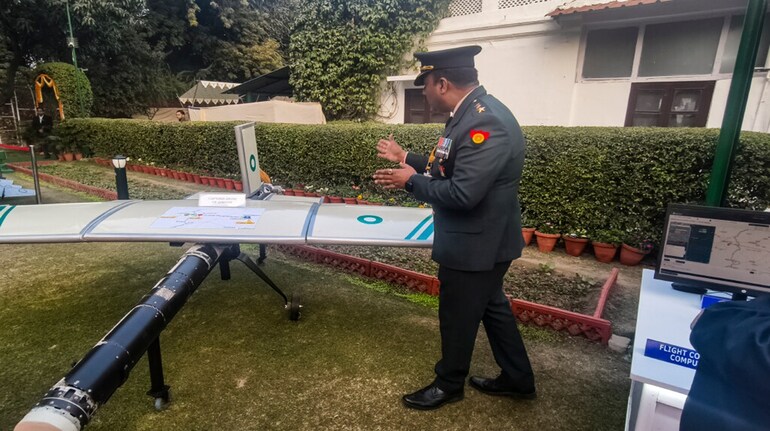
The Indian Army, on Monday, displayed a Turkish-made kamikaze drone that was neutralised by Indian forces on May 10, the final day of Operation Sindoor, a four-day military operation against Pakistan following the Pahalgam terror attack.
The display was part of an exhibition marking the 54th Vijay Diwas, hosted by Army Chief General Upendra Dwivedi, commemorating India’s victory in the 1971 war.
The drone, identified as a Yiiha-class unmanned combat aerial vehicle (UCAV), was launched from Lahore International Airport with Jalandhar as its intended target. Flying at approximately 2,000 metres, the drone carried a 10-kg explosive payload and was designed to detonate on impact.
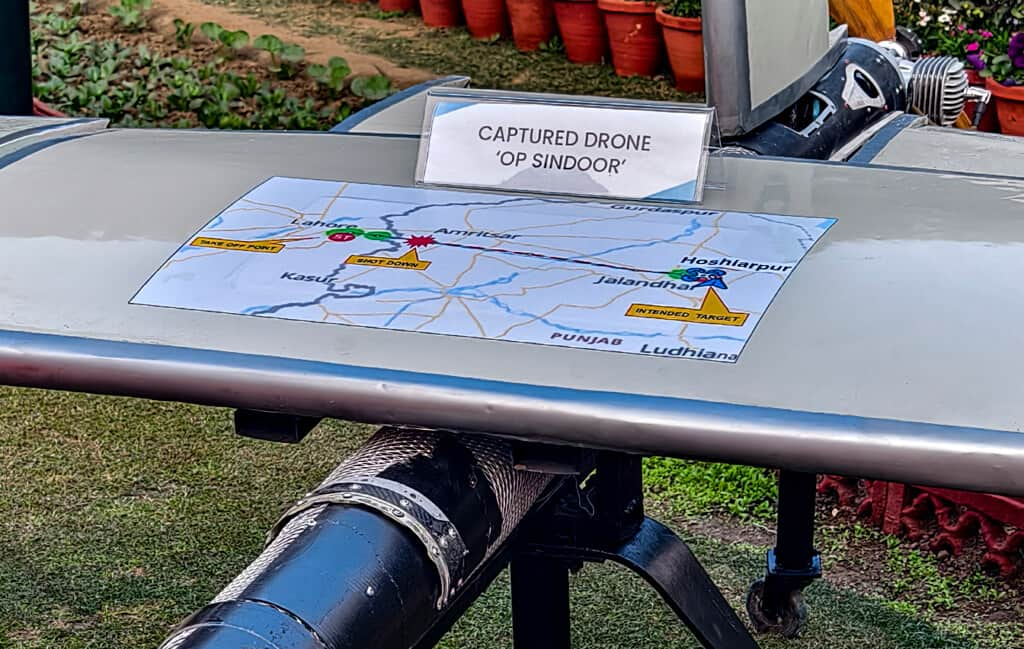
Notably, the Army Air Defence had successfully intercepted it before it could reach its target. The UCAV has a wingspan of about two metres and is powered by a 170 cc two-stroke engine.
Kamikaze drones, also known as “suicide drones,” are designed to loiter over a target area before striking.
Operation Sindoor was launched on May 7 in retaliation for the April 22 Pahalgam terror attack, which killed 26 civilians. The operation targeted terrorist infrastructure across Pakistan and Pakistan-occupied Jammu and Kashmir (PoJK), focusing on groups including Lashkar-e-Taiba, Jaish-e-Mohammed, and Hizbul Mujahideen. Over the course of the four-day operation, India destroyed nine major terror launchpads and killed over 100 militants.
During the 4-day conflict, the Pakistani military deployed hundreds of drones, including Turkish-made Asisguard Songar models, across 36 locations. Indian forces had successfully intercepted most of these drones using a combination of kinetic and non-kinetic methods.
The Indian Air Force played a key role, conducting precision strikes on strategic targets such as Nur Khan and Rahimyar Khan airbases while maintaining robust air defence to counter Pakistani drone and UAV attacks.
Indian air defence systems, including the indigenously developed Akash surface-to-air missiles, Pechora, and OSA-AK platforms, were deployed in a layered defence grid. The IAF’s Integrated Air Command and Control System enabled real-time coordination of air assets, allowing efficient neutralisation of aerial threats.
The Army’s air defence units complemented the Air Force by deploying shoulder-fired MANPADS, low-level air defence guns, and long-range SAMs, ensuring a comprehensive counter to waves of enemy drones.
(With inputs from agencies)Discover the latest Business News, Sensex, and Nifty updates. Obtain Personal Finance insights, tax queries, and expert opinions on Moneycontrol or download the Moneycontrol App to stay updated!
Find the best of Al News in one place, specially curated for you every weekend.
Stay on top of the latest tech trends and biggest startup news.