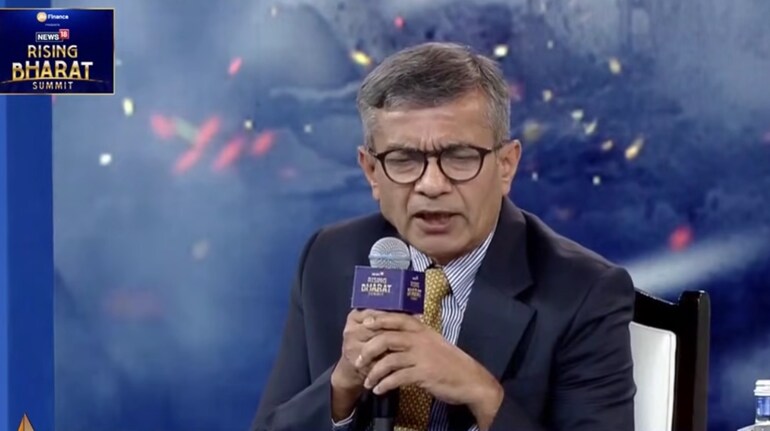
As tensions escalate in the Gulf following US-Israel strikes on Iran and Tehran’s retaliation, India’s Defence Secretary Rajesh Kumar Singh said at Network18's Rising Bharat Summit that New Delhi will safeguard its strategic interests through negotiation while maintaining its policy of strategic autonomy. From the future of the Chabahar port and fighter jet acquisitions to lessons from Operation Sindoor and India’s push for defence indigenisation, Singh outlined how India plans to navigate an increasingly volatile geopolitical landscape.
Here's the full transcript of his interview:Story continues below Advertisement
Story continues below Advertisement
Rahul Shivshankar:
Well, the man in the hot seat is Mr. Rajesh Kumar Singh. He's India's Defense Secretary and he's in on a day when there's been another war that has broken out, this time in the Gulf. And as you know, this morning we got news that the US and Israel conducted what they are calling pre-emptive strikes on Iran, not unexpected.
And the Iranians have hit back and they have targeted several US bases. They've also targeted, of course, places in Israel, US bases in the Gulf, in different countries, there's a whole list out there. So we speak in troubled, clamorous times, Mr. Singh. I want us to first look at this and focus a little bit on this latest conflagration. India obviously is going to be in focus because we are friends with Tehran and Tel Aviv. How will India approach this?
Rajesh Kumar Singh:
Well, Rahul, the events are moving pretty fast, so I don't want to make too many comments at this stage. But I do want to say that I'm happy that we're in India. We are an oasis in this world where there is a lot of geopolitical, a kind of geopolitical flux that is of conflicts around the world, including in the Middle East and in Europe for that matter.
So I think the present government under Prime Minister Modi has given us a level of both macroeconomic as well as geopolitical stability. And I'm happy that we are, you know, we are living in this country. But of course, in the Middle East, we have stakes there.
We have a very large diaspora. We'll be watching developments very, very closely. We have strong strategic partnerships with some of those countries.
And we will have to sort of continue to maintain those. Our policy is to have a multi-aligned kind of diplomatic engagement. So let's see where it goes.
But as of now, I would only say that we hope things will settle down, both for our own interests in terms of its impact on our oil supplies, but also for the people of those countries.
Rahul Shivshankar:
Well, let me ask you this because we also have an important stake in Iran, in a sense. There is the Chabahar port. We were, and this is what has come out in the media, that we were asked to pull back from that arrangement that we have and we secured an exception, which has now, of course, been, we've been put on notice, so to speak, by Trump.
How does that affect India's strategic play in that particular neck of the woods if we have to give up our interest in Chabahar?
Rajesh Kumar Singh:
Well, Rahul, the short answer is that we'll have to sort of negotiate our way to ensure that our interest in Chabahar is sustained and it brings us the benefits that we need in terms of access to trade routes, Central Asia, et cetera, and to Afghanistan. So, yeah, I mean, things are moving very, very quickly in terms of developments. Let's see where this takes us, but as far as I'm concerned, we are still, we intend to ensure that our investment in Chabahar yields us the dividends that we need.
Rahul Shivshankar:
How do we do that?
Rajesh Kumar Singh:
We do that by negotiating. I mean, you would have asked us, I mean, a few months back, you would have been wondering how would we manage the U.S. trade relationship along with the defense engagement. The fact is that we've been able to manage both. So let's see where this takes us. It's a bit early to say, but the intent is obviously to negotiate our way into a situation where our investment in Chabahar is protected.
Rahul Shivshankar:
So let me ask you because I'll just extrapolate on this. India is a firm believer in plurilateralism, multilateralism, and guards its strategic autonomy, as you know, fiercely. But here we have a situation where there are tugs now, increasingly in a conflict-ridden world.
We are expected to take stands, whether it's in the United Nations General Assembly or, of course, by some of our partners. And the United States perhaps is expecting India to stand with it. We've already made a commitment to Israel that we are going to stand with it in the interest of the defense of its realm.
The Prime Minister made that commitment. Do you think that alienates Iran and, by extension, our friends in the BRICS world that support Iran and have a problem with U.S. unilateralism?
Rajesh Kumar Singh:
So let me take you to the recently concluded International Fleet Review that we had in Vizag a few days back where there were 74 odd countries that took part. Incidentally, that included both the Iranian Navy and the U.S. and the Russians and a bunch of other countries. So India's strategic autonomy and its convening power is quite distinct in that sense.
We are able to maintain these high levels of alignment with different countries. Of course, it goes without saying that with some countries, the relationship is a bit closer. It is more strategic, and you mentioned one of them, Israel, maybe a few others, but I don't want to mention them right now.
There's no need to differentiate among friends, but India's ability to strike and align and engage with different countries, even when they are in conflict with each other, has been sort of shown over the years.
Rahul Shivshankar:
Just to press you on that, you said that we don't want to differentiate, but when we don't take a stand, for example, in the United Nations on issues that are shaped as moral questions, and the number of our abstentions has actually gone up over the years. I'm not saying that we're the only ones, because other powers are also abstaining more often than not. So we're not isolated or alone in this, but when we see these abstentions going up, many people will say that we are actually differentiating, specifically if this matter of Iran comes up, which it will in the UNGA, because it's not going to be resolved in the UNSC, it's going to come up for vote.
What do you think India should be doing? We haven't heard from the Indian government as of, I checked last, about an hour back, so do excuse me if things have overtaken. But fundamentally, should we at least express serious concern, or should we stand up and say that perhaps it's going a bit too far?
We have a political interest also. We have ties with the go-back – civilizational ties with Iran. How far can we just keep sitting on the fence and hedging?
Rajesh Kumar Singh:
Well, I'm sure the Ministry of External Affairs will give a response. It's fairly early days, it's not even a day, to be very frank. And about, you know, taking a stance on every issue, I think this is a time when you have this situation where it is kind of becoming a situation where every man is for himself, where to some extent might is right is resurfacing.
I'm not, I mean it's better that I don't sort of get into the diplomatic sort of domain so much.
Rahul Shivshankar:
I appreciate that. That is not really your area, and I will respect those red lines. But let me bring you back to the larger questions that have emerged now after Operation Sindoor.
How do you see, after Operation Sindoor, the defense scenario changing? India obviously needs to now take into account its experience in Operation Sindoor. How does it equip itself for the next few decades?
What are the learnings?
Rajesh Kumar Singh:
Well, it was an important learning experience. It showed certain things clearly, the primacy of standoff weapons, of air power, of unmanned systems of different types, both for ISR and for combat. All of those areas revealed certain strengths that we had.
They also revealed certain capability voids that were there, and those are being filled up at a very rapid pace. We've created this accelerated green channel for emergency procurements to fill some of those capability voids. In addition, you would have observed that we've got a significant jump in our modernization budget for the year, for the next financial year of 24%.
That would enable us to ensure that in different areas for the Air Force, we will need more fighters, more refuelers, and more AWACS. For the Navy, we need more platforms, including underwater platforms, and as I mentioned, we need more unmanned systems of different types for both ISR and for combat. So all of those areas are being addressed very, very speedily in terms of faster procurements.
We've signed, as I keep mentioning, a record 2.9 lakh crore worth of contracts last year. This year, we've already hit about 2 lakh crores of contracts. The intent is to give visibility to industry in terms of what they need to do all the way down the value chain, and we're going to keep up the pace until every area of where we have a capability issue is speedily addressed.
Rahul Shivshankar:
So the DAC has gone ahead and approved purchases of the Rafales, as you know. There are also conversations happening with the Russians for the purchase of the advanced Sukhoi. There's also, of course, U.S. interest. Which direction are we headed? Are we going to keep all three engaged? Are they all three players that we're looking at to acquire aircraft and other weapons systems, specifically aircraft? Let's talk about those first.
Rajesh Kumar Singh:
So on aircraft, you're aware that we've indicated our willingness to go ahead, in-principle, with the MRFA, the Rafales that you mentioned, subject to two conditions, that they have to be largely made in India and that they would have a minimum level of indigenous content, which we are going to negotiate with them, and we will have a threshold that we have in mind, and also the ability to integrate our weapons on them, if not complete access to the source code, at least to the ICDs, so that our weapons can be integrated. So subject to us able to negotiate those outcomes, we will proceed with that program in a big way.
It also gives us the advantage of having a second fighter jet production line in the country, since so far we've essentially had only one player in that area. And as you are aware, for our own fifth generation program, the AMCA, we are in the process of shortlisting, most probably a private player for building the prototypes. So as of now, the direction is clear, we are going to do the MRFA program with Rafale.
Our fifth generation fighter is going to be the AMCA. On the other two candidates that you mentioned, we've not taken a call as yet, but as of now, that is the way we are proceeding.
Rahul Shivshankar:
So you're saying we haven't taken a call on the Russian and the American offer that's on the table?
Rajesh Kumar Singh:
Yes.
Rahul Shivshankar:
That's an important bit of news coming out from Rising Bharat Summit. I know that it's not possible for you to give names of any preferred partners, but will India take a call on procuring the fifth generation fighters this year?
Because the deadlines that were invaluable at one time, as far as our own AMCA is concerned, are constantly being pushed, and I know that the Air Chief has also expressed his disappointment.
Rajesh Kumar Singh:
I wouldn't be able to give a timeline on this, because frankly, we've not really applied our mind. There are too many other things happening around the world. It's going to be a major strategic decision. Once we take a call, the media will get to know, but as of now, we don't have a decision on that.
Rahul Shivshankar:
The Air Chief did express his disappointment at the fact that indigenous production is not meeting the timelines. What is the issue here, number one? Number two, on the issue of procuring engines or manufacturing our own engines, where are we as of now?
You have said that you're hoping to involve private players. Has anyone come forth? Is there a lot of interest?
Rajesh Kumar Singh:
So two or three different issues here. I think you were talking about the delays with regard to the Air Chief's statement, I guess about the light combat aircraft Tejas' program.
Rahul Shivshankar:
That's right.
Rajesh Kumar Singh:
Now, in that program, there is a dependency on the engine, which has caused delays in the past, but five engines have come now, and the expectation is that 20 more will come in this calendar year. The delay in terms of taking delivery right now is in relation to integration of certain weapons and radar and EW systems, which is ongoing. Hopefully, that will get sorted out by April this year.
The intent really is that now that HAL has an order for 180 of these LCA Mark 1A aircraft, that they will be able to perfect this. Not only it is a very, very safe, very, very dynamic aircraft, but there is an issue in terms of integration of adequate weaponry on it. Hopefully, that will be perfected over the course of this order in the next one year or so, I would imagine, or even earlier.
So that process will enable then this large sort of increase in our fighter aircraft inventory. In addition, when I mentioned the private sector part, I was really talking about the AMCA. For the jet engine program that you mentioned, which is an important import dependency for us, has been for a long time.
The government is intending to have one of our labs, the GTRE, a DRDO lab, tie up with an international engine house, subject to the condition that they tie IPR West within the country. Now, that process of taking an approval for that program, which will be a significant and fairly financially large program, is currently underway.
Rahul Shivshankar:
So I'll come back to the Tejas question in just a few moments. But I just want to go back to where we were with Russia, purchase of Sukhoi 57s and so on and so forth. Have sanctions and now, of course, the talks with regards to the framework of a trade deal with the United States, in any way impeded on India's interest in acquiring Russian weapon systems, A, B, the Sukhoi 57?
Rajesh Kumar Singh:
I can assure you that that is not the case. There has been no sort of overflow from the trade negotiations on our defense engagement. In fact, we signed a 10-year defense cooperation framework in December, much before the trade deal got finalized.
So that's not the case. We continue to take from the Russians equipment that we need, and we will do so with the Americans and the French or anybody else, where we identify weapons or platforms that we really need. But more than any of this, we really want to double down on indigenization and try to make sure that either we do it ourselves, or at least where the TRL level is a bit low in India, at least we get TOT and do it through the Make in India route.
Rahul Shivshankar:
But is the Sukhoi 57 on the table? Because a number of people don't think it's the best.
Rajesh Kumar Singh:
Yeah, so again, which is why I mentioned that we have not taken a call on this yet. And the issue that you mentioned, the comparisons, all of that, I would not be able to really answer. But yes, all of those issues have prevented us from taking a final call on this.
Rahul Shivshankar:
Coming back to Tejas, what is the initial feedback on the recent Tejas crash?
Rajesh Kumar Singh:
Well, this was an incident at the ground level. It is a relatively minor accident. It did not involve an ejection.
The pilot was safe. There is some damage to the aircraft. But because it involved some level of malfunctioning, that is why the entire aircraft seat is still operational.
But meanwhile, the precautionary checks are being done with respect to this particular element. So I would say that it's not that serious an accident. But nonetheless, as a precaution, we are ensuring that the safety checks are done, which is why everybody has been saying that they didn't take part in Vayu Shakti. Well, that was the reason. But the aircraft are still operational.
Rahul Shivshankar:
But nothing that happened in the Dubai Airshow has led to the decision not to showcase the Tejas?
Rajesh Kumar Singh:
No, nothing to do with that. This was linked to, as I mentioned, a ground level incident, which happened only much after the Dubai incident. As far as the overall safety record of LCA is concerned, you would see that from 2019 onwards, it has had several thousand hours of flying and its safety record is one of the most robust in the world.
Rahul Shivshankar:
So are you saying that the Dubai incident was an aberration?
Rajesh Kumar Singh:
That's what I'm saying. Yes. Correct.
Rahul Shivshankar:
And there was no underlying technical issue which would raise red flags?
Rajesh Kumar Singh:
Yes. I mean, that is the indication that we have from the Air Force and from HAL.
Rahul Shivshankar:
How do you expect defense production exports to go up? You said Atmanirbharta is obviously the most important spoke in the wheel now going forward. How do we get to the point where we become Atmanirbhar? And what is the timeline that we have in mind? And let's look across all sectors.
Rajesh Kumar Singh:
Well, I mean, the way you make it happen is by taking certain policy decisions and then sticking to those. One of those is that we don't do any imports until we do them only as an exception. And that too, every such decision goes to the entire Defense Acquisition Council, which means the Raksha Mantri personally has to clear any imports.
The second is that we ensure that we have a normative target in front of us, that every year we'll ensure that at least 75% of our money, the modernization budget is spent within the country. And we've achieved that over the last two years. Last year it was as high as 88%.
So this combination of factors, the fact that global buyers would be an exception, that your Indian rupee contracts will dominate to the extent of 75%, and the fact that even when you do any import of platforms, you ensure that the bulk of those two are made in India, as you would have observed in respect of the prospective Rafale deal as well. So this policy framework ensures that Atmanirbharta is built into the procurement process itself.
Rahul Shivshankar:
Now, there are some people who say that one way of making our own industry, specifically the PSUs, more competitive is to perhaps open them up, divest. So are we seeing any roadmap towards the privatization of certain defense PSUs? Is that on the cards at all?
Rajesh Kumar Singh:
Well, I mean, before that, let me say that for a long time, we've been hearing that this phrase, the level playing field, and the private sector doesn't get a level playing field. I think over the course of the last couple of years, those complaints have largely disappeared, because we've ensured that whether it is the AMCA project, where we actually opened it up beyond HAL, whether it is in terms of ammunition, where we revised the defense procurement manual to ensure that there is no NOC business from a private sector. We've removed product reservations.
So all of these areas, the monopoly position of the public sector has already been dismantled. So in that sense, we've taken real steps, and I don't think the private sector will have any complaints to say. We've removed the issue of nomination of any orders being guided towards a particular PSU.
All that is over. We are doing everything, almost everything, through tendering, through competitive bidding, where the private sector gets to play a role. The only area that is different is that the private sector industry in France needs a license, whereas the PSU, obviously, because it is fully owned by government, doesn't need a license.
Everything else is probably the same for both categories. As regards disinvestment or divestment, I don't have a brief on that, so I wouldn't be able to tell you right now as to what is the plan.
Rahul Shivshankar:
But are you open to the idea?
Rajesh Kumar Singh:
Personally, I am open to the idea. I think in many of our PSUs, which are, in any case, public companies with significant quantities which are already available in the markets, the possibility of many of them are riding high in terms of their stock prices as well. But in terms of whether you dilute some of it, that is a decision that perhaps is not entirely mine to take.
My personal view is that some level of dilution could be done, but more importantly, as I mentioned, we have tried to ensure that public sector monopoly is dismantled, not only to improve efficiency, but my view, and I believe it passionately, is that the competition from the private sector will improve the performance of the public sector as well.
Rahul Shivshankar:
How many applications does the defense ministry have for 100% FDI? In new and existing defense projects?
Rajesh Kumar Singh:
I don't have a current figure. The only 100% FDI that we have so far is one particular company, a Swedish company. I don't know if there are others as well.
See, the reason why the FDI in defense is not that high in numbers is because in our procurement process, we don't treat a majority foreign-owned firm as an Indian vendor. Until we change that, the large FDI may not come. But at this stage in our development process, as we develop a modern defense industrial complex, incidentally, during the process of review of our defense acquisition procedure, this was discussed, whether we should allow even a 100% foreign OEM subsidiary in India to be also treated as an Indian vendor.
But most Indian companies who are growing their business in this space, including the large ones, the big conglomerates, everybody felt that it's a little too early. This definition of an Indian vendor gives them leverage in terms of getting technology and tie-ups from foreign OEMs, which is why a considered decision right now is that we won't do it right away, which is why I don't expect big numbers in FDI to come. However, I want to say that there could be cases where there is a particular niche technology which is not available anywhere else.
And in such a case, a strategic partnership, even with a foreign OEM, with a subsidiary, or even a 100% subsidiary, could be considered. But as a policy, we have not decided to treat a foreign company as an Indian vendor as of now.
Rahul Shivshankar:
Sir, let me ask you this, because we are seeing Operation Sindoor as perhaps one of those watershed moments. For the first time, you saw two nuclear powers go up against each other, and it has obviously sparked an entire new conversation about the way the wars of the future might be fought.
Capital allocations have been made in the budget. How much of those have been made, keeping in mind scenarios that emerge from Operation Sindoor? And I would like first for you to paint some of these scenarios.
Rajesh Kumar Singh:
Well, obviously, during Operation Sindoor, you saw the use of mostly stand-off weaponry, of precision munitions, of not too much of conventional warfare, a lot of use of different types of one-man systems. In the Middle East today, also you are seeing something similar.
The importance of air defense obviously has gone up, which is why the Honourable Prime Minister announced our version of a protective dome for the country, the Sudarshan Chakra mission, where we already have good capabilities, but we can improve it further in terms of bringing new cutting-edge elements to it. So all of those are lessons, and I mentioned that as a part of that drawing from those lessons, we have drawn up both an emergency procurement pipeline as well as a fast-track pipeline to meet some of these gaps in these critical areas. And by doing so, the emerging trends in warfare will, of course, be kept in mind.
Rahul Shivshankar:
So you want to match some of these or basically fill some of these gaps in developing the Sudarshan Chakra, because what we did see was a lot of beyond-the-line-of-sight munitions being used. Is Israel going to fill that gap?
We know that they have Iron Dome capabilities. It is being tested even as we speak right now. Was that part of the conversation between the two Prime Ministers just a few days ago, sir?
Rajesh Kumar Singh:
Let me just say, I am not privy to that conversation, of course, but I do want to say that we have a very detailed memorandum of understanding on defence cooperation with the Israeli side, which I signed in November when I was there. And we are building on that with a lot of industrial collaborations with the key Israeli companies, two of which are public sector companies, IAI and Rafael, and one is a private company, Elbit.
All three are active in India. They have tied up with multiple Indian companies, including both public and private sector companies. Now the intent is that in the coming years you will see a lot of co-production and joint ventures happening in India, where Israeli and Indian companies will collaborate.
They need India's scale and our labour, because obviously it is a small country. They will never be able to get the kind of scale and production in production that India can offer. They in turn can offer us cutting-edge technologies, particularly in some of the niche areas that you mentioned.
So we are working on all of that, but a lot of this stuff, by definition, has to be kept confidential. So all I would say is that, yes, we have a very active, very robust defence cooperation engagement with Israel, and I am sure the Prime Minister's recent visit will strengthen this relationship in this domain as well.
Rahul Shivshankar:
So on a follow-up there, after Operation Sindoor, there was this apprehension that we might have depleted some of our munitions. Have we now replenished to levels prior to Operation Sindoor? Are we back to where we should be?
Rajesh Kumar Singh:
Well, the emergency procurement was in fact designed to replenish some of those inventories. I would say we have signed contracts to replenish most, and even strengthen those inventories. That process is on with various countries, including both the US and the Russians, just to sort of re-emphasise the point about strategic autonomy.
So yes, that process is on, and in certain cases, the inventory would be not only replenished, but would be further strengthened.
Rahul Shivshankar:
There will be an augmentation. Beyond the line-of-sight munitions, obviously a game-changer, and we are seeing them again being used in the Gulf over the last few hours. Just to take that conversation with you forward, there has always been a debate about whether we should be investing, for example, in hardware like your main carriers, battleship carriers. Has Operation Sindoor brought any clarity to that debate? Which side of the fence are we now on?
Rajesh Kumar Singh:
So I'll talk about the aircraft carrier a little later, but as you know, India does already have two aircraft carriers. Equally importantly, this government has had the courage and the clarity to ensure that our island territories are also suitably utilised to meet our strategic needs, whether it is in terms of building up strategic assets or commercial development of our islands. And the importance of stand-off weapons, of course, was borne out during Operation Sindoor, and let me stress that a lot of our, because of the long, because of the foresight of Dr. APJ Abdul Kalam in particular, India has a fairly large, well-developed, diversified missile development programme. This is one area where DRDO has done quite well. And these are, I mean, some of these stand-off weapons, long-range missiles, strategic types of systems, nobody is going to give it to you, frankly. So you have to do it yourself, and we have done it ourselves.
There are, there would still be some niche areas which we would rely on friendly foreign countries for technology transfers or co-production, but for the most part, for many of these systems, I think this is a success story of indigenisation in any case.
Rahul Shivshankar:
But let's just go back to the battleship question. Has that been resolved now after Operation Sindoor? I think we need some clarity on that.
Rajesh Kumar Singh:
We have not taken a view on the third aircraft carrier, so I would say that the debate is still on.
Rahul Shivshankar:
The development, as you said, of some of our island territories, that's been a priority, and it's, of course, now come out in the news also that we are going ahead with the Great Nicobar Project. How did that change dynamics from a defence strategy point of view? I know some of these will be dual use, so it won't just be purely commercial.
Rajesh Kumar Singh:
Yeah, so, I mean, without talking too much about...
Rahul Shivshankar:
So let me just be very direct, sorry. I didn't mean to cut you off. Is this aimed at some of the region's powers? Let me be very direct.
Rajesh Kumar Singh:
Yeah, so the Andamans are very strategically located, right? Very close to the Malaccas and Malacca Straits, some other choke points in the Indian Ocean, so our ability to project power from there is important for us. Also, there is an important, they are important economic assets as well.
If we can develop it, if we can develop a large ICTT, a large container terminal there, if we can develop it as a tourist hub, build a township there, all of that are on the anvil, and the point is that because it is so close to some of the densest, one of the densest trade routes in the world, it enables you to create a condition where we can rival Hong Kong or Singapore in terms of developing that territory.
Rahul Shivshankar:
Mr. Rajesh Kumar Singh, Defense Secretary of India, thank you very much for taking these questions from us and thank you for going into such details, and thank you for making the time.