






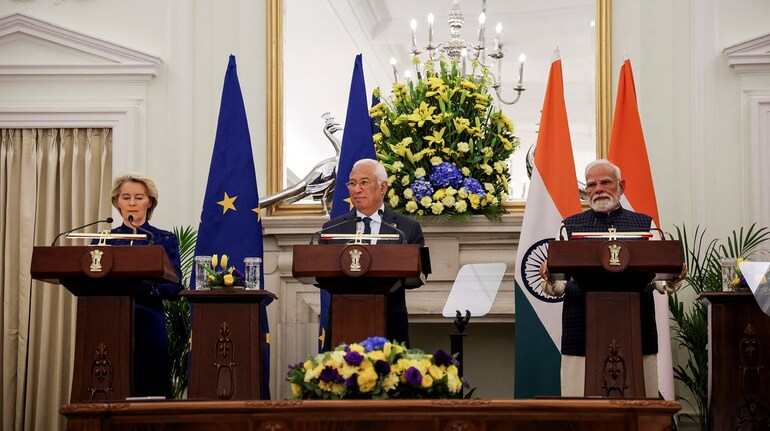

India and the European Union on January 27 announced a landmark trade agreement that will provide a massive boost to economic and security partnership between the two sides.
The deal is set to provide a $75 billion boost to Indian exports with preferential access in the European markets for 99 percent of goods. The Union also expects to double its shipments to India by 2032.
Prime Minister Narendra Modi met European Commission president Ursula von der Leyen and European Council president Antonio Costa during the India-EU summit held in New Delhi, where the formal conclusion of the talks was announced.
However, does it mean that the pact will become effective immediately?
No, the agreement will now go through a lengthy review process by various stakeholders before it gets implemented. The documents signed and exchanged on January 27 were the procedural documents to mark the end of the talks and not the actual trade agreement.
So, what happens now?
The agreement will now go through a process referred to as “legal scrubbing”, under which a detailed technical and legal review will be carried out by both India and the European Union. Officials said a cleaner and consolidated version of the agreement will be readied in the next two weeks before being set for legal checks. This process is expected to take at least 5-6 months, following which the FTA can be signed formally.
However, the process won’t be over until the agreement is ratified by the top decision-making bodies on both sides. In India, the deal will be ratified by the Union Cabinet and the European Parliament will have to stamp its approval for EU, which is expected to take more time.
The EU will publish the draft text, which will later go for revision and translation into all the official languages of the Union. The agreement will be then proposed for conclusion and adoption. It can then go for signature between EU and India, following which the European Parliament will give its approval. The final step includes the EU Council’s decision on concluding the deal.
When can we expect the deal to come into force
Union commerce minister Piyush Goyal on January 27 indicated that the government hopes to make the deal become effective in 2026 itself.
“Every agreement stands on its own legs and this is a wonderful agreement. It will be taken up for legal scrubbing on a fast track basis as we discussed today and translated into 25 languages simultaneously. We do hope that we should be able to celebrate the entry into force of this agreement within calendar 2026,” Goyal said during a press briefing.
Top government officials have also hinted at singing the deal by the end of this year. However, the deal is likely to be implemented in early 2027, depending on how quickly the ratification process is completed.
Prime Minister Narendra Modi hailed the conclusion of the India-European Union Free Trade Agreement (FTA), describing it as "not just a trade agreement, but a blueprint for shared prosperity."
PM Modi noted that India-EU relations have grown exponentially in recent years, rooted in shared democratic values, economic synergy, and strong people-to-people ties, acknowledging that the India-EU trade stands at EUR 180 billion.
The trade negotiations between India and the EU had first opened in 2007. However, the talks remained frozen for several years, before picking up pace in 2022.
Discover the latest Business News, Sensex, and Nifty updates. Obtain Personal Finance insights, tax queries, and expert opinions on Moneycontrol or download the Moneycontrol App to stay updated!
Find the best of Al News in one place, specially curated for you every weekend.
Stay on top of the latest tech trends and biggest startup news.





