Black Friday Sale
Black Friday Sale
HomeNewsIndiaNegative RT-PCR report may become mandatory for passengers arriving from China, 5 other countries: Sources

Negative RT-PCR report may become mandatory for passengers arriving from China, 5 other countries: Sources

Filling up of 'air suvidha' forms and 72-hour prior RT-PCR testing may be made mandatory from next week for international passengers coming from China, Japan, South Korea, Hong Kong, Thailand, and Singapore.

December 28, 2022 / 17:16 IST
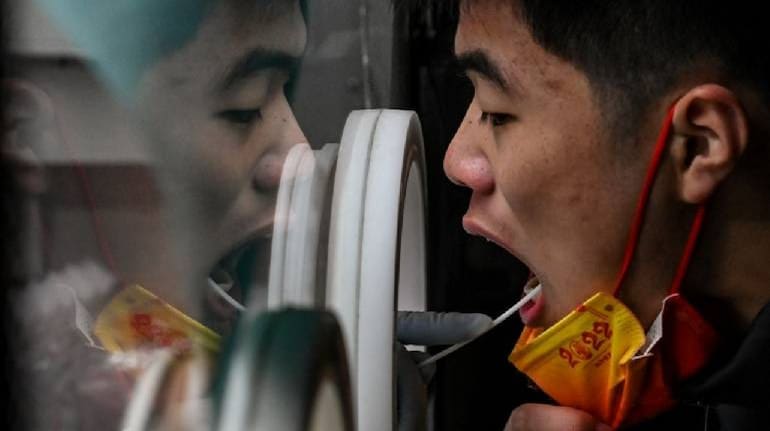
Representative image

The government is likely to make it mandatory for passengers arriving from China and five other places to have negative RT-PCR reports from next week, official sources said on Wednesday. They also cautioned that the next 40 days will be crucial as India may see a Covid surge in January.

Even if there is a wave, deaths and hospitalisation will be very low, the Health Ministry sources said.

"Previously, it has been noticed that a new wave of COVID-19 hits India around 30-35 days after it hits East Asia…. This has been a trend," an official said.

The sources said filling up of 'air suvidha' forms and 72-hour prior RT-PCR testing may be made mandatory from next week for international passengers coming from China, Japan, South Korea, Hong Kong, Thailand, and Singapore.

The sources said 39 international passengers were found positive for COVID-19 out of the 6,000 tested on arrival in the last two days.

COVID-19 Vaccine

Frequently Asked Questions

View more
How does a vaccine work?

A vaccine works by mimicking a natural infection. A vaccine not only induces immune response to protect people from any future COVID-19 infection, but also helps quickly build herd immunity to put an end to the pandemic. Herd immunity occurs when a sufficient percentage of a population becomes immune to a disease, making the spread of disease from person to person unlikely. The good news is that SARS-CoV-2 virus has been fairly stable, which increases the viability of a vaccine.

How many types of vaccines are there?

There are broadly four types of vaccine — one, a vaccine based on the whole virus (this could be either inactivated, or an attenuated [weakened] virus vaccine); two, a non-replicating viral vector vaccine that uses a benign virus as vector that carries the antigen of SARS-CoV; three, nucleic-acid vaccines that have genetic material like DNA and RNA of antigens like spike protein given to a person, helping human cells decode genetic material and produce the vaccine; and four, protein subunit vaccine wherein the recombinant proteins of SARS-COV-2 along with an adjuvant (booster) is given as a vaccine.

What does it take to develop a vaccine of this kind?

Vaccine development is a long, complex process. Unlike drugs that are given to people with a diseased, vaccines are given to healthy people and also vulnerable sections such as children, pregnant women and the elderly. So rigorous tests are compulsory. History says that the fastest time it took to develop a vaccine is five years, but it usually takes double or sometimes triple that time.

View more
Show

Union Health Minister Mansukh Mandaviya will visit the airport in Delhi on Thursday to take stock of testing and screening facilities there, they said.

The proposed tightening of Covid guidelines and warning of a fresh surge come days after Health Minister Mandaviya asked Congress leader Rahul Gandhi to consider suspending the Bharat Jodo Yatra if COVID-19 protocols could not be followed.

The yatra, currently on winter break, will resume on January 3.

Amid a spike in COVID-19 cases in some countries, including China and South Korea, the government has sounded an alert and asked states and Union territories to prepare for any eventuality.

Following the surge, the government made random coronavirus testing mandatory for two per cent of passengers arriving in each international flight from Saturday.

Prime Minister Narendra Modi and Health Minister Mandaviya have held meetings to assess the country's preparedness to deal with a fresh surge in cases.

Mock drills were held at health facilities across India on Tuesday to check operational readiness to deal with any spurt in COVID-19 infection, with Union Health Minister Mansukh Mandaviya saying the country has to remain alert and prepared as cases are rising in the world.

The latest spike in cases is being driven by Omicron sub-variant BF.7.

The official sources said the transmissibility of this BF.7 sub-variant is very high. A person infected with the sub-variant can further infect 16 persons.

PTI
first published: Dec 28, 2022 05:12 pm

Discover the latest Business News, Sensex, and Nifty updates. Obtain Personal Finance insights, tax queries, and expert opinions on Moneycontrol or download the Moneycontrol App to stay updated!

Subscribe to Tech Newsletters

  • On Saturdays

    Find the best of Al News in one place, specially curated for you every weekend.

  • Daily-Weekdays

    Stay on top of the latest tech trends and biggest startup news.

Advisory Alert: It has come to our attention that certain individuals are representing themselves as affiliates of Moneycontrol and soliciting funds on the false promise of assured returns on their investments. We wish to reiterate that Moneycontrol does not solicit funds from investors and neither does it promise any assured returns. In case you are approached by anyone making such claims, please write to us at grievanceofficer@nw18.com or call on 02268882347