






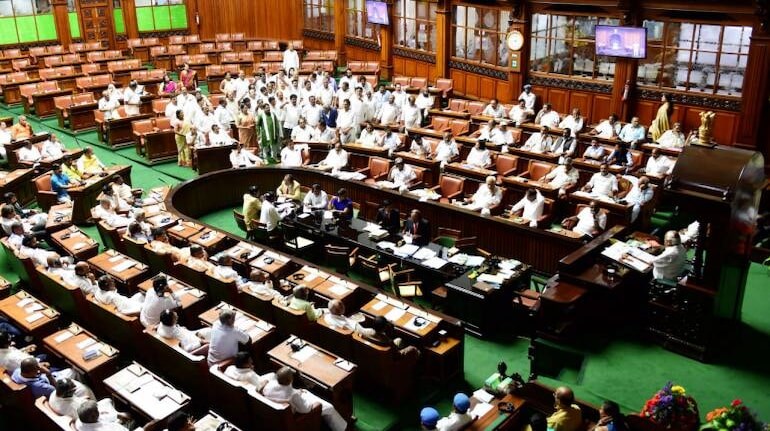
The Karnataka legislature witnessed an uproar on Thursday when Governor Thawarchand Gehlot left the joint sitting of the Assembly and Council abruptly after reading just two lines of his customary address and refusing to deliver the complete cabinet-cleared speech.
“My government is committed to doubling the economic, social and physical development of the state. Jai Hind, Jai Karnataka,” he read in Hindi.
The development followed a confrontation between Raj Bhavan and the Congress-led state government over 11 paragraphs in the address that were critical of the Centre, particularly on issues related to the rural employment guarantee scheme and claims of inadequate tax devolution and fund transfers to the state.
Congress members expressed strong displeasure over the Governor curtailing his speech, and raised “Shame Shame” slogans on the floor of the House.
Three days, three governor walkouts
Since January 20, Karnataka has become the third southern state – after Tamil Nadu and Kerala – to witness a confrontation between the government and Governor over the customary address to the joint sitting of the legislature.
While Tamil Nadu Governor RN Ravi walked out without delivering the speech, his Kerala counterpart Rajendra Arlekar omitted portions that were critical of the union government.
In a press release issued by Lok Bhavan, the Governor's office elaborated on the reasons for RN Ravi's decision. It stated that the speech contained numerous unsubstantiated claims and misleading statements while ignoring crucial issues affecting the people.
Thereafter, a similar scenario was witnessed in Karnataka too.
Strongly criticising the governor, Siddaramaiah accused him of acting at the behest of the Centre and said that he was acting as a “puppet".
“Addressing the joint session at the beginning of every year, and at the time of formation of a new government, is a constitutional duty of the Governor. Under Articles 176 and 163 of the Constitution, the Governor is bound to read the address prepared by the Council of Ministers and has no authority to substitute it with a speech of his own. This has been the established constitutional practice since the adoption of the Constitution,” he said.
So what does the Constitution say?
Article 176 of the Constitution makes it mandatory for the Governor to address the legislature at the first session each year and after elections. Article 163 also provides that the Governor acts on the aid and advice of the Council of Ministers, except in narrowly defined discretionary matters, which do not include the Governor’s address.
The address reflects the state government’s views and is drafted by the elected executive, not the constitutional head.
In the Nabam Rebia case (2016), a five-judge Constitution Bench of the Supreme Court ruled that Governors cannot use constitutional authority to undermine elected governments and must strictly follow the Cabinet’s advice, reinforcing the argument that the Governor cannot selectively omit or alter portions of the address.
Unlike opposition walkouts, which are political in nature, a Governor’s walkout constitutes a constitutional rupture that underscores the need to clarify the grey area.
Discover the latest Business News, Sensex, and Nifty updates. Obtain Personal Finance insights, tax queries, and expert opinions on Moneycontrol or download the Moneycontrol App to stay updated!
Find the best of Al News in one place, specially curated for you every weekend.
Stay on top of the latest tech trends and biggest startup news.




