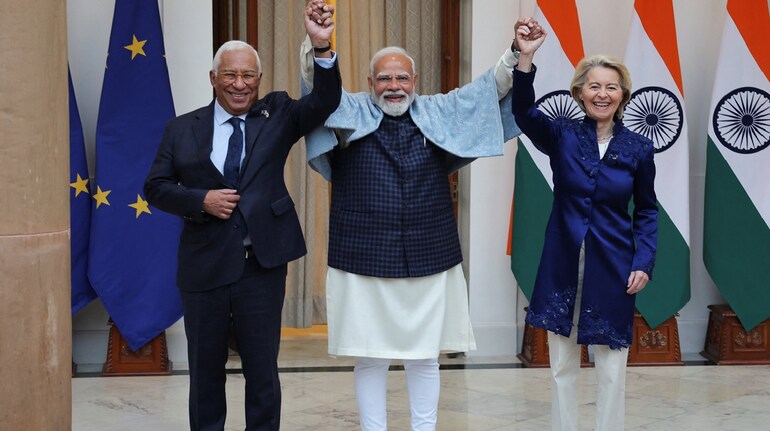

India and the European Union signed an historic trade deal on January 27, an agreement that cements the partnership between two economic giants and reshapes the global trade order.
The landmark trade deal provides unprecedented market access for Indian companies, with 99 percent of Indian shipments receiving preferential entry into the EU and triggering a new era of industrial growth.
The preferential regime is likely provide a massive boost to India’s various labour-intensive sectors such as textiles, leathers, marine products and jewellery, with an estimated $75 billion worth of exports ready to be shipped.
The development also comes at a time when New Delhi is trying to conclude a deal with Washington and reduce 50 percent tariffs on its goods.
Let’s take a look at how the deal will benefit major sectors:Textile and clothing sector
The deal will see tariffs come down from 12 percent to 0 percent, providing a big win for exports. The sector, considered to be labour-intensive and driven by MSMEs, will receive a strong upside from the deal as zero import duty on goods will make Indian garments and textiles cheaper, leading to bigger buyer contracts and steadier factory utilisation.
The deal opens door for Indian companies to a $263.5 billion EU textile market, providing mega opportunities for growth as current exports stand at just $7.2 billion.
The major beneficiaries of the deal will be -- Tiruppur in Tamil Nadu, Ichalkaranji in Maharashtra, Surat in Gujarat, Ludhiana in Punjab, and Hyderabad - Warangal in Telangana. Easier access for textile hubs has the potential to turn into larger EU orders and more factory jobs across spinning, weaving, processing and stitching.
Leather and Footwear
This sector will see its EU tariffs drop from 17 percent to 0 percent, providing a decisive competitiveness to Indian footwear and leather products in an industry where the margins are tight and seriously affect buying decisions.
The deal is likely to trigger new orders from the European market worth over $100 billion in both mass and mid-premium categories, fueling new job creation in the country’s organized segment.
Top hubs set to benefit are -- Vellore–Ambur in Tamil Nadu and Kanpur and Agra in Uttar Pradesh. Improved competition due to the deal can lift exports across tanning, finishing, components and final footwear manufacturing.
Electronics
The Union currently imposes up to 14 percent tariff on 99.6 percent of electronics exports from India. The import duty is set to be removed completely, becoming a major growth catalyst for India’s already galloping electronics industry.
The increased trade access can reinforce “build-in-India” supply chains, creating stronger linkages between large manufacturers and MSME suppliers, testing and repair services, tooling packaging and logistics.
The deal is likely to spur growth in electronics hubs of Pune in Maharashtra and Rajkot in Gujarat, alongside Noida in Uttar Pradesh, Hyderabad in Telangana, and Visakhapatnam in Andhra Pradesh, linking large manufacturers with MSME suppliers and downstream services.
Gems and Jewellery
The EU’s tariff rate on this structure stands at 4 percent as of today and it is set to drop to zero following the trade deal.
Zero-duty access sharpens the country’s competitiveness in design-led and precision jewellery exports, where turnaround time, craftsmanship and supply reliability are as critical as pricing. Reduced landed costs are expected to lift EU demand across both plain gold and studded segments, while fostering closer ties with European wholesalers and brands. Given the sector’s strong MSME and artisan base, the employment impact could be substantial, particularly across cutting, polishing, setting and finishing activities.
The most immediate benefits are likely to accrue to established export hubs in Mumbai, Surat and Jaipur, where mature ecosystems can scale quickly with improved price competitiveness and easier market access.
Chemicals
The Union’s tariff rate of 12.8 percent is set to become zero after the deal 97.5 percent of exports.
The tariff elimination supports one of India’s most export-ready manufacturing sectors and is expected to accelerate scale-up in both bulk and specialty chemicals. Major gains are anticipated in industrial clusters such as Bharuch–Vadodara in Gujarat and Maharashtra’s chemical belt, reinforcing downstream manufacturing and generating ancillary employment linked to these hubs.
Pharmaceuticals and medical devices
Preferential access under the FTA strengthens India’s position in the EU’s large pharmaceutical market and improves competitiveness in medical devices, where cost and compliance play a decisive role. Export momentum is expected from clusters in Thane–Raigad in Maharashtra, Bengaluru–Tumakuru in Karnataka, Hyderabad in Telangana, and Visakhapatnam in Andhra Pradesh, supported by integrated networks of suppliers, packaging, testing and logistics providers.
Engineering goods
Engineering exports stand to gain from tariff relief and improved market access across a broad product basket, enabling multiple manufacturing regions to expand in parallel. Key beneficiaries include Pune in Maharashtra, Rajkot in Gujarat, Chennai–Coimbatore in Tamil Nadu, Bengaluru–Tumakuru in Karnataka, and Mandi Gobindgarh in Punjab, where MSME ancillaries are well placed to grow alongside larger exporters.
Agriculture-linked exports and marine products
The agreement also bolsters farm and coastal incomes by widening access for agri and food exports. Assam tea from Dibrugarh–Jorhat and spices from Upper Assam are positioned for stronger demand, while pepper and cardamom from Idukki and Wayanad in Kerala could benefit from smoother EU entry. On the marine side, export growth is expected from Visakhapatnam and Kakinada in Andhra Pradesh, Veraval in Gujarat, Kochi and Alappuzha in Kerala, and Digha and Haldia in West Bengal, supporting employment across fisheries, processing and logistics.
Handicrafts, furniture and sports goods
Improved market access is particularly significant for artisan-led and MSME clusters that ship smaller consignments but generate high local employment. Saharanpur in Uttar Pradesh and Jodhpur in Rajasthan are well placed to expand furniture and handicrafts exports, while bamboo-based furniture and crafts from Barpeta and Nalbari in Assam could find new EU opportunities. Sports goods exporters in Jalandhar in Punjab and Churu in Rajasthan are also likely to benefit as entry into the EU market becomes easier.
Discover the latest Business News, Sensex, and Nifty updates. Obtain Personal Finance insights, tax queries, and expert opinions on Moneycontrol or download the Moneycontrol App to stay updated!
Find the best of Al News in one place, specially curated for you every weekend.
Stay on top of the latest tech trends and biggest startup news.