






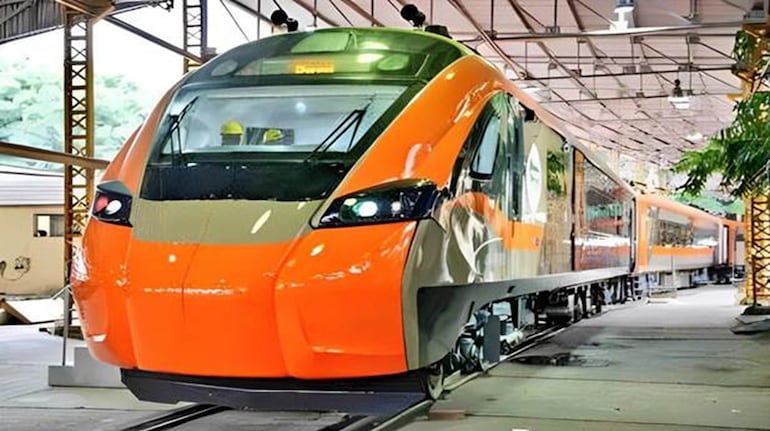

Indian Railways is set to roll out the sleeper version of the Vande Bharat Express on the Guwahati–Howrah route, marking a major shift in how the national transporter approaches long-distance travel. Once defined by legacy premium trains such as the Rajdhani, Shatabdi and Duronto, Indian Railways is now repositioning its long-haul services around speed, comfort, technology and strong branding, led by the expanding Vande Bharat platform.
For decades, the Rajdhani Express, first introduced on the New Delhi–Howrah route, symbolised fast inter-city travel, while Shatabdi trains catered to short, daytime journeys. Over time, however, ageing coaches, growing competition from airlines and evolving passenger expectations pushed Indian Railways to rethink its premium travel offering.
The seater version of the Vande Bharat Express has already redefined rail travel since its launch in February 2019. Today, 164 Vande Bharat services operate across the country, connecting major cities with faster, safer and more comfortable journeys. Since its introduction, over 7.5 crore passengers have travelled on Vande Bharat trains, underlining their growing popularity.
With the upcoming sleeper version of the Vande Bharat Express, Indian Railways is now preparing to take the Vande Bharat brand into overnight and long-haul segments traditionally dominated by Rajdhani and Duronto services. The sleeper trains are expected to cater to distances of 700–1,000 km and beyond, offering a strong rail-based alternative to short-haul flights with improved city-to-city connectivity.
“These trains offer a completely new experience compared to conventional long-distance services like the Rajdhani,” said Lloyd Mathias, Business Strategist and Independent Director.
“Vande Bharat Express train services have become a major boon for passengers and tourists. They connect India’s cultural, spiritual, and economic hubs with speed and comfort. These trains are operational in 274 districts across the country. This wide reach is improving travel, tourism, and regional connectivity nationwide.” Built under the Make in India initiative, each Vande Bharat trainset features advanced technology such as automatic plug doors, rotating seats, bio-vacuum toilets, GPS-based passenger information systems and full CCTV coverage, offering a world-class travel experience.
Unlike locomotive-hauled trains, Vande Bharat services are based on all-electric distributed-traction technology, allowing faster acceleration and deceleration. This translates into reduced travel times, smoother rides and greater energy efficiency. Modern interiors, quieter coaches, sealed gangways and improved onboard amenities further enhance passenger comfort.
Vande Bharat services already serve key routes across the country. The Delhi–Varanasi train connects the national capital with one of India’s most important spiritual centres, benefiting pilgrims and tourists alike. The Srinagar–Shri Mata Vaishno Devi Katra route, inaugurated on June 6, 2025 by Prime Minister Narendra Modi, has significantly improved access to a major pilgrimage destination. Meanwhile, the Bengaluru–Hyderabad service has emerged as a preferred option for IT professionals and business travellers commuting between two technology hubs.
From its modest start with a single service in 2019, Vande Bharat has grown into a nationwide network of 164 trains carrying lakhs of passengers every month. Alongside trains like the Amrit Bharat Express and Namo Bharat Rapid Rail, it reflects Indian Railways’ broader push toward modern, high-tech and passenger-centric travel.
The Vande Bharat sleeper trains are designed with features like automatic doors, ultra comfortable berths, on board WiFi & an aircraft-like design.
The real challenge for Indian Railways was to add berths and test the trains for full passenger & luggage load conditions in order to convert them into Vande Bharat sleeper coaches while achieving the peak speed of 180 km/ hour. With the successful trials, rail commuters can hope for world class travel experience in long distance travel like Kashmir to Kanyakumari, Delhi to Mumbai, Howrah to Chennai and many other routes also. They will benefit as travel time will come down considerably.
The current average speed of Mumbai Delhi long-distance travel is 90 km/hr with maximum permissible speed of 140 km/h for the Tejas Rajdhani Express, which is fastest among all Rajdhani train services in India.
Discover the latest Business News, Sensex, and Nifty updates. Obtain Personal Finance insights, tax queries, and expert opinions on Moneycontrol or download the Moneycontrol App to stay updated!
Find the best of Al News in one place, specially curated for you every weekend.
Stay on top of the latest tech trends and biggest startup news.





