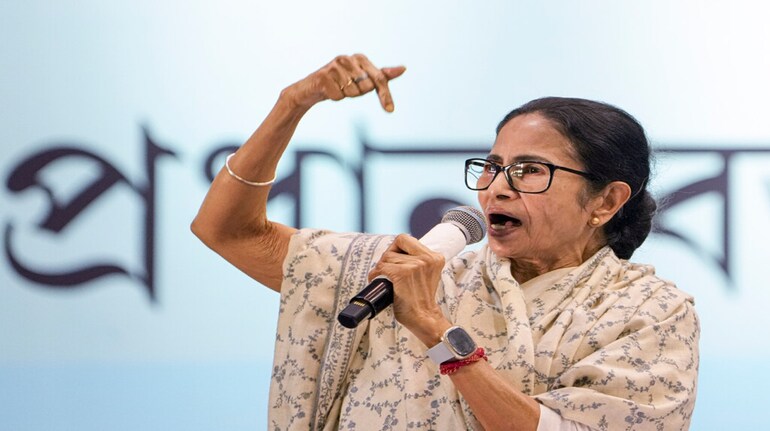

With the West Bengal Assembly elections approaching, Chief Minister Mamata Banerjee has made the Special Intensive Revision (SIR) a major political fight.
Chief Election Commissioner Gyanesh Kumar on Monday was met with protests during his visit to Kolkata’s Kalighat Temple, as demonstrators waved black flags, surrounded him, and shouted slogans demanding he “go back”.
Since March 6, Banerjee has been participating in her party Trinamool Congress’ sit-in protest against the alleged “voter deletions”. She has been calling it a “BJP-EC conspiracy to disenfranchise Bengali voters”.
“I will bring forward the voters who have been wrongly declared dead by the Election Commission at this protest site,” he said.
The heart of her political campaign was the Metro Y crossing in Dharmatala. It was here in 2006 that Mamata, then the opposition leader, undertook a 26-day hunger strike against the Jyoti Basu-led Left Front government. The protest eventually led to the withdrawal of the Tata Nano project from Singur, cementing her "street fighter" image and propelling her to West Bengal’s top post in 2011.
Bengal’s SIR dilemma
The Election Commission data released on February 28 showed that 63.66 lakh names—around 8.3% of the electorate—have been removed since the SIR process began in November last year, reducing West Bengal’s voter base from about 7.66 crore to just over 7.04 crore.
Additionally, over 60.06 lakh electors have been placed in the “under adjudication” category. It means their eligibility will be decided through legal review in the coming weeks—a process that could further alter constituency-level electoral dynamics.
According to the EC data following the SIR of electoral rolls, the number of women electors stands at around 3.44 crore, down from 3.77 crore when the process began in November, while male voters declined from 3.89 crore to 3.60 crore. Overall, women account for nearly half of the state’s 7.04 crore electorate.
The drop among women voters is 8.7%, marginally higher than the roughly 7.5% decline among male electors.
According to Times of India, districts that saw the steepest decline in voter numbers include North Kolkata, Malda, Murshidabad, and parts of North 24 Parganas and Nadia. Of the 63.7 lakh deletions, around 58 lakh were classified as ASD (absent, shifted, or dead) voters, already excluded in the draft SIR list, while an additional 5.5 lakh were removed through Form 7 proceedings.
Mamata’s protest against SIR, BJP
The Bengal CM has turned the SIR exercise into a political weapon by combining constitutional arguments and public protests to paint the BJP as “anti-democratic”.
Apart from writing many letters to Gyanesh Kumar criticising the move, the Bengal CM personally appeared in the Supreme Court to argue against the SIR exercise. “Justice is crying behind closed doors," she said while requesting five minutes' time to present her case before Chief Justice of India Surya Kant.
This marked a rare moment in Indian electoral politics with a sitting chief minister directly challenging an ongoing electoral roll revision and arguing in court.
The CJI allowed her 15 minutes before the bench. The chief minister also sought SC relief to scrap EC’s SIR, use existing rolls, stop deletions, ease name checks and accept Aadhaar.
“When Mamata di sits for the dharna it is for all the voters. It is to protect the democratic right of all the voters. Our concern is that voting rights cannot be snatched,” Shashi Panja, state minister and Trinamool spokesperson, told The Telegraph.
Banerjee earlier labelled the poll body a “Tughlaqi Commission” and alleged that it was targeting Bengal to “satisfy” the BJP. "The EC has become a 'Tughlaqi Commission' run by a political party," she said at a press briefing.
She has also been linking the SIR to upcoming elections, warning that these deletions could reshape constituency-level equations.
By highlighting the deletion of over 63 lakh names from the electoral rolls, she positioned the exercise as a deliberate attempt to weaken Trinamool’s voter base, especially in urban and minority-heavy districts.
What did the top court say?
While the initial top court hearing largely allowed the SIR in West Bengal to continue, it later imposed unprecedented judicial supervision over the process.
In mid-February, the top court authorised the deployment of additional judicial officers, including from Jharkhand and Odisha, to expedite scrutiny of nearly 50 lakh disputed cases.
However, in its latest remarks, the court strongly criticised the West Bengal government for filing what it called repeated “vague and irrelevant” pleas.
The SC on Tuesday agreed to consider a fresh plea filed by some persons whose names have been deleted from the electoral rolls by EC.
Discover the latest Business News, Sensex, and Nifty updates. Obtain Personal Finance insights, tax queries, and expert opinions on Moneycontrol or download the Moneycontrol App to stay updated!
Find the best of Al News in one place, specially curated for you every weekend.
Stay on top of the latest tech trends and biggest startup news.