






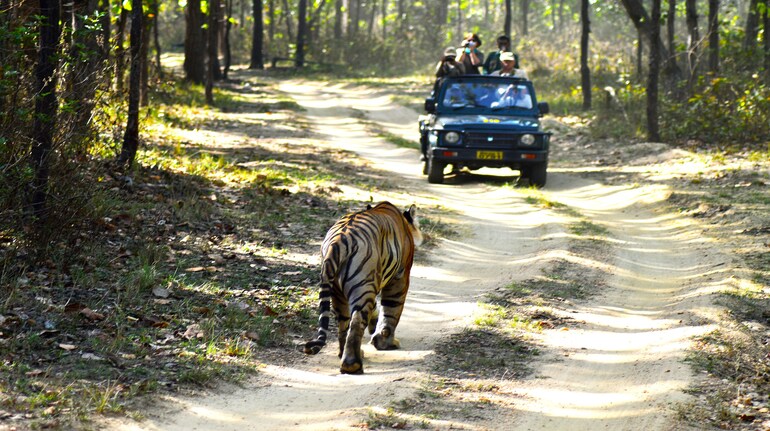

A forest route once quietly flagged by security agencies as a movement corridor for armed Maoist cadres in eastern Madhya Pradesh is now being reimagined as a gateway for wildlife revival.
The Supkhar range of Kanha Tiger Reserve (KTR) is preparing to receive its first batch of wild buffaloes, a species considered extinct in the state for over 100 years, reported NDTV.
The report citing forest officials said that the first batch of 10 wild buffaloes from Assam is expected to arrive by February–March 2026, marking the beginning of what is being described as one of Madhya Pradesh’s most ambitious wildlife reintroduction projects. Over the next five years, the plan is to bring in 50 animals in phased translocations.
The Supkhar’s dense, non-tourist forest stretches were earlier linked to the CPI (Maoist) KB division, which had allegedly planned expansion towards Mandla, Dindori, Umaria, Anuppur and the Amarkantak plateau. At its peak, the KB division reportedly had around 60 armed cadres operating in three platoons.
However, with the elimination and surrender of Maoist cadres active in Madhya Pradesh in early December 2025, officials say the ground situation now allows major conservation initiatives to move ahead.
Wildlife exchange plan: Buffaloes in, Tigers out
The buffalo reintroduction is part of a broader wildlife exchange programme between Assam and Madhya Pradesh. During a recent meeting between Assam Chief Minister Himanta Biswa Sarma and Madhya Pradesh Chief Minister Dr Mohan Yadav, the two states agreed on a reciprocal plan involving multiple species.
Under the agreement, Madhya Pradesh will receive 50 wild buffaloes from Assam, along with a pair of rhinoceros and three cobras. In return, Assam will receive a pair of tigers and six crocodiles from Madhya Pradesh. Officials said the rhinos and cobras will be housed at Van Vihar National Park in Bhopal, while Kanha Tiger Reserve will be the release site for the wild buffaloes.
Puneet Goyal, Divisional Forest Officer, told NDTV that detailed protocols are being designed to ensure high survival rates and successful breeding. “Every species has its own role in the ecology, and with this objective, the habitat here is being maintained,” he said.
Goyal said the animals will be transported by road in batches of 10 each year. “We will create an enclosure of around 150 hectares, which can be expanded later. Transportation will take two to three days, and we will coordinate with Assam and the states in between. We will bring animals of breeding age, breed them here and then release them. The conditions are suitable for wild buffaloes,” he added.
NDTV quoted officials as saying that the project has entered an advanced stage of approvals. The National Tiger Conservation Authority has already cleared the plan, following a detailed scientific assessment. Clearances from the Central Zoo Authority and the central government are expected soon.
The report further said that a study by the Wildlife Institute of India identified Kanha Tiger Reserve as the most suitable site for reintroduction, citing healthy grasslands, reliable water sources and minimal human interference. The long-term goal is to establish a stable, breeding population through secured enclosures, monitored acclimatisation and gradual release.
Conservationists note that the return of wild buffaloes is more than symbolic. The species plays a critical role in maintaining grassland and wetland ecosystems. Their grazing helps regenerate vegetation, prevents shrub encroachment, improves nutrient cycling and supports other herbivores such as deer. They also strengthen the food chain by serving as potential prey for apex predators like tigers.
For Kanha’s Supkhar range, the transformation is striking. Once spoken of in terms of insurgency routes and armed platoons, the forest is now being mapped for enclosures, breeding strategies and conservation logistics. If the February-March 2026 timeline holds, the first convoy of wild buffaloes will not just cross state borders, but a century of absence, turning an old corridor of conflict into a new corridor of recovery.
Discover the latest Business News, Sensex, and Nifty updates. Obtain Personal Finance insights, tax queries, and expert opinions on Moneycontrol or download the Moneycontrol App to stay updated!
Find the best of Al News in one place, specially curated for you every weekend.
Stay on top of the latest tech trends and biggest startup news.





